


Guest contributor
Shalini Perumal
In the complex and often contradictory world of international relations, words are rarely chosen by accident. Every phrase, every turn of speech, is a calculated move on a diplomatic chessboard.
This principle is never more apparent than in the Indian government’s recent statements regarding the junta’s 2025 elections scheduled to begin on December 28 in Myanmar.
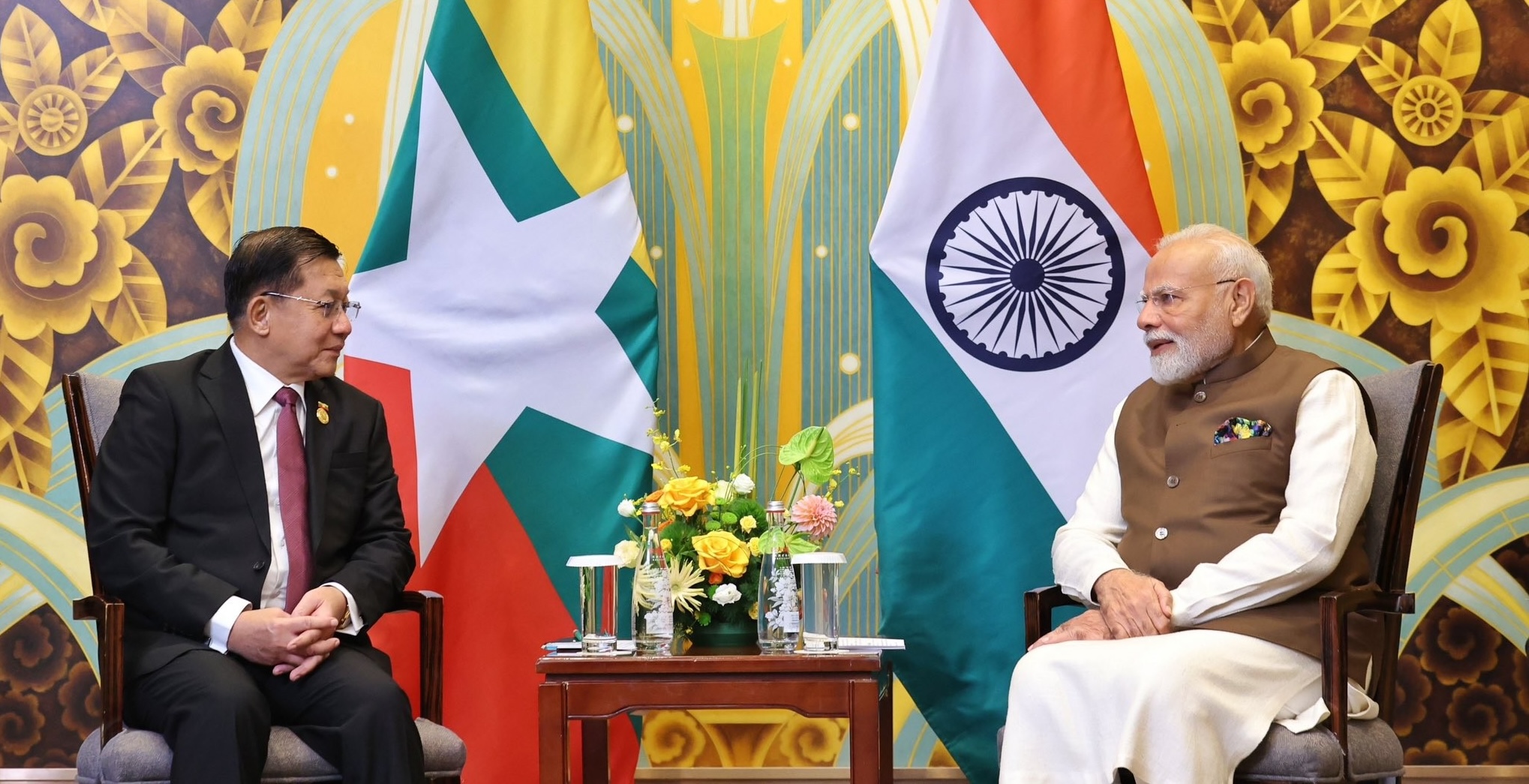
At first glance, India’s Prime Minister Narendra Modi “expressed hope” for “fair and inclusive” elections to Senior General Min Hlaing Aung, who has an outstanding arrest warrant issued by a federal court in Argentina on the crime of genocide.
Min Aung Hlaing is also under investigation by the International Criminal Court (ICC) for crimes against humanity, but no arrest warrant has been issued so far.
The meeting between Min Aung Hlaing and Narendra Modi on the sidelines of the Shanghai Cooperation Organization (SCO) summit might seem like a benign, pro-democracy stance.
However, a closer analysis of this carefully crafted language reveals a deeper, more self-serving strategy—one that allows India to maintain a veneer of democratic support while simultaneously appeasing the illegal junta, known for egregious human rights violations.
The upcoming elections in Myanmar are widely dismissed by critics as a “sham.” Since the 2021 military coup, the junta has systematically dismantled democratic institutions, jailed political opponents, killed activists, and overseen a brutal civil war that has displaced over four million people.
The planned polls, to be held only in areas under junta control and with pro-democracy parties excluded or officially “dissolved,” are seen not as a path to a genuine return to civilian rule but as a cynical ploy to legitimize Min Aung Hlaing’s grip on power. Against this backdrop, India’s diplomatic posture is telling.
There is a world of difference between “demanding” and “hoping” in the lexicon of diplomacy. A demand implies a moral and political imperative, a non-negotiable condition tied to a country’s core values. It is a tool of leverage, signaling that a failure to meet the demand will have consequences.
In contrast, “hoping” for something is a passive, non-committal gesture. It projects an aspirational image without requiring any concrete action. By “hoping” for fairness, the Modi government signals its awareness of the problem without taking any steps that could jeopardize its relationship with a junta that kills civilians with military equipment that India supplies.
This allows India to present a “pro-democracy” façade to the international community while avoiding a rupture with the very regime it would otherwise be expected to condemn according to both Indian and international law.
This diplomatic ambiguity is not a sign of a confused policy but a reflection of India’s strategic priorities. India’s foreign policy towards Myanmar is a classic example of realpolitik, where national interest trumps ideological or human rights concerns.
For India, Myanmar is not just a neighbor; it is a critical aspect of its “Act East” and “Neighbourhood First” policies. A friendly Myanmar, which means cozying up to the junta currently in Naypyidaw is portrayed as vital for India’s national security and economic interests.
This would include countering China’s power in Myanmar, as New Delhi is in a fierce geopolitical competition with Beijing for power in the region. China has significantly invested in Myanmar, developing ports and infrastructure projects, and maintaining a close relationship with the junta.
India fears that a breakdown in its relationship with the military regime would push Myanmar further into Beijing’s orbit, potentially giving China a “back door” to the Indian Ocean.
Furthermore, India shares a long, porous border with Myanmar, and the country’s internal conflict has direct security implications for India’s northeastern states.
The Modi government believes that engaging with the junta is necessary to ensure stability and cooperation on border management and “counter-insurgency” operations.
Key infrastructure projects, such as the Kaladan Multi-Modal Transit Transport Project, are also deemed crucial for India to connect landlocked Northeast to the Bay of Bengal.
For India, the success of these colonial projects that occupy indigenous lands without the consent of ethnic communities depends on cooperation with the junta in Naypyidaw, regardless of its lack of democratic credentials.
When contrasted with the positions of other international players, India’s stance becomes even more revealing. Many western countries have consistently and unequivocally condemned the coup and the junta’s human rights abuses.
Their condemnations are often accompanied by targeted sanctions and a clear refusal to recognize the military’s legitimacy. They have “demanded” a return to democracy and the release of political prisoners. Their stance is rooted in a values-based foreign policy, prioritizing human rights and democracy, even at the cost of direct engagement.
Meanwhile, other regional players like the Association of Southeast Asian Nations (ASEAN) have adopted a more ambiguous and often internally divided position.
While some ASEAN members have expressed concerns, the bloc’s principle of non-interference has largely prevented a unified response. The current chair of ASEAN, Malaysia and its Prime Minister Anwar Ibraham has stated that peace, not elections, is the immediate priority.
This position can also be seen as a form of strategic calculation, prioritizing regional stability and economic ties over internal political reform in a member state.
In this diplomatic puzzle, India’s approach is neither a full-throated condemnation nor a silent acceptance. It is a carefully calibrated middle path. By using language like “expressed hope,” the Modi government has managed to walk a tightrope, projecting a public image of supporting democratic principles while privately maintaining a neo-colonial and transactional relationship with the junta.
This dual strategy shows the hypocrisy of India’s foreign policy, where the pursuit of strategic autonomy and national interest often takes precedence over espousing a human rights position.
It exposes an alarming and neo-fascist choice being made by New Delhi: that in the face of a complex geopolitical reality, the politics of diplomacy prioritizes national self-interest above human rights.
Shalini Perumal is a creative international development professional who has worked previously in Mae Sot, Thailand at Mae Tao Clinic, consulted for Finnish Refugee Council Myanmar, and served as a Writer/Researcher at Insight Myanmar Podcast. She is currently a freelance journalist working on a novel.
DVB publishes a diversity of opinions that does not reflect DVB editorial policy. We’d like to hear what you think about this or any of our stories: [email protected]