


Guest contributor
James Shwe
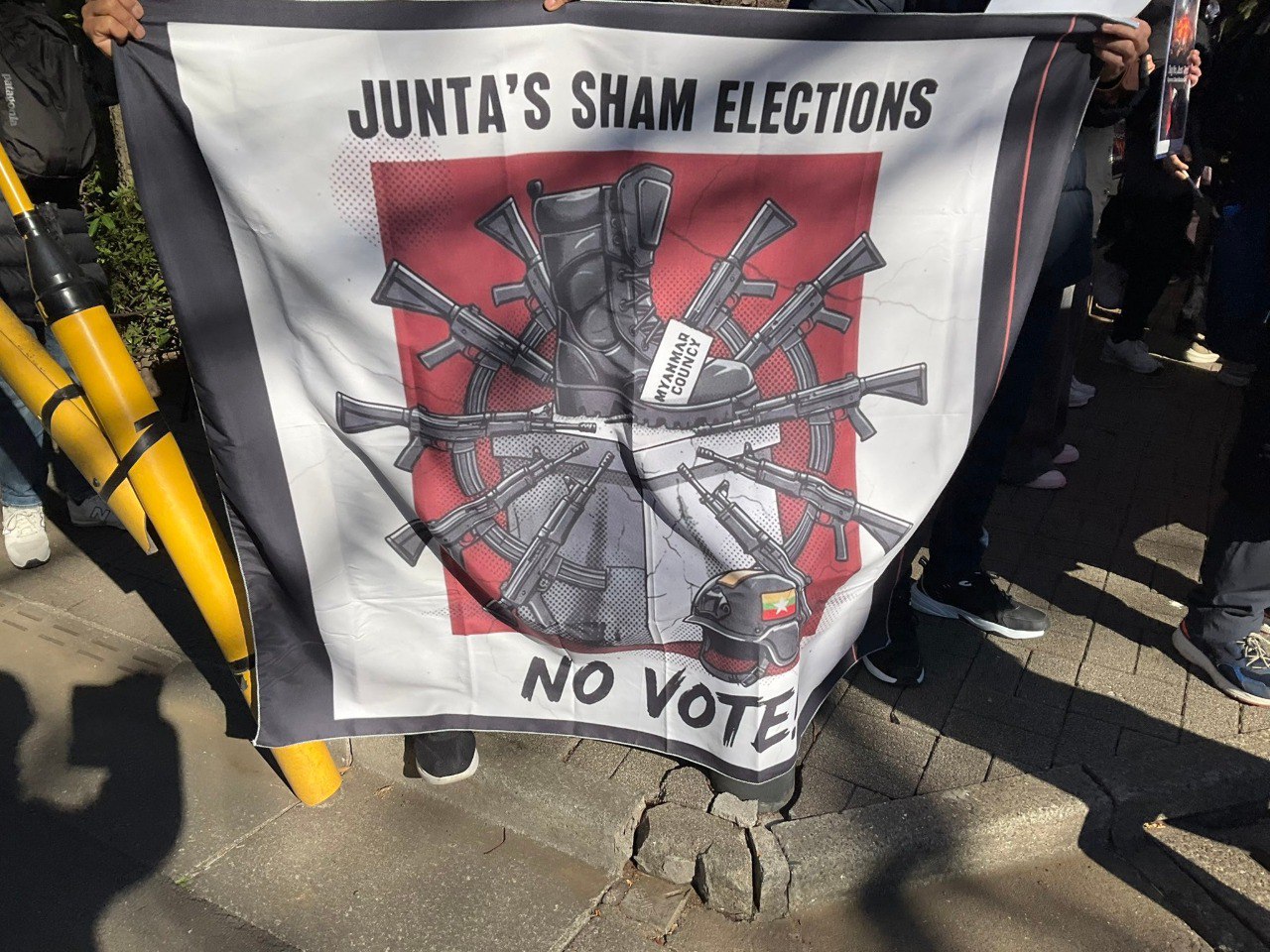
On December 28, the Myanmar military junta concluded the first phase of an electoral performance that was as tragic as it was farcical. In a fractured nation where the military has lost control of vast territories, they staged a hollow vote to claim a mandate they never earned. But while the generals in Naypyidaw congratulate themselves, the verdict from the credible international community has been swift, unified, and damning.
The world knows the truth. The question now is whether our policies will reflect it.
The verdict of the free press
While the junta attempts to broadcast images of “order,” the world’s premier news organizations have stripped away the veneer. Extensive reporting and analysis from the New York Times, The Washington Post, and The Guardian have meticulously documented the coercion and violence underpinning this process.
It is important to be precise: while these papers’ editorial boards have not all issued formal institutional condemnations, their seasoned correspondents and opinion pages have provided irrefutable evidence that this exercise is a fraud. They have reported what diplomats cannot always say: there is no democracy in a vote held at gunpoint, where the opposition is jailed and the electorate is bombed.
The observer charade: Who actually showed up?
The junta claims “international observers” validated the polls. A closer look reveals a rogue’s gallery of autocracies and private proxies.
The countries that officially sent observers read like a roll call of authoritarian enablers: Russia, China, Belarus, Vietnam, Cambodia, and Nicaragua. These are not impartial arbiters; they are partners in repression.
But the junta also engaged in deception to feign democratic support.
- The Japanese proxy: State media touted the presence of the Japan-Myanmar Association (JMA), a private business lobby with deep historical ties to the military and the late Hideo Watanabe. The junta used the presence of this private group to imply endorsement from Tokyo. In reality, the Japanese government refused to send official monitors and has expressed serious concern over the election’s lack of credibility.
- The Thai dilemma: Thailand faced a self-imposed dilemma. While publicly stating that the election is “neither free nor credible,” Bangkok permitted its embassy staff in Yangon to “monitor” the process. This half-measure reflects Thailand’s fear of border instability, but it risks lending a veneer of diplomatic normalcy to a process their own Foreign Minister knows is deeply flawed.
- India’s strategic hedge: India played a similarly cynical game. New Delhi did not send official Election Commission observers but allowed private Indian delegates to attend. Meanwhile, the Ministry of External Affairs issued vague calls for an “inclusive” process. This attempt to maintain influence with the generals without fully committing to the fraud is a dangerous calculation that undermines India’s status as the world’s largest democracy.
The US policy disconnect: A call for alignment
In Washington, a confusing signal has emerged that requires urgent clarification. The Department of Homeland Security (DHS) recently justified terminating Temporary Protected Status (TPS) for 4,000 Myanmar nationals by citing “upcoming elections” as a sign of improving stability.
This bureaucratic assessment stands in stark contrast to the reality described by U.S. foreign policy experts. At the recent U.N. Conference on the Rohingya, the U.S. Mission to the United Nations was clear, rejecting any premise of normalization.
We are encouraged by reports that senior administration officials have privately clarified that “DHS does not determine U.S. foreign policy.” This distinction is vital. The TPS decision appears to be a technical determination based on outdated data, rather than a strategic shift by the White House.
Congressional foreign policy leaders from both parties have forcefully stepped into this breach. They are publicly condemning the elections as illegitimate and calling on President Donald Trump’s administration to harmonize its message: The U.S. cannot condemn the junta’s violence at the U.N. while citing its “stability” in immigration courts.
The global wall of rejection
Beyond the few enablers, the rejection of this election is robust and official:
- New Zealand parliament’s unanimous stand: In November, the New Zealand parliament unanimously endorsed a motion declaring the junta’s elections a “sham” that lacks all legitimacy.
- European Union action: The European parliament adopted a formal resolution in November unequivocally rejecting the polls, warning they would only deepen the violence.
- Southeast Asian solidarity: MPs from across the region, organized under the ASEAN Parliamentarians for Human Rights (APHR), have joined these calls, isolating the junta within its own neighborhood.
- Expert consensus: Leading election monitors—including the Asian Network for Free Elections (ANFREL) and International IDEA—have rejected the process, noting that a credible election is technically impossible in a climate of mass incarceration.
- Labour’s stand: The International Labour Organization (ILO) has invoked Article 33, calling on members to review relations with Myanmar due to the regime’s use of forced labor.
The real obstacle: Authoritarian protection
Why does the junta persist? Because Russia and China continue to shield them at the U.N. Security Council.
China’s role demands specific scrutiny. While Beijing claims to want stability, it is arguably trapping Myanmar in a cycle of debt. By pushing forward with mega-dams and infrastructure projects under the cover of this “election,” China is securing hydropower-hegemony over our rivers while turning a blind eye to the transnational crime syndicates on its border.
The junta remains the primary enabler of the cyber scam centers that victimize citizens across the world, yet Beijing protects the generals to secure its strategic access to the Indian Ocean.
The way forward
The junta is betting that the world is too distracted to care about the details of a rigged election. We must prove them wrong.
1. A unified voice on legitimacy:
We call on the U.S. Administration to close the gap between its agencies. President Trump should join Congressional leaders in formally declaring the 2025-2026 elections illegitimate. This would provide the necessary guidance to correct the flawed DHS assessment regarding TPS.
2. Sanctions on the financial engine of crime and war:
We need targeted sanctions on the junta-controlled financial institutions (such as the Myanmar Foreign Trade Bank and Myanma Investment and Commercial Bank) and its intermediaries.
These banks are dual-use threats: they process payments for the weapons killing civilians and launder the proceeds from the cyber scam centers and human trafficking operations. Shutting them down serves both human rights and global security.
3. Sanctions that bite:
We need full enforcement of sanctions on aviation fuel to stop the airstrikes, and targeted financial sanctions against the Union Election Commission (UEC) as an institution, preventing international engagement with the sham process.
4. Investigate the enablers:
Parliaments worldwide should launch inquiries into the external lifelines sustaining the junta—specifically, the complicity of foreign actors in the cyber scam centers operations that fund the junta’s war machine used against the people of Myanamr.
The world has facts. The experts, the reporters, and the legislators have spoken. Now, we need the executive action to match.
James Shwe is a Myanmar democracy activist in the U.S. and is a member of the advocacy groups Free Myanmar and the Los Angeles Myanmar Movement. He has been trying to organize and motivate the Myanmar diaspora to advocate for democracy in Myanmar.
DVB publishes a diversity of opinions that does not reflect DVB editorial policy. We’d like to hear what you think about this or any of our stories: [email protected]