


Guest contributor
James Shwe
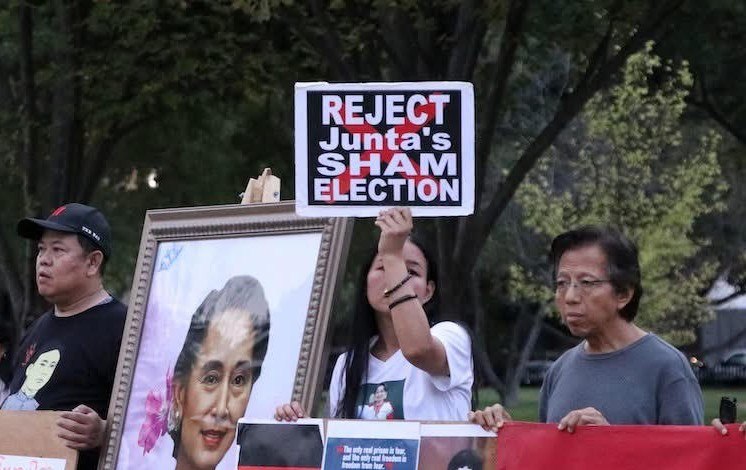
Five years ago, on February 1, 2021, Min Aung Hlaing gambled that he could steal a nation and the world would eventually look away. He banked on the cynics’ wisdom that time erodes moral outrage and that elections—however flawed—would offer a polite off-ramp for the international community.
He was wrong.
Today, on the fifth anniversary of the military coup in Myanmar, the diplomatic verdict is in. Far from providing legitimacy, the military’s 2026 election has solidified its status as a pariah. The diplomatic landscape has shifted from concern to criminalization—and crucially, the flow of material support is bypassing the regime to reach the people directly.
The global chorus: Coordinated rejection
As we mark five years of the Spring Revolution—five years of sacrifice by Civil Disobedience Movement (CDM) workers who lost their jobs and left their families, as well as villagers who sheltered resistance fighters at great personal risk—the international community has issued a coordinated wall of rejection.
The United Nations provided devastating data: 5.2 million people have been displaced from their homes in Myanmar. During the election period, which began on Dec. 28, over 400 airstrikes were carried out by the military.
U.N. Secretary-General António Guterres and Human Rights Chief Volker Türk condemned the election for excluding large segments of the population, rendering any claim of legitimacy void.
The United Kingdom’s Foreign Minister Yvette Cooper issued its 5th anniversary statement on January 31, explicitly rebranding the regime from a political actor to a “criminal enterprise” linked to cyber scams and drug production threatening U.K. citizens.
Canada’s Foreign Minister Anita Anand echoed this on the same day, condemning transnational crime and rejecting the election as neither free, fair, nor inclusive.
The European Union backed its words with €63 million Euros in aid designed to flow through civil society partners—treating the National Unity Government (NUG) and ethnic organizations as the de facto government of public welfare.
Japan—historically cautious—dismissed the election as neither free nor fair, a devastating blow from Myanmar’s largest traditional investor.
Australian Senator Penny Wong emphasized that organized crime has flourished under the regime, directly threatening regional stability.
New Zealand went the furthest. Its Parliament passed a resolution legally rejecting the election results—a legislative precedent that permanently locks the junta out of dealing with the government in Wellington.
Switzerland issued a statement on February 1, emphasizing the election did not meet international standards and expressing concern about transnational crime.
Denmark marked the anniversary with a powerful visual statement on social media—02.01.21 formed by crowds of people, symbolizing the millions standing in resistance—while continuing to channel direct aid to displaced communities in Sagaing Region.
Their message is clear: you do not need an embassy in Yangon to stand with the people.
The Association of Southeast Asian Nations (ASEAN) delivered the final blow. The Philippines, as 2026 Chair, confirmed the bloc has not endorsed the election, reaffirming that without inclusive dialogue, there is no government with legitimacy.
The congratulatory vacuum: Only three dictators
Here is the most telling statistic: Only three countries congratulated the junta.
- China called the election smooth and orderly, betting the junta will protect Chinese investments.
- Russia sent congratulations, reinforcing its role as a geopolitical counterweight to the West.
- Belarus’ President Aleksandr Lukashenko, himself a pariah dictator, congratulated the junta after visiting in November 2025.
The contrast is devastating. Several nations sent election observers, including India, Indonesia, Vietnam, and Cambodia, but deliberately refused to congratulate.
India’s Foreign Ministry explicitly stated it continues to call for inclusive, fair and free elections so that we have a mandate that is credible. Sending observers is not endorsement—their silence speaks volumes.
Why the American silence should not alarm you
The United States has not issued a high-profile rejection statement comparable to the U.K. or Canada. This silence is a product of the America First doctrine, which limits State Department commentary on foreign elections. But look at the actions:
- No congratulations: Washington sent no congratulatory cable. The protocol for recognizing an election is congratulation. The junta received nothing.
- Congress speaks: In January 2026, the US Senate approved $121 million USD in assistance for Myanmar with strict guardrails ensuring no new funds reach the junta—only humanitarian aid and pro-democracy support.
The message is clear: The President may not speak, but the appropriation has passed—and it’s made out to the people, not the generals.
To the movement: Unity is the precondition for victory
Your sacrifice over these five years has been extraordinary. You have endured losses that would break most nations. But international support—no matter how generous—means nothing if the resistance to the military fractures from within.
The international community will only invest in a movement that demonstrates unity. Donors need to see that the NUG, the CDM, and ethnic organizations are working toward a common goal, not pursuing separate agendas. Every public split signals to the world that you are not ready to govern a post-junta Myanmar.
Think critically. The revolution has attracted genuine patriots, but also opportunists who see conflict as a path to personal enrichment or power. Question leadership constructively. Hold them accountable transparently.
But do not attack your comrades with the same venom you reserve for the generals—every internal war you wage publicly is a victory handed to Min Aung Hlaing.
To the NUG and ERO leadership: When donors pledge €63 million or $121 million, they are betting on you. Use these resources with integrity. Publish your budgets. Coordinate across ethnic lines. Show unified governance, not fragmented fiefdoms. The world is waiting to see institutional coordination before committing the full weight of their support.
Demonstrate cooperation visibly. When the NUG and ethnic organizations coordinate on humanitarian delivery, publicize it. When ethnic Bamar and ethnic nationality leaders work together on policy, showcase it. The world needs to see you are united not just in opposition, but in vision.
The path forward: From resistance to governance
1. Weaponize the “crime” narrative
Only dictators are willing to endorse the junta. Everyone else is horrified by the crime. Document the scam compounds and drug labs. Send data to Interpol and Australian Federal Police. Help the world treat the junta like a cartel—but do this as a unified movement, not competing intelligence services.
2. Be the government you claim to be
The E.U., U.K., Japan, and the U.S. have pledged millions they refuse to give to the junta. Prove you can deliver—together. Build supply chains for vaccines, rice, and schools. Coordinate across factions. Show unified governance.
3. Build trust through transparency
Publish budgets. Show where money goes. When people see donated funds reaching villages through a coordinated system, support will deepen.
Five years is a lifetime of pain. But look at where we stand: The military has no economy, no people, no international legitimacy, and now—with only three dictators offering congratulations and the entire democratic world closing the door—no future.
Hold fast. The world has closed the door on them. Now, we finish the job—with integrity, with unity, and with the strength you have already proven you possess.
James Shwe is a Myanmar democracy activist in the U.S. and is a member of the advocacy groups Free Myanmar and the Los Angeles Myanmar Movement. He has been trying to organize and motivate the Myanmar diaspora to advocate for democracy in Myanmar.
DVB publishes a diversity of opinions that does not reflect DVB editorial policy. We’d like to hear what you think about this or any of our stories: [email protected]