


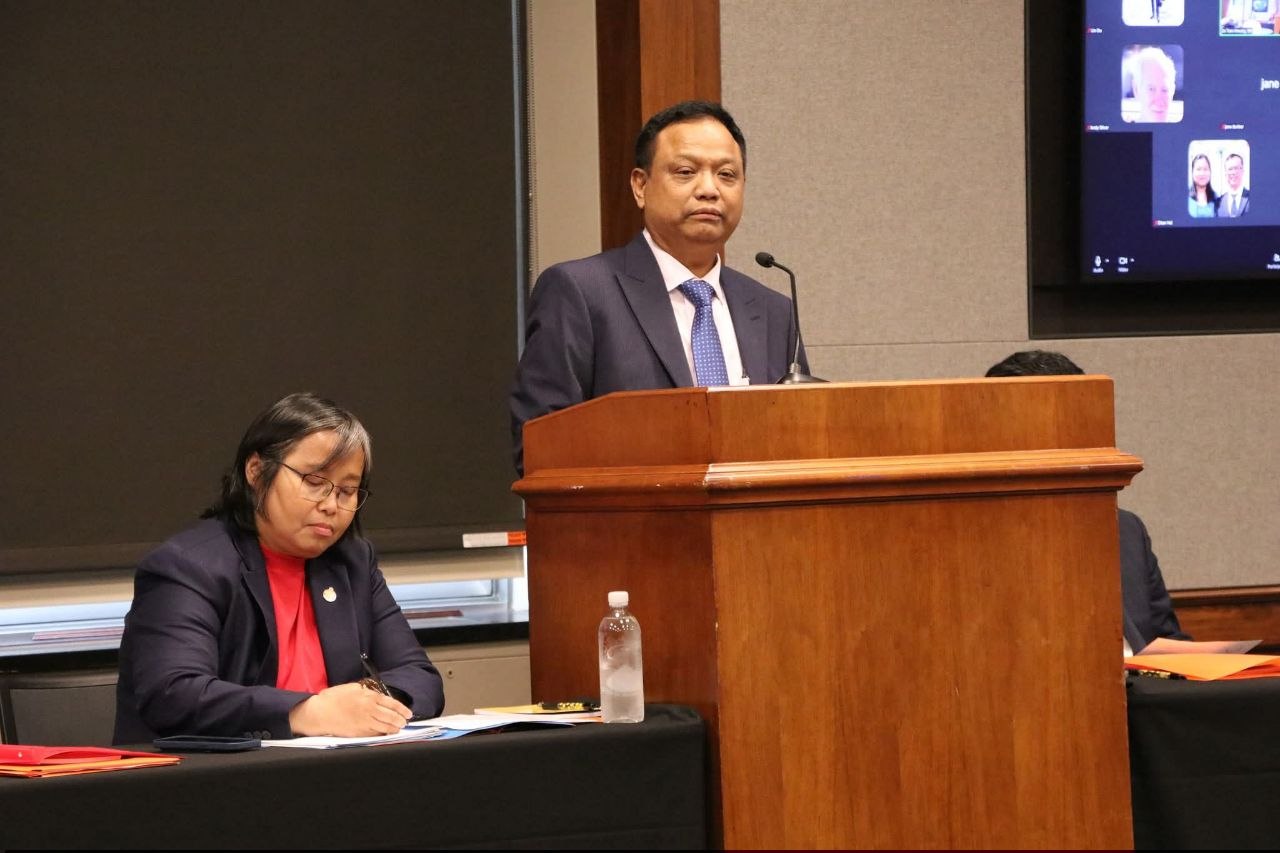
In a high-level briefing on Capitol Hill on Friday, National Unity Government (NUG) Foreign Minister Zin Mar Aung called on U.S. lawmakers to exert direct diplomatic pressure on Myanmar’s military regime to provide independent verification that jailed State Counsellor Aung San Suu Kyi remains alive.
Speaking at the Rayburn House Office Building during a briefing hosted by the Burma Research Institute (BRI), Zin Mar Aung also urged Washington to partner directly with Myanmar’s democratic resistance coalition to dismantle border-based cyber scam operations targeting American citizens.
‘Proof of Life’ demand for Aung San Suu Kyi
The 81-year-old State Counsellor has been held incommunicado by the regime since the military coup on Feb. 1, 2021. Regime state media reported on April 30 that she had been moved from prison to house arrest, no independent proof or physical evidence of her condition or location has been provided to her family.
“Aung San Suu Kyi’s fundamental human rights are being violated by the regime as she has been barred from meeting her son Kim Aris, [and] it’s difficult to verify if she’s even still alive,” Zin Mar Aung told congressional members and staff.
The appeal aligns with the ongoing “Proof of Life” campaign launched in April by Suu Kyi’s son, Kim Aris, who has urged the Association of Southeast Asian Nations (ASEAN) and Western governments not to engage with or legitimize regime leader Min Aung Hlaing until verifiable proof of her well-being is produced.
During a recent meeting in Bangkok, regime Foreign Minister Tin Maung Swe claimed to Philippine Special Envoy Ma. Theresa P. Lazaro that Suu Kyi was being cared for as a “sister.” However, the regime subsequently denied Lazaro’s formal request for a face-to-face meeting with Suu Kyi.
Cyber scams: A $12.5 billion threat to U.S. national security
A major focal point of the Washington briefing centered on the proliferation of transnational industrial-scale online fraud compounds along the Myanmar-Thailand border.
Zo Tum Hmung, founder and executive director of the Burma Research Institute, accused regime leader Min Aung Hlaing of directly undermining U.S. national security by allowing criminal syndicates to operat in Myanmar and target Americans.
U.S. Losses & Cyber Scam Profile (Southeast Asia)
├── Total Stolen from Americans (2025): Exceeded $12.5 Billion USD (Up 25% YoY)
├── Victims Trafficked Globally: Estimated 300,000 individuals forced into fraud labor
└── U.S. Enforcement Action: Over $15 Billion in crypto restrained by DOJ since Oct 2025
The briefing follows June 25 testimony before the House Foreign Affairs Committee by U.S. Assistant Secretary of State for East Asian and Pacific Affairs Michael DeSombre, who formally designated border scam networks as a grave threat to U.S. national security.
“We estimate that they defrauded Americans out of $12.5 billion in 2025, which is actually a 25 per cent increase from 2024,” DeSombre testified, noting that the State Department is pursuing a government-wide strategy to dismantle criminal syndicates rather than merely closing individual compounds.
Urging direct U.S. partnership with the resistance
Zin Mar Aung reiterated that the most effective way to eliminate scam compounds is for Washington to coordinate directly with local resistance forces that exercise actual administrative and territorial control along the border.
She pushed for formal U.S. engagement with the Steering Council for the Emergence of a Federal Democratic Union (SCEF)—the premier resistance coalition established on March 30, which unites civilian lawmakers with key ethnic revolutionary organizations:
- National Unity Government (NUG)
- Committee Representing Pyidaungsu Hluttaw (CRPH)
- Kachin Independence Organisation (KIO)
- Karen National Union (KNU)
- Chin National Front (CNF)
- Karenni National Progressive Party (KNPP)
Controversy over reported US ‘scam talks’ with regime
The Washington briefing took place amid growing friction between civil society groups and the State Department over reported diplomatic contact with Naypyidaw.
Advocacy groups, including the U.S. Campaign for Burma, issued a joint statement condemning reported talks between unnamed U.S. officials and regime officials in Tokyo, Japan, in late June regarding law enforcement cooperation against scam centers.
Rights groups warned that engaging Naypyidaw to combat cyber fraud ignores the regime’s direct financial and operational ties to border criminal networks.
“Cooperating with the junta on this issue is like asking an arsonist to help put out a fire,” warned Myra Dahgaypaw, board member of the U.S. Campaign for Burma, urging Washington to align its strategy strictly with ethnic resistance organizations and local civil society networks.