


Myanmar regime leader Min Aung Hlaing concluded an official two-day state visit to Thailand on Friday. The summit—hosted by Thai Prime Minister Anutin Charnvirakul—resulted in several bilateral agreements on trade, border security, labor, and technology, but drew fierce condemnation from human rights groups, diaspora activists, and Thai opposition lawmakers.
Parliamentary Disruption and Protests in Bangkok
The final day of the visit was marked by direct political protests inside the Thai Parliament and across the capital:
- Parliamentary Ejection: Thai Opposition MP Anusorn Tamajai (People’s Party) was forcibly removed from the parliamentary reception area by police after repeatedly shouting “For peace, for humanity” as Min Aung Hlaing arrived for a meeting with Senate Speaker Mongkol Surasajja. Anusorn had intended to submit a formal letter urging action on human rights and the restoration of democracy in Myanmar.
- Opposition Critique: Thai MP Kannavee Suebsang publicly criticized Prime Minister Anutin’s red-carpet reception of the regime leader stating on social media that “peace must come before investment.”
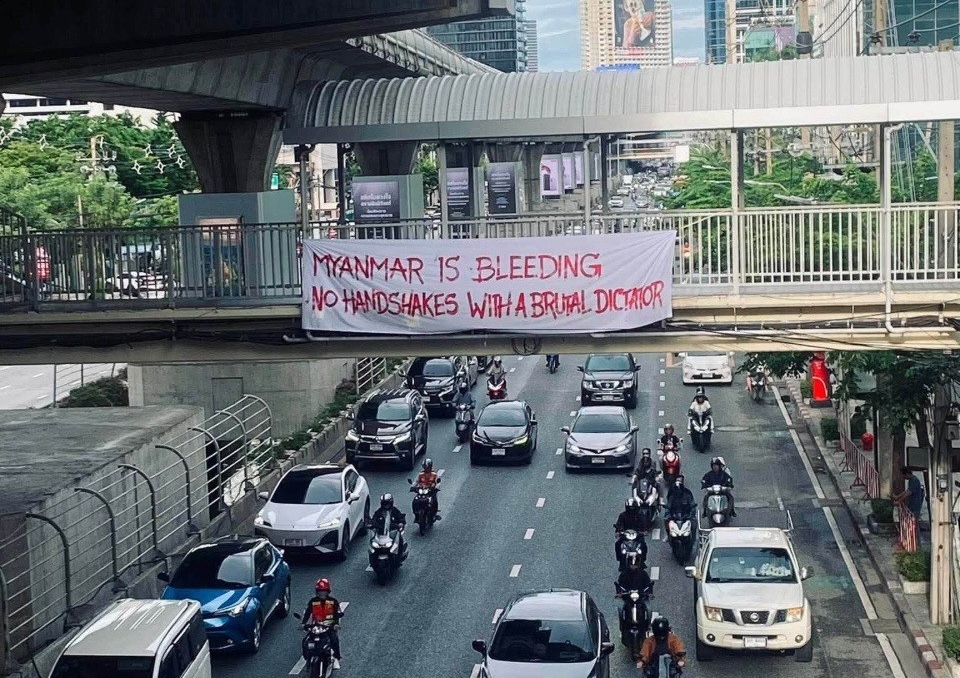
- Street Demonstrations: The Yangon Public Strike Committee and the Burmese Exile Movement (BEM) unfurled a banner opposite the Myanmar Embassy in Bangkok reading: “Myanmar is bleeding. No handshakes with a brutal dictator.” Protesters also gathered outside the United Nations building in Bangkok on Aug. 6.
- Rights Groups Statement: Amnesty International, Justice For Myanmar, and Fortify Rights condemned Bangkok’s reception of Min Aung Hlaing, highlighting his role in mass atrocities and his status as the subject of an International Criminal Court (ICC) arrest warrant application.
Thai Government Defense: Pragmatism Over Legitimacy
Thai Foreign Minister Sihasak Phuangketkeow defended Bangkok’s decision to host Min Aung Hlaing, framing the talks as necessary for national security and border management:
“It’s not about legitimacy; it’s about reality,” Sihasak Phuangketkeow told reporters in Bangkok on Aug. 6.
Sihasak emphasized that Thailand shares a 1,501-mile (2,415 km) border with Myanmar and must engage Naypyidaw directly to combat cross-border criminal operations, including cyber scam compounds, drug trafficking, human smuggling, and transboundary environmental pollution.
Bilateral Agreements and Joint Statement Deliverables
| Sector | Key Agreement / Directive |
| Cross-Border Trade | Joint commitment to reopen the Second Thailand–Myanmar Friendship Bridge connecting Mae Sot (Thailand) to Myawaddy (Myanmar), subject to security conditions. |
| Labor Cooperation | Formalized agreements regarding the registration, protection, and regulation of Myanmar migrant workers in Thailand. |
| Environmental Policy | Memorandum of Understanding on transboundary river water quality management. |
| Technology & Defense | Agreements on space technology for earth observation and joint border security efforts. |
| Regional Status | Thailand reiterated support for Myanmar’s participation in ASEAN mechanisms via a “Myanmar-owned and Myanmar-led process.” |
Context: Post-Election State Visits and Suu Kyi Access
The Bangkok summit marks Min Aung Hlaing’s second official state visit to an ASEAN member state after Laos in July, since he was inaugurated president by a pro-military parliament on April 10—following elections widely condemned by the UN and Western governments as a sham.
The visit coincided with international discussions following the Aug. 3 visit by the International Committee of the Red Cross (ICRC) to jailed State Counsellor Aung San Suu Kyi in Naypyidaw, which provided the first independent proof of life for the 81-year-old leader after nearly five years in incommunicado detention.