


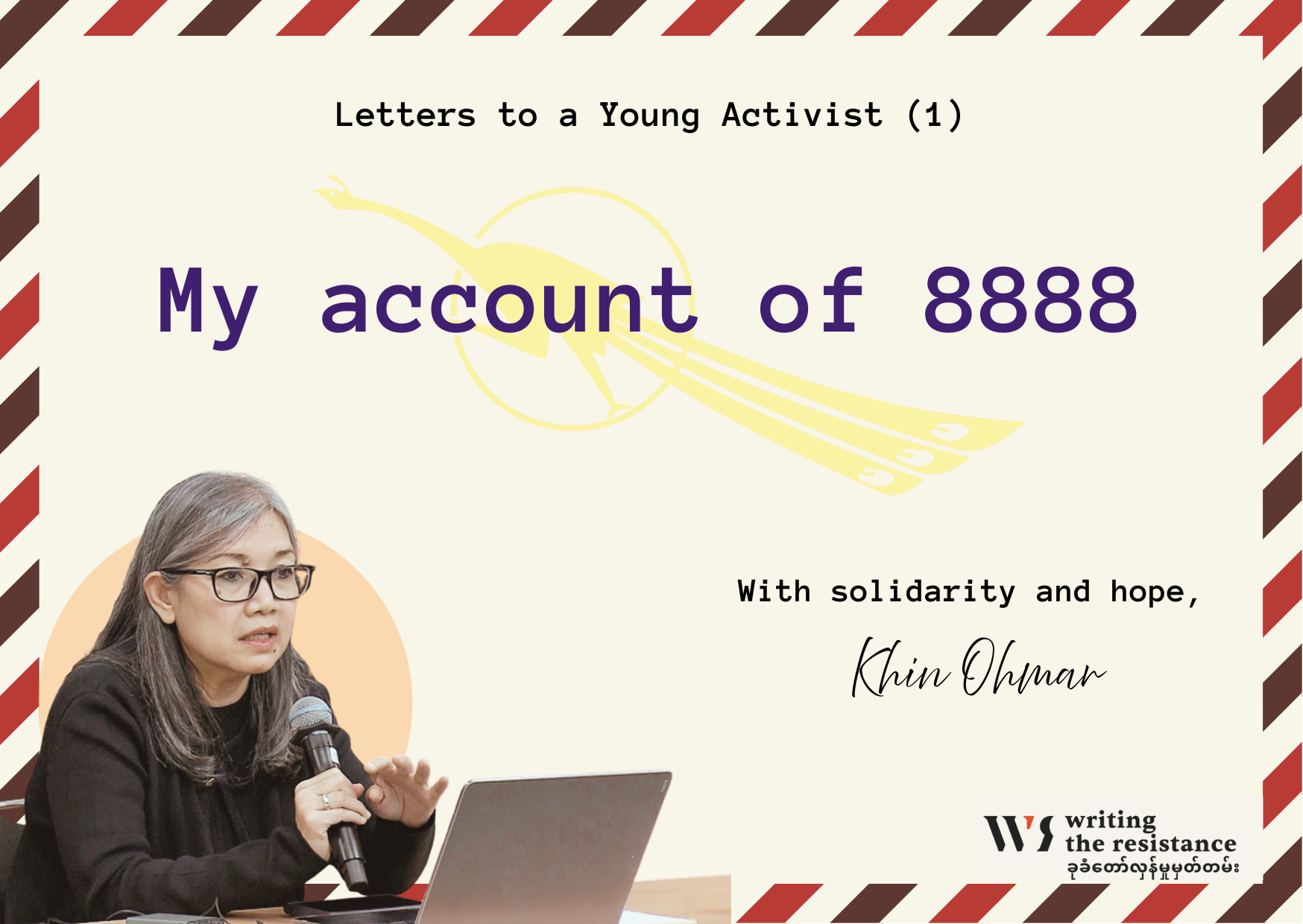
Guest contributor
Khin Ohmar
Dear young activist,
Every activist my age has our ‘8888’ story. It was a time of intense energy, as we deeply believed the country could rise up and break free.
The All Burma Students Democratic Movement,or Ma-Ka-Da, was among the initiators of the 8888 Uprising, and my involvement in this organization has determined the path of my life’s activism.
My movement activism began around March 16, known as Red Bridge Day, as our student protests and the subsequent crackdowns began early in the year of 1988.
We knew Ne Win dictatorship had to go and for that we had to mobilize the public to join us. We worked hard to connect with other student groups, workers, monks, and anyone in our communities who would stand with us. Then we called for a nationwide general strike on August 8.
You have to remember there were no mobile phones, social media, or the internet. So we organized person to person, often in crowded teashops, monasteries and homes.
On August 6, we were able to send our message about the August 8 general strike through BBC journalist Christopher Gunness; via the BBC, we reached the world and also reached back to Burmese people across the country.
In those days, that was the fastest and broadest reach.
On August 7, we held our final preparation meeting. I went home full of anticipation and focus, but my family had other plans for me.
Concerned for my safety, a male friend had warned my family of my involvement, and out of fear they locked me inside my brother’s family apartment in downtown Rangoon.
Throughout the night I plotted escapes and on the morning of August 8 I woke my brother’s family crying and pleading to be let out. They refused, and I stood by the balcony, angry and helpless.
From the apartment, I could see the road towards City Hall and the Sule Pagoda, our main gathering points, but I felt a world away.
The morning was deathly quiet. No one was on the street. People began to appear shortly after 9 am – first individuals, then in small clusters, and then in waves.
Peoples’ expressions were a mix of hope, courage, agony, and the stressful knowledge of the immense risk they were taking.
This was the first time in 26 years of Ne Win’s regime that people had dared to gather openly and voice their dissent and opposition to his one-party dictatorship. Everyone knew the danger, and everyone was firm in their determination.
I felt guilty as I stood by the balcony watching and listening to the crowds chanting. My friends were out there, and I wasn’t beside them. I felt ashamed to be in a safe place while they were enacting the plans that I had been part of developing, mobilizing and preparing.
The whole day I argued, schemed, and tried to find a way out, but I couldn’t. By late afternoon, my anxiety deepened. Would the crowd hold? Would they be dispersed? Would the shooting start?
Night fell, and it seemed like maybe the worst wouldn’t happen. The chants grew quieter, but the people remained. But as time drew closer to midnight, I heard shouting from the police station behind my brother’s apartment building: “Go, go, go!”
From the kitchen window, I saw boots pounding down the stairs, rifles in hands. Moments later, gunfire began. I screamed as the shots echoed through the streets. The next day, Rangoon was silent.
Late on the morning on August 9, I managed to get out and I ran to the hospital. It was overflowing with protesters who were bruised, bandaged, and exhausted. I was devastated, guilt-ridden and powerless.
It took days to reconnect and consider next steps, but like my friends and fellow activists, I held on to the courage grounded in our deep conviction that we could create the change we envisioned for our country.
The struggle that began around 8888 became one of the many seeds that continues to grow today. Whether you were part of the 8888 uprising, the Saffron revolution, the Spring revolution, or have found your own ways to resist military tyranny, we must hold on to the belief that our peoples’ movements are stronger than any unjust, violent regime, and we will overcome.
I am both heartbroken and also deeply inspired that our struggle to dismantle the military tyranny and for justice has continued across decades and generations.
As we have strengthened and continue to build our movements, refined our strategies and tactics, sharpened our analyses of what is justice for all the diverse peoples of Burma, I’m constantly reminded of the words of Vaclav Havel, a Czech human rights defender and the first president of the post-communist Czech Republic:
“Hope is not the conviction that something will turn out well, but the certainty that something makes sense, regardless of how it turns out.”
Our struggle has been a long road. The world is changing drastically. But HOPE strengthens our resistance and resilience to keep going. Even if we don’t yet see the light for Burma, we know we are on the right track as we follow our hearts to do what is right.
With solidarity and hope
Khin Ohmar is a Myanmar human rights activist who was involved in organizing the ‘8888’ nationwide pro-democracy uprising. She is also the founder and chairperson of Progressive Voice, a Myanmar human rights organization. She developed the Women Peacebuilding Program for Women’s League of Burma and served as program coordinator from 2000 to 2006.
DVB publishes a diversity of opinions that does not reflect DVB editorial policy. We’d like to hear what you think about this or any of our stories: [email protected]