


After the Philippines assumed the chair of the Association of Southeast Asian Nations (ASEAN) in 2026, it faced a decision that could shape the future of Myanmar and the credibility of ASEAN itself.
In May, ASEAN leaders will gather for the Foreign Ministers’ Meeting and the ASEAN Summit. At the same time, the illegal military junta in Myanmar is attempting to present a so-called “post-election government” dominated by its largest proxy Union Solidarity and Development Party (USDP) to the international community following a deeply weaponized, flawed, violent, and coercive electoral process.
Now that this sham election is over, there is growing concern that, as the 2026 ASEAN Chair, the Philippines will invite the military-led façade government to represent Myanmar at high-level meetings, particularly the upcoming Foreign Ministers’ Meetings and ASEAN Summits.
If ASEAN opens this door, the consequences will extend far beyond one diplomatic event. Allowing the post-sham election façade government to represent Myanmar would lend false legitimacy to the military and its attempts to reinstate its tyrannical rule over Myanmar.
It also risks triggering a broader normalization of relations with a military that commits war crimes and crimes against humanity against the people of Myanmar and should instead be held accountable under international law.
For the people of Myanmar, who have sacrificed immensely to end military repression and its blanket impunity, such recognition would be devastating. The Philippines, as this year’s ASEAN chair, has the opportunity—and both moral and legal obligations—to ensure this does not happen.
Myanmar’s crisis is not simply a civil war
Myanmar is often described as having the world’s longest-running civil war. But this description fails to capture the deeper reality of the country’s crisis.
For decades, the central conflict in Myanmar has been between a powerful and ruthless military and the people of Myanmar, a diverse society of ethnic nationalities and communities seeking equality, self-determination, democratic governance, and rule of law—not rule by the law of the military.
Ethnic Resistance Organizations (EROs) have long struggled against the military’s repression and denial of their rights. At the same time, the majority ethnic Bamar population has repeatedly mobilized to challenge military repression and domination of the country’s political life.
These movements are interconnected expressions of the same fundamental struggle: the effort to end military rule and build a political system based on federal democracy.
Dismantling the system, not just the junta
I experienced this struggle firsthand as a student activist during the 1988 nationwide uprising against the dictatorship of General Ne Win.
Two years earlier, the Philippines had successfully overthrown the Marcos regime through a historic people power movement. Forty years later, many of us in Myanmar believed that we could achieve a similar democratic breakthrough.
We succeeded in toppling the Ne Win regime. But we did not get the chance to dismantle the repressive system that he and his military constructed, profited from, and used to dominate the country.
What Myanmar needed was not merely regime change, but systemic change. Because we failed to achieve that transformation in 1988, the military eventually reasserted its control, and the country lost a historic opportunity for genuine democratization.
A second chance at a post-military future
Myanmar had another chance for systemic transformation in 2021. After the military’s illegal coup attempt to overturn the results of the 2020 general election by imprisoning elected leaders, including State Counsellor Daw Aung San Suu Kyi and President U Win Myint, millions of people across the country rose up in peaceful protest.
The military responded with brutal violence—using snipers to shoot protesters in the head in the streets, arresting thousands, and attacking communities across the country in collective forms of punishment.
Yet instead of crushing resistance, the military’s unprecedented violence ignited an extraordinary nationwide people’s movement. Myanmar’s people declared clearly that there can be no future under the military and that they will not live or serve under military rule.
A broad resistance movement quickly emerged, bringing together civil society, youth activists, and professionals participating in the Civil Disobedience Movement (CDM) by refusing to work under military rule.
Their aim was not simply to restore the pre-coup status quo, but to dismantle military domination and build a federal democratic system. Immediately they were joined and supported by long-standing EROs fighting for the same goal: genuine federal democracy that guarantees equal rights and partnership in Myanmar’s federal state.
Despite the military’s daily airstrikes and ground artillery attacks, the movement continues to grow and sustain itself. Resistance forces, including the National Unity Government (NUG), EROs, the CDM, and people-led local administrations now operate across large parts of the country, and communities are building new people-led governance structures and providing basic services under the military’s constant threat.
The sacrifices of Myanmar’s people, particularly the younger generation, have been immense.
But the violence and the suffering continue
Five years after the attempted coup, Myanmar faces one of the world’s most severe humanitarian crises, engineered by the military.
Myanmar now ranks among the most violent countries on the Global Conflict Index. The military’s campaign of violence has engulfed nearly two-thirds of the country.
More than 3.7 million people are internally displaced. Sixteen million people—nearly 1 in 3—require humanitarian assistance. Twelve million are projected to face acute hunger in the coming year, and hundreds of thousands of children and mothers are suffering from severe malnutrition.
Women and girls have borne the brunt of the conflict. Thousands of women have been killed during the 2021 Spring Revolution protests, in military attacks, or in detention. More than 4,000 women activists remain imprisoned.
The Myanmar military continues to use sexual and gender-based violence as a tactic of war, with documented cases of rape, gang rape, forced nudity, and other forms of brutality.
Myanmar also recorded the highest number of new landmine casualties in the world in 2024. Many of the victims are women searching for food for their families.
The junta’s sham election is a step towards deepening crisis
Against this backdrop of violence and repression, the junta recently staged a so-called election in its ongoing attempt to manufacture political legitimacy. This process was conducted under conditions that cannot be mistaken for democratic participation.
More than 1,200 attacks occurred during the six-week sham election period alone. Large areas of the country remained outside the junta’s control, and it could not coerce people in these liberated areas to participate in its farce of a process. Opposition parties and independent candidates were systematically excluded.
People in junta-controlled areas responded with widespread resistance. An estimated 11 million people boycotted the polls despite coercion, threats of arrest, and restrictions on movement. More than 400 people, including 80 women, were charged under the junta’s so-called Election Protection Law simply for opposing the process.
No election conducted under bombardment and mass repression can be legitimized. Nor will it provide a pathway to resolve the crisis or lead to any durable solution. Instead, it will only deepen and prolong the crisis.
ASEAN must not repeat its past mistakes
ASEAN 2025 chair Malaysia has already taken an important step by refusing to recognize the junta’s sham election and by not sending observers.
The Philippines’ Foreign Affairs Secretary and Special Envoy on Myanmar Theresa Lazaro, however, said in January that ASEAN has not reached a consensus on whether to endorse the sham election’s results.
However, she added that the Philippines is willing to engage with the façade government of the military once it takes office.
The regional bloc must avoid repeating the mistakes made when Myanmar was accepted into ASEAN in 1997 and again during Myanmar’s so-called democratic transition after 2010, when many international actors normalized relations with the military despite the repressive structural power it retained over the country’s political system and the continuation of grave human rights violations.
In fact, that premature normalization strengthened the military’s position and emboldened it to carry out the genocidal campaign against the Rohingya people in 2017. It later contributed to the crisis we face today.
Recognizing or engaging with a post-sham election façade government would repeat that mistake and risk legitimizing the very criminal institution responsible for the country’s past and current devastations.
The Philippines has a unique and critical opportunity
As the current Chair, the Philippines has a unique opportunity to help steer the ASEAN toward a more principled approach with practical solutions to address the Myanmar crisis effectively, especially to save Myanmar people’s lives under the military’s daily bombing.
The Philippines understands from its own history the struggle against dictatorship and authoritarian rule and the power of people-led democratic movements. The legacy of the People Power Revolution of 1986 remains a powerful reminder for us in the struggle for democracy and freedom that authoritarian systems can be dismantled when people unite in pursuit of freedom.
The Philippines can demonstrate regional leadership by ensuring that ASEAN does not legitimize the junta’s post-sham election façade government. Representatives of an illegal military junta responsible for widespread atrocities must not be allowed to represent Myanmar at ASEAN Summits, Foreign Ministers’ Meetings, or any other ASEAN forums.
Instead, ASEAN should deepen engagement with Myanmar’s legitimate representatives toward Myanmar’s federal democratic future.
Improving humanitarian aid and international accountability
ASEAN must also support humanitarian assistance that reaches communities in need through locally trusted networks rather than channels controlled by the military, which has repeatedly blocked and weaponized aid.
Point 25 of the October 2025 ASEAN Summit decision to advance safe, effective, and transparent humanitarian assistance, including cross-border aid, is a critical step in the right direction.
With 1 in 3 people in Myanmar now in need of humanitarian assistance and 12 million facing acute hunger, the Philippines as ASEAN Chair must urgently operationalize an aid delivery mechanism coordinated with Myanmar’s legitimate representatives—including the NUG, EROs, and civil society—to ensure assistance reaches internally displaced communities without military interference.
The Philippines should also rally ASEAN member states to support international accountability efforts, including Timor-Leste’s decision to pursue legal proceedings against the Myanmar military and broader international efforts to ensure justice for victims and survivors of atrocity crimes.
ASEAN must keep the door closed to the junta
Myanmar’s people are risking their lives to dismantle a military system that has for decades dominated their country and repressed their lives. They are building democratic institutions under the most challenging circumstances imaginable while facing the military’s daily aerial and ground bombardments and its nationwide campaign of terror.
If ASEAN cannot close the skies to stop the military’s aerial bombardment, it must at the very least close the diplomatic door to the military. The Philippines, as ASEAN Chair, has both the authority and the responsibility to ensure that ASEAN does not legitimize the junta’s post-sham election façade government. To uphold ASEAN’s credibility, the Philippines must:
● Reject the results of the junta’s sham election and refuse recognition of any post-sham election façade government. Any electoral process that is weaponized and conducted under bombardment, mass repression, and coercion cannot be a legitimate pathway toward peace or political transition.
● Ensure that representatives of the military junta are not permitted to represent Myanmar at ASEAN Summits, Foreign Ministers’ Meetings, or any other ASEAN forums. Allowing such participation would confer legitimacy on a military responsible for widespread atrocity crimes.
● Deepen engagement with Myanmar’s legitimate stakeholders, including the NUG, EROs, democratic representatives, ethnic communities, and civil society organizations working toward a federal democratic future.
● Implement the ASEAN Summit’s October 2025 decision to urgently operationalize cross-border humanitarian assistance through trusted local networks coordinated with Myanmar’s legitimate representatives, including the NUG, EROs, and civil society, to ensure aid reaches internally displaced communities without military interference.
● Ensure member states – including Vietnam – stop supplying aviation fuel to the Myanmar military to disrupt its ability to conduct aerial bombardments against the people and end complicity in the military’s atrocity crimes.
● Support international accountability efforts to end the military’s decades-long blanket impunity. ASEAN member states must fully support legal proceedings brought against the Myanmar military in Timor-Leste and other broader international efforts to hold the Myanmar military to account and ensure justice for victims and survivors of atrocity crimes.
● Formally invite the Myanmar people’s legitimate representatives to ASEAN’s upcoming review of the Five-Point Consensus. Any future engagement led by the Philippines as ASEAN Chair must prioritize human rights, justice, and accountability for the military’s ongoing violations and crimes.
Taking a principled, moral stand
The crisis in Myanmar represents a test of ASEAN’s credibility and poses a severe threat to regional peace and stability.
As the fifth year of ASEAN’s Five-Point Consensus is fast approaching on April 24, the question is whether the Philippines, as ASEAN Chair, and its Foreign Affairs Secretary and Special Envoy for Myanmar are ready to take courageous steps and urgently act based on a principled, moral stand in solidarity with the people of Myanmar—or inadvertently legitimize the junta responsible for war crimes and crimes against humanity.
The Philippines’ actions must meet the aspirations and expectations of the people of Myanmar. Refusing to recognize the military’s post-sham election façade government and not permitting it to represent Myanmar at upcoming ASEAN Summits, Foreign Ministers’ Meetings, or any other ASEAN forums is a good start.
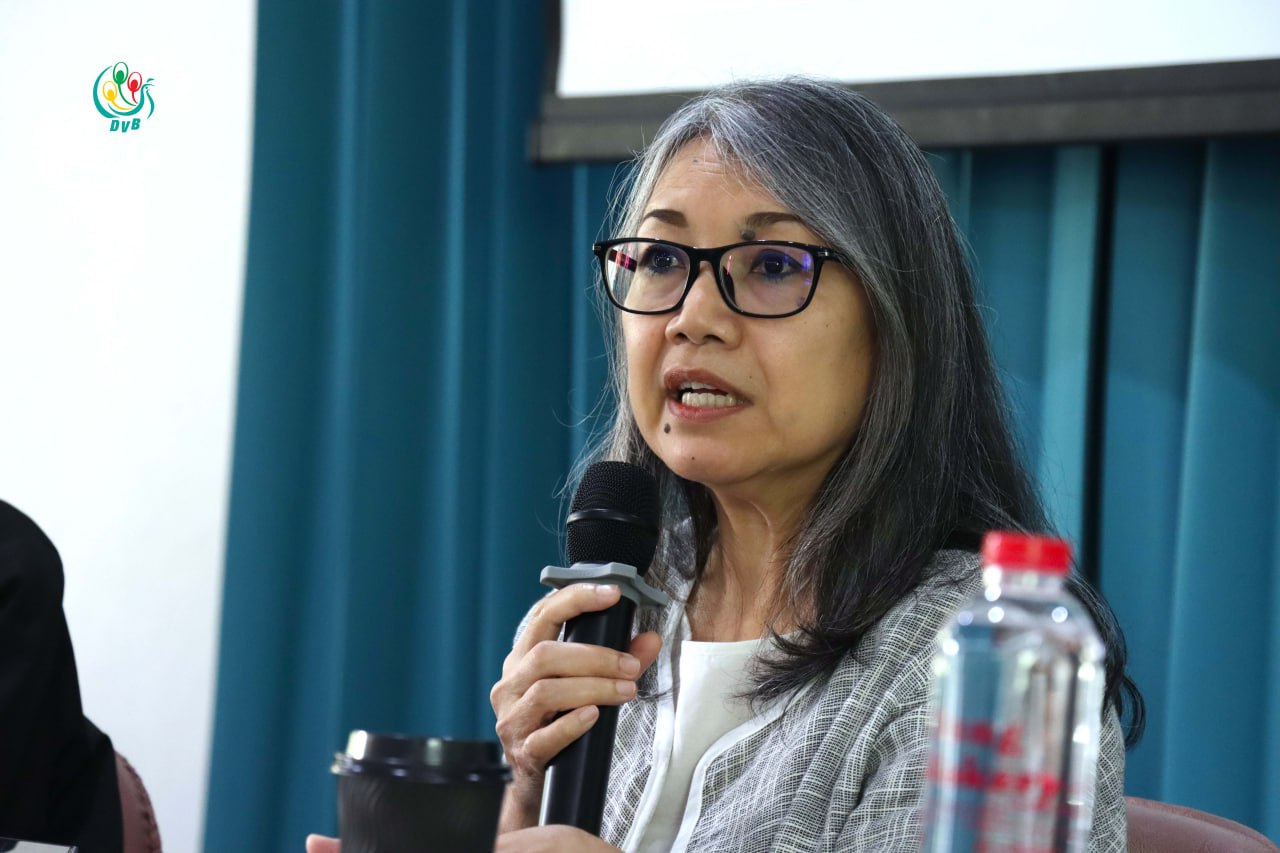
Khin Ohmar is a Myanmar human rights activist who was involved in organizing the 1988 nationwide pro-democracy uprising. She is also the founder and chairperson of Progressive Voice, a Myanmar human rights organization. She developed the Women Peacebuilding Program for Women’s League of Burma and served as program coordinator from 2000 to 2006.
DVB publishes a diversity of opinions that does not reflect DVB editorial policy. We’d like to hear what you think about this or any of our stories: [email protected]