


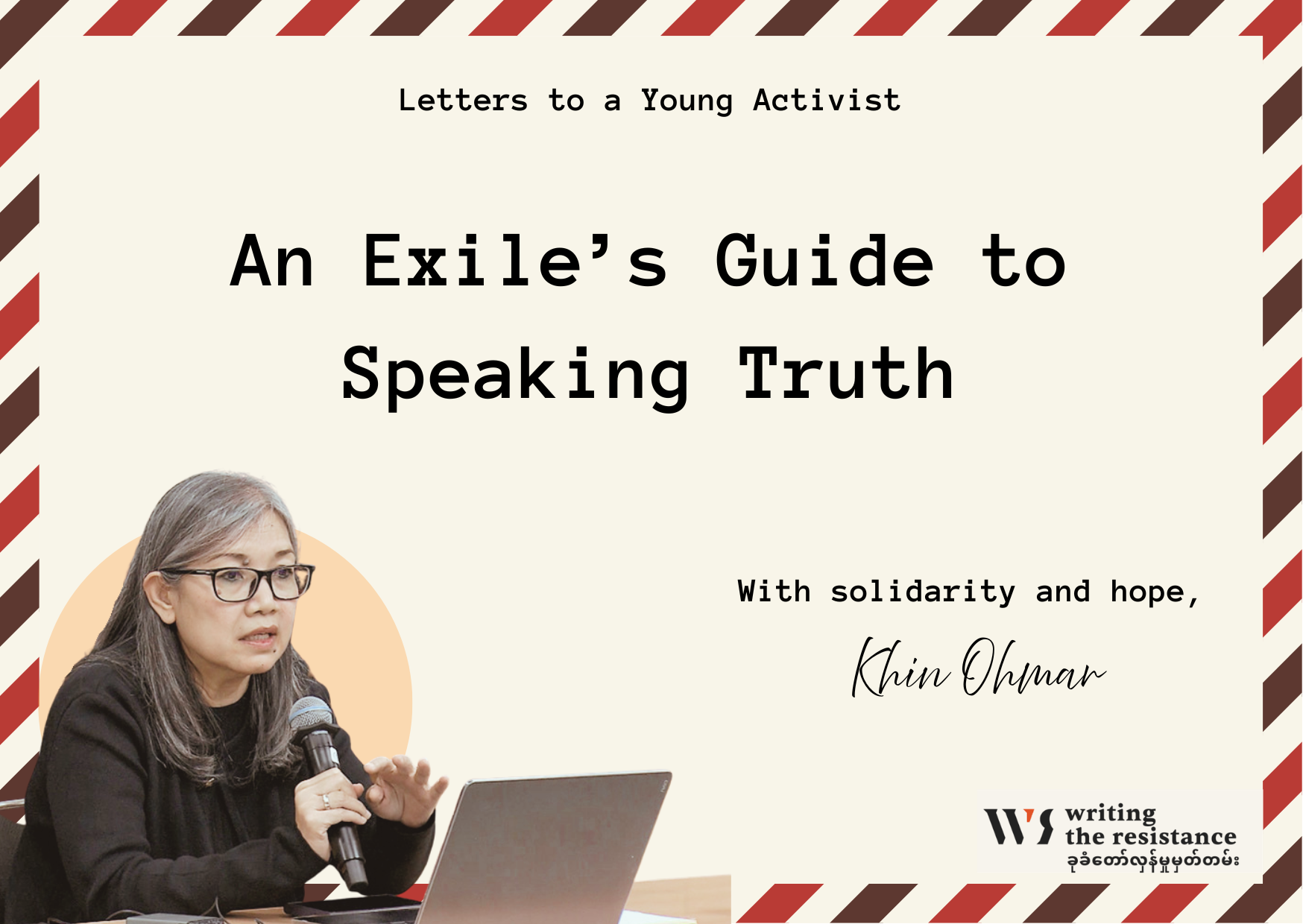
Guest contributor
Khin Ohmar
For many activists, a combination of personal pain, anger, and a commitment to justice defines our life paths. Witnessing violence and discrimination in my childhood and my refusal to remain silent laid the foundation for a lifetime dedicated to resistance, solidarity, and the pursuit of equality and justice.
As a child, I witnessed my father abuse my mother. I was angry my mother had to suffer, and I intervened with all the force I could muster. My act of defiance must have shifted something in him.
He became more reflective, and while he distanced himself from our family, over the years he imparted wisdom and critical thought that have shaped my worldview.
He taught me that change is possible, but it does not erase the harm done. The mix of admiration and deep anger I felt towards him has taught me how to hold the complexity of emotions in my work for justice and peace.
As I grew older, I understood that anger can be a powerful force to fight injustice, but only when it is grounded in awareness, humility and the willingness to listen deeply to my heart and to others’.
My journey took me from personal resistance at home to joining the student movement in 1988, motivated by a deep conviction that transformation and change are possible. I’ve learned over the years that activism takes many forms.
It may take us into the streets. Or it may be the quiet act of refusing to accept what is wrong, the courage to ask uncomfortable questions, or the persistence to keep seeking justice even when others turn away.
My experiences have taught me about the layered nature of discrimination and oppression in Burma/Myanmar. Meeting minoritized ethnic communities at the border in late 1988 after leaving the city to join the resistance, I had to confront my own privilege as an urban, majority Buddhist, Bamar woman.
The struggle for justice must include all forms of oppression, whether ethnic, gender-, or religious-based, and this recognition deepened my commitment to activism for systemic transformation.
I have learned that being an activist is about being willing to listen deeply and learn, to make mistakes, reflect on and correct my course of action, offer sincere apologies, and to continue striving for a more just world.
My journey has included many ups and downs, as well as heartbreak. I have been encouraged by clear signs of the weakening of the military junta, but I have felt discouraged by times when the junta’s divide-and-rule tactics against our movements succeeded.
In 2012, as Myanmar opened to the world under the military-engineered transition, I came to learn how changes of heart by individuals could impact our coalitions and thus our movement as a whole.
I felt despair when I had to face some leaders and comrades departing from principles and values I believed we once shared. I had to reaffirm that my activism did not depend on any particular persons or leaders, but on my own beliefs.
The isolation I felt then taught me that our movements must always be anchored in ethical clarity and in the people.
Leaders may inspire or disappoint us, and comrades may abandon us, but the true strength of any movement lies in the collective vision and resilience of those who resist injustice.
Those difficult moments confirmed that my activism since March 1988 has never been contingent on any leader or any actions of others. It has always been rooted in my personal conviction and in solidarity with the oppressed.
A vital element of my learning and commitment has been Burma/Myanmar’s women’s movements.
Early in my activism, I struggled to comprehend the systemic violence faced by ethnic minority women, including the military’s use of sexual violence as a weapon of repression against minoritized ethnic nationalities.
Over time, by listening to survivors and standing alongside them, I saw how deeply entrenched systems of power perpetuate abuse and silence victims. My own privilege meant I could not fully grasp the daily realities of those most marginalized and oppressed.
Yet, it became clear that true change could only come from within, through organizing across differences and centering the voices of those most affected.
Real progress demands that our resistance strategies be grounded in the visions of grassroots women, especially those from communities most impacted by the military’s systemic campaign of violence, conflict and oppression.
Our goal cannot be for women to simply be present at decision-making or peace negotiation tables. Our goal must be to redefine the very nature of collective leadership and inclusive peacebuilding from the ground up.
I have always known deeply that my instincts, my anger, and my commitment are sources of my strength. That may be true for you, too. You may have been told that you are “too much”: too emotional, too radical, or too stubborn.
But I tell you, it is precisely this depth of feeling that fuels resistance and also empathy and compassion. We must never let fear silence us. The world needs your courage, your clarity, and your refusal to accept anything less than justice.
My activism began as small acts of defiance against abuse at home, discrimination at school and in the community, and then violence by the state. Yours may or may not be the same.
Regardless of our motivations, we need to remember that we do not have to be perfect or have all the answers. What matters is our willingness to stand up, to question, and to persevere in the face of adversity.
Every act of resistance brings us closer to equality, justice, and peace.
Twice a month, I’ll publish a ‘letter to a young activist’ offering my reflections and analysis about Burma/Myanmar grounded in my own experiences, history and a chronology of the building of our movements.
I will also share my feelings and emotions, because it is by understanding the personal impacts of politics, oppression and violence that we can truly act in solidarity with trust and perseverance.
I deeply believe that this is how we build inclusive and effective movements for transformative change.
I offer these letters in the spirit of solidarity, sharing, and most importantly, hope. And I hope you will find them helpful as you carry on with your own path of activism for a better world.
With the solidarity and hope,
Khin Ohmar
Khin Ohmar is a Myanmar human rights activist who was involved in organizing the ‘8888’ nationwide pro-democracy uprising. She is also the founder and chairperson of Progressive Voice, a Myanmar human rights organization. She developed the Women Peacebuilding Program for Women’s League of Burma and served as program coordinator from 2000 to 2006.
DVB publishes a diversity of opinions that does not reflect DVB editorial policy. We’d like to hear what you think about this or any of our stories: [email protected]