


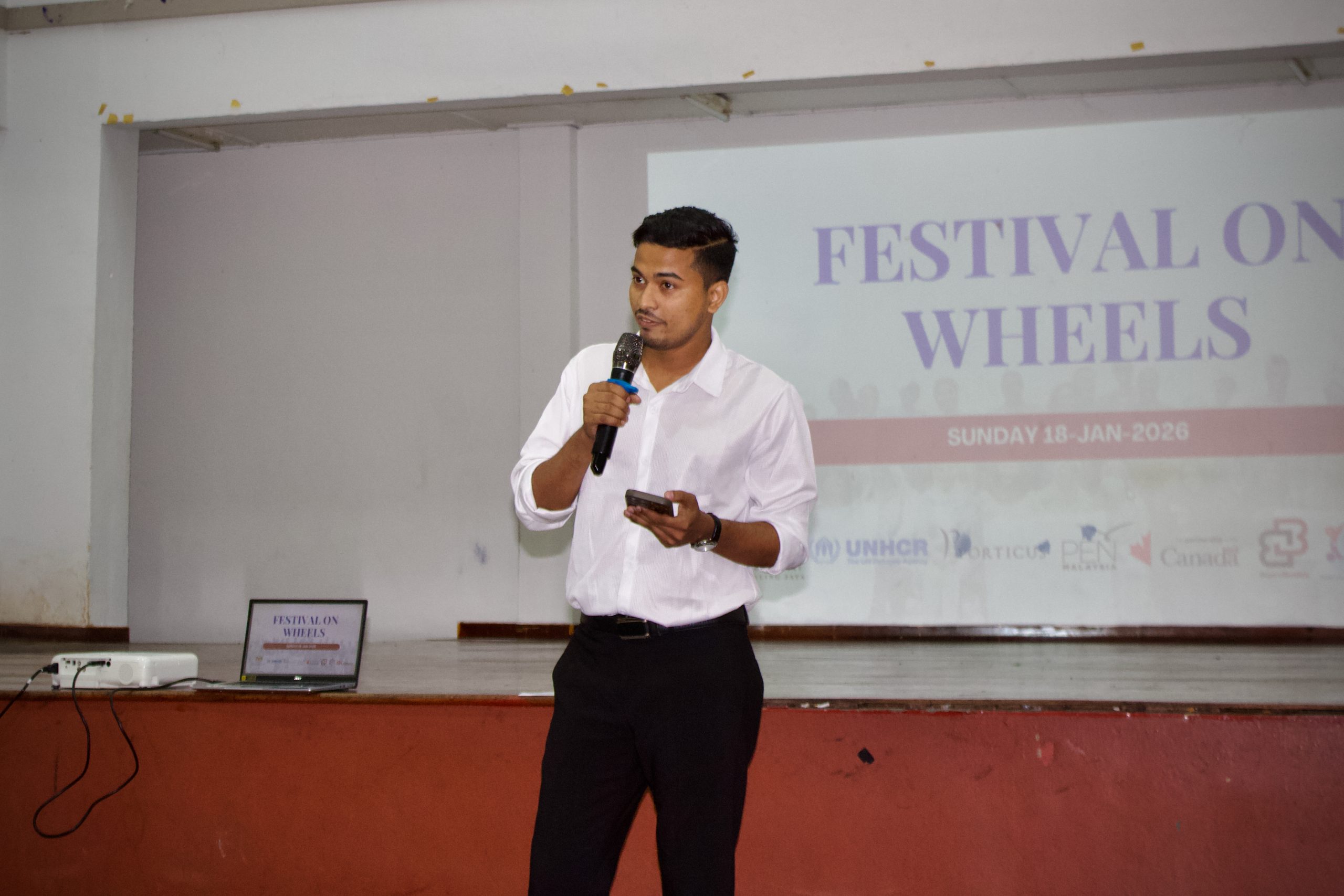
When Pacifist Farooq fled the Myanmar military’s genocidal campaign in 2016, he hoped to find safety in Bangladesh.
Years later, after surviving targeted violence in refugee camps, he sought sanctuary in Malaysia.
Today, the Rohingya teacher and activist finds himself fighting a different kind of war: an escalating wave of online hate speech, media misrepresentation, and xenophobia.
“We are fleeing genocide,” Farooq says. “We are not coming here to take over jobs, or to take land, or for citizenship. We are here just to survive and stay safe.”
Fleeing genocide, war & violence
Farooq was born and raised in Buthidaung, in northern Rakhine State. After passing his matriculation exams in 2016, he worked as a school teacher.
However, the Myanmar military’s brutal genocidal offensive against the Rohingya forced him to escape across the border to Bangladesh.
For five years, Farooq lived in the overcrowded refugee camps of Cox’s Bazar. But safety proved elusive. As armed Rohingya factions began forcibly recruiting young men in the camps, Farooq spoke out against the violence.
“We were not supportive of this armed group, so they targeted us,” Farooq recalls. “One of my friends, Mohammad Faisal, was killed, and I was threatened that I would be killed too.”
Forced to flee once again to save his life, Farooq made his way to Malaysia two years ago.
From refugee to facing xenophobia
Initially, life in Malaysia offered a brief sense of security. Farooq re-established himself as an educator at an NGO-backed refugee learning center, teaching children and conducting community workshops on local laws, social norms, and gender-based violence.
However, the climate in Malaysia has deteriorated sharply. Increased police raids on informal learning centers have forced schools to close for weeks at a time, leaving refugee children without education and families trapped in their homes by fear.
Refugee Community Impact Snapshot
├── Learning Centers: Raided and forced offline for weeks
├── Mobility: Families afraid to leave homes due to arrests and harassment
├── Economic Toll: Loss of informal employment and mounting financial distress
└── Psychological Toll: Pervasive anxiety driven by rampant online hate speech
“People are always afraid to go out of their homes,” Farooq says. “Not just the Rohingya, almost all refugees are affected—both mentally and financially—because people cannot work.”
The weaponization of the Rohingya name
A central driver of the rising hostility, Farooq points out, is widespread media sensationalism and misidentification by Malaysian legacy media and netizens.
Farooq notes that local news outlets frequently use the term “Rohingya” as clickbait to drive traffic, even when reporting on incidents involving other ethnic groups or foreign nationals:
- Double Standards in Crime Reporting: When members of other ethnic groups from Myanmar are involved in crimes, local media typically use generic terms like “Warga Myanmar” (Myanmar national). However, when a refugee is involved, outlets routinely single out the word “Rohingya.”
- Mislabeled Market Hubs: News reports regularly label Kuala Lumpur’s Selayang Pasar Borong market as a “Rohingya market,” despite Rohingya making up less than 5 per cent of the local vendor population, which consists mostly of Burmese Muslims and Bengalis.
- Misidentified Incidents: Online videos have repeatedly mislabeled non-Rohingya individuals—such as a Chin motorcycle rider arrested for traffic violations, or a Myanmar Muslim girl begging in Kuala Lumpur
“Malaysians don’t know much about the difference between who is Rohingya and who is not. Content creators deliberately use the name of the Rohingya to reach a larger audience. It is yellow journalism.”
The online hostility has spilled over into direct threats against activists. Farooq regularly receives abusive messages and death threats on social media, noting that platforms like Meta’s Threads are particularly volatile due to inadequate content moderation compared to mainstream platforms.
When threats occur in the physical world, refugees rarely report them to law enforcement. “Even when refugees report to the police, no action is taken,” Farooq explains. “That is why people have stopped reporting altogether.”
Setting the Record Straight
Farooq emphasizes that the anti-refugee rhetoric circulating online—including claims that Rohingya refugees seek land or citizenship in Malaysia—is completely baseless propaganda.
“The Rohingya have never asked for citizenship rights or land,” Farooq stresses. “We are here temporarily. When the situation in Myanmar is safe and stable, we will go back.”
With both the Myanmar military and the Arakan Army (AA) having forced Rohingya youth into military service back in Rakhine State, Farooq appeals to the Malaysian public for empathy rather than hostility.
“We fled the genocide under the Myanmar government, and now the Arakan Army is doing the same thing. People are fleeing wherever they can just to survive.”
Watch the Newsroom interview with Pacifist Farooq on DVB English News YouTube.