


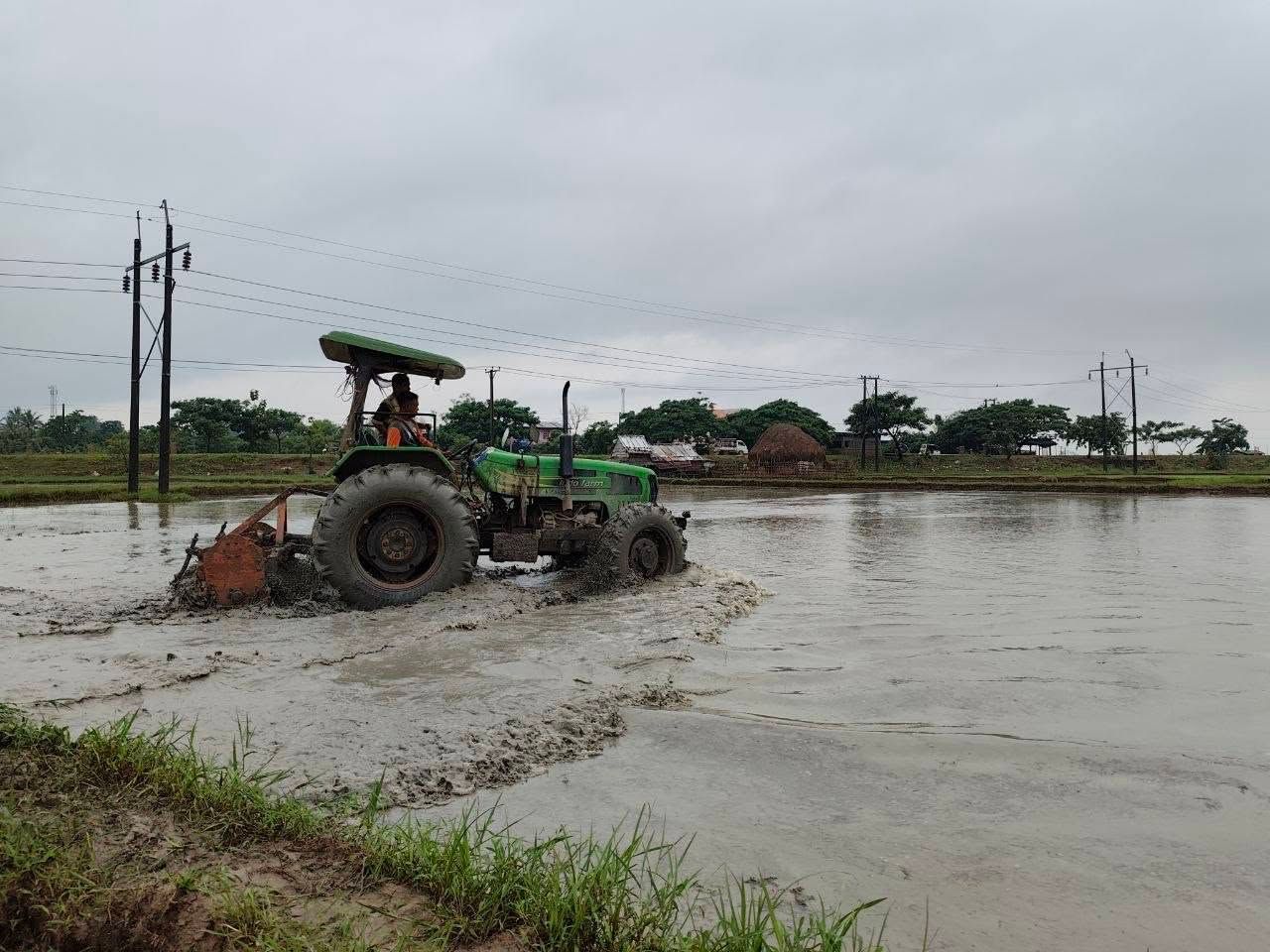
Tens of thousands of acres of agricultural farmland across at least 11 townships in Arakan State have been devastated by historic monsoon flooding, leaving rural communities in urgent need of seed rice and emergency financial aid.
Heavy torrential rains July 6-13 submerged newly planted paddy fields for nearly a week during the peak monsoon planting season.
Described by residents and humanitarian workers as the worst flooding seen in the region in nearly two decades, the inundation destroyed crops, contaminated drinking water sources, and triggered severe riverbank erosion that swept away homes.
Depleted grain reserves and replanting struggles
With the monsoon planting window rapidly closing, local farmers report that their stored seed supplies have been entirely ruined or exhausted. To avoid total crop failure for the coming harvest, many farming households are now forced to sow rice reserves originally set aside for daily family consumption.
In Kyauktaw Township—located 40 miles (64 km) northeast of the state capital, Sittwe—residents estimate that more than 3,000 acres of farmland were damaged or destroyed in a single river valley.
“We have to plow and sow again. Many farmers are now using the rice they kept for food,” Maung Kyaw Than, a farmer from Pan Hpyar Chaung village in Kyauktaw Township, told DVB.
Widespread agricultural impact across central and northern Arakan
The disaster has disrupted agricultural livelihoods across at least 11 townships throughout central and northern Arakan State:
Arakan State Flood Impact Snapshot
├── Severely Affected Townships: Kyauktaw, Minbya, Mrauk-U, Ponnagyun, Rathedaung, Buthidaung, Maungdaw
├── Agricultural Ruin: Tens of thousands of acres of paddy fields submerged & destroyed
├── Secondary Threats: Contaminated freshwater ponds, riverbank erosion, health risks
└── Immediate Needs: Emergency seed rice, direct cash transfers, & agricultural aid
Local aid networks warn that without rapid interventions—specifically targeted distributions of high-yield seed rice and direct financial support—rural farming households will be unable to restore production before the growing season ends, triggering severe multi-year food insecurity across the region.
Coordination for emergency relief
The Arakan Army (AA)—which maintains administrative and military control over 14 of Arakan State’s 17 townships as well as Paletwa Township in Chin State—governs most of the flood-impacted areas.
While the AA has not yet issued an official public policy statement regarding long-term local agricultural aid, relief efforts were a central focus during high-level virtual talks on July 23 between AA Commander-in-Chief Twan Mrat Naing and the Steering Council for the Emergence of a Federal Democratic Union (SCEF)—Myanmar’s premier resistance coalition.
During the session, the National Unity Government (NUG) provided initial emergency funding to assist with regional flood relief, with both sides agreeing to collaborate on joint post-flood rehabilitation and humanitarian delivery for affected farming communities.