


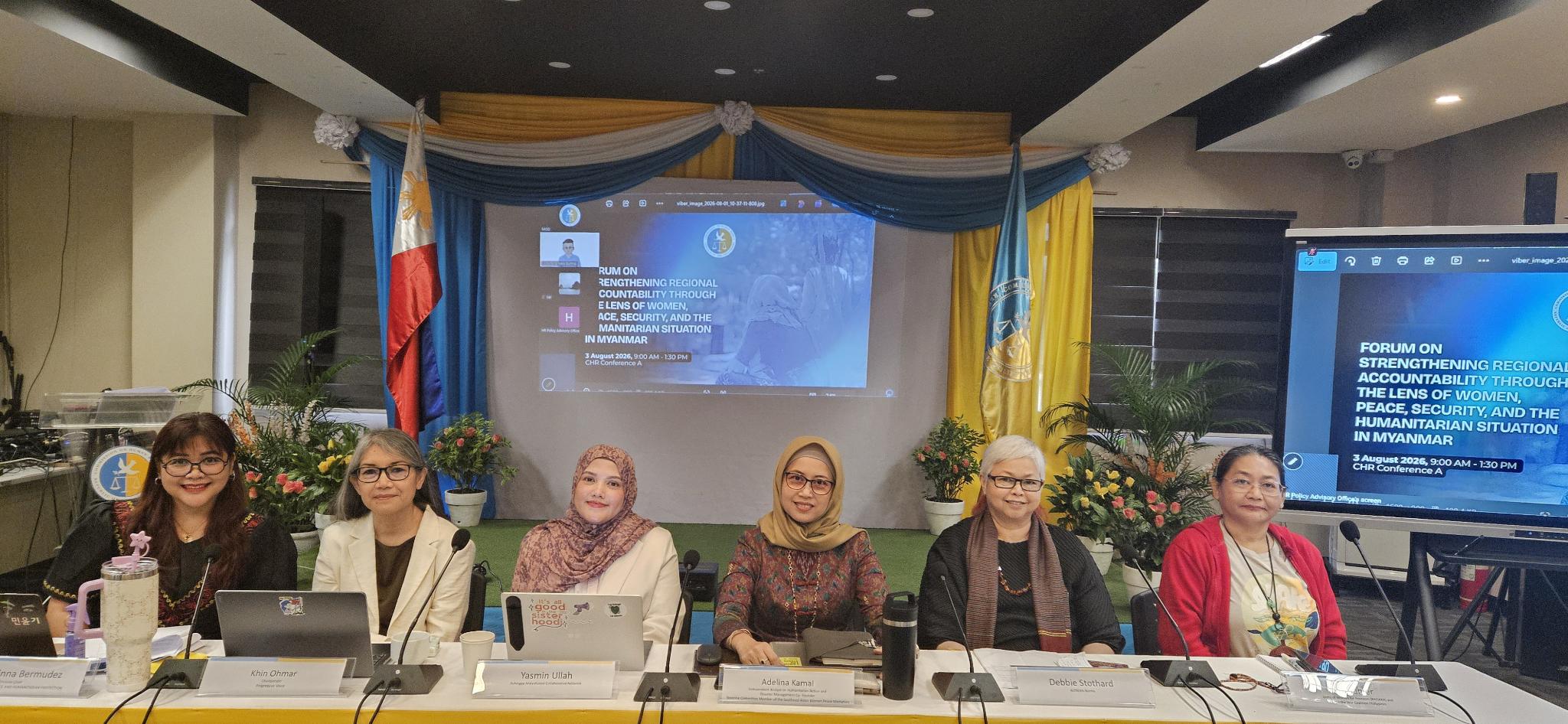
The Commission on Human Rights of the Philippines (CHRP), alongside Myanmar and Philippine civil society and women’s rights organizations, convened a high-level regional forum in Manila on Monday calling on the Association of Southeast Asian Nations (ASEAN) to take urgent, principled action to address Myanmar’s deepening human rights and humanitarian crises.
Titled “Strengthening Regional Accountability through the Lens of the Women, Peace, Security, and Humanitarian Situation in Myanmar,” the forum brought together 80 representatives from women’s rights groups, humanitarian actors, diplomats, academics, and international experts on Myanmar.
The gathering critically evaluated the implementation of the ASEAN Regional Plan of Action on Women, Peace, and Security (ASEAN RPA on WPS) and the bloc’s stalled Five-Point Consensus peace plan for Myanmar, exposing a widening divide between ASEAN’s policy commitments and the lived realities of conflict-affected communities.
Featuring video testimonies from former female political prisoners and young resistance fighters, the session underscored both the acute risks women face—including conflict-related sexual violence (CRSV)—and their indispensable role as human rights defenders, peacebuilders, and democratic leaders.
“The women of Burma are not waiting for someone to save us. We are building courts, training judges, drafting constitutions, feeding the displaced, and healing the wounded—with almost nothing, under fire, every single day. We are only asking the world to stand with us while we do it,” said Naw K’nyaw Paw, the chairperson of the Karen Women’s Organisation (KWO).
Evaluating the performance of regional frameworks, civil society representatives argued that current mechanisms fail to protect those on the frontlines.
Humanitarian experts emphasized that single state-facing mechanisms are fundamentally ineffective when the military itself acts as the primary perpetrator of violence and systematically blocks aid channels.
“Myanmar’s complex and decentralized conflict landscape means that there are multiple systems of territorial control, access, service delivery, protection, and local authority. A single state-facing mechanism cannot reliably reach all these realities—especially when the military authority is the principal perpetrator… In this context, humanitarian action must move beyond delivering relief. It must also defend dignity, justice, and our shared humanity,” said Adelina Kamal, a regional humanitarian and peace building expert.
Calls to Action for 2026 ASEAN Chair the Philippines
With the Philippines serving as the 2026 ASEAN Chair, participants stressed that Manila holds a critical opportunity to steer the regional bloc toward a principled, people-centered approach.
Khin Ohmar, Chair of Progressive Voice, directly addressed Philippine Foreign Affairs Secretary and ASEAN Special Envoy Ma. Theresa Lazaro, urging immediate operational shifts:
“The Philippine Foreign Affairs Secretary and ASEAN Special Envoy Ma. Theresa Lazaro must urgently undertake the ASEAN’s October 2025 Summit decision by directly supporting locally led, border-based mechanisms to deliver non-discriminatory humanitarian aid to conflict-affected communities,” said Khin Ohmar.
The forum concluded with a joint commitment to deepen alliance-building between Philippine and Myanmar civil society organizations, while delivering a comprehensive package of policy recommendations to ASEAN leadership to ensure women’s security, humanitarian access, and justice across Myanmar.