


Guest contributor
James H. Shwe
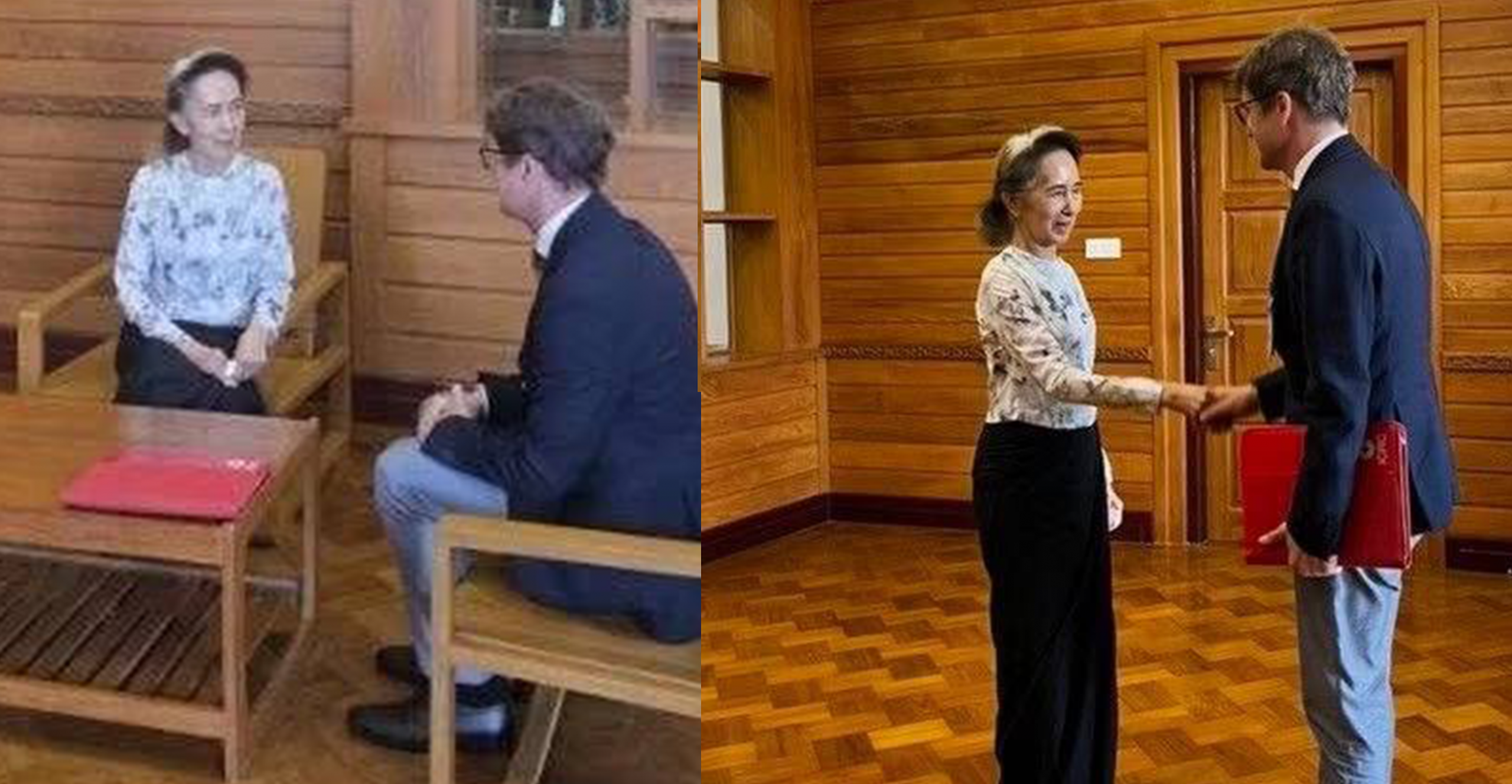
Over thirty English-language outlets carried the same set of images on August 3 — four photographs, released by the junta’s own spokesperson on Telegram before the International Committee of the Red Cross had confirmed anything, showing Aung San Suu Kyi in a wood-paneled room, dressed in traditional attire, standing unaided, shaking hands with Arnaud de Baecque, the ICRC’s resident representative in Myanmar.
Al Jazeera, France 24, ABC News Australia, Nikkei Asia, Euronews, the Straits Times, the Guardian, NPR, CNN, AFP, and outlets from Bangkok to Sydney to Dhaka moved essentially the same story: proof of life, first foreign visitor in five years, meeting ahead of Min Aung Hlaing’s Thailand visit.
Most of the coverage stayed at the level of the image itself. The visuals travelled; the analysis did not.
One significant exception ran the same morning. In a Washington Post opinion piece published Aug. 3, Keith Richburg named the pattern directly: “A coup leader in a suit and tie is still a dictator.”
He urged democratic governments not to fall for the junta’s post-election rebranding; a rebranding built on precisely the kind of images that saturated the wires later the same day.
The alignment was not accidental. Where the news desks framed the photograph as a positive humanitarian step, the opinion columns — those willing to read intent — framed the entire month’s choreography as a legitimation campaign to be refused.
That divide, between wire-service framing and analytical framing, is the story within the story.
The image is not what we should be reading. The choreography is, and the intent behind that choreography is unmistakable. This was not a humanitarian development.
It was a scheduled operational move in a campaign that has been running since April, when Min Aung Hlaing awarded himself the title of “President” and signed his own order commuting a fraction of Suu Kyi’s 27-year sentence to house arrest under a statute that keeps release revocable on the regime’s say-so.
From that April maneuvers, through the December 2025 sham election held under bombardment, through the July 12 ASEAN meeting where Bangkok began softening the benchmarks, to the August 3 photograph, every step has been aimed at one destination: securing the recognition of the regime as a normal government by the time Min Aung Hlaing arrives in Bangkok on Aug. 6.
Three days before that trip, the regime released photographs of Suu Kyi that state media announced before the ICRC. Within hours, Thailand’s Deputy Prime Minister and Foreign Minister Sihasak Phuangketkeow issued a formal statement welcoming the meeting “in light of the upcoming visit of the President of Myanmar to Thailand.”
Bangkok gets its diplomatic cover. Min Aung Hlaing arrives as the leader that “opened” Suu Kyi to international humanitarian access. Three days is a schedule, not a coincidence.
Richard Horsey, senior Asia adviser at the International Crisis Group, told CNN the regime had “deliberately chosen” an ICRC representative for Suu Kyi’s first public meeting so Naypyidaw could address “concerns over her status and health without opening the door to diplomatic access.”
That is the intent stated plainly by an experienced Myanmar analyst: address the health concern to defuse the pressure, refuse the diplomatic access that would validate other governments’ authority to inquire.
Grant the minimum. Keep the maximum — access, verification, family contact — under regime control.
The concession was cheap. The ICRC’s own working standards for detention visits require unrestricted access, the ability to repeat visits, and — critically — the restoration of family links. What the regime granted was one visit, on one morning, with no commitment to any of that.
Daw Suu’s son Kim Aris, hours after the images were released, welcomed the visit as “the first positive development” concerning his mother in more than five years but was unequivocal about how much it did and did not settle.
He has still not received independent confirmation of his mother’s condition. His five requests — direct contact, family access, verified information, release for her, release for all — are, in every particular, what the U.N. Standard Minimum Rules for the Treatment of Prisoners — the Nelson Mandela Rules, adopted by consensus at the General Assembly in 2015 — require for every criminal prisoner regardless of status: regular family communication, access to independent medical care, access to legal counsel.
One managed meeting after five years of isolation does not satisfy those baseline norms even for an ordinary convict. Suu Kyi is not an ordinary convict. She is a political prisoner recognized as arbitrarily detained by the U.N. Working Group on Arbitrary Detention in six separate opinions across two decades, and one of an estimated 15-20,000 political prisoners held under the same regime that just staged this photograph.
The intent becomes clearer in what the four photographs do and do not show. They show Suu Kyi standing unaided, shaking hands formally with a foreign representative, and a table set with tea.
In the corner of one frame sits a birthday cake inscribed “Happy Birthday Aunty Suu 29.6.2026” — six weeks after her actual June 19 birthday, staged in the room now.
They do not show Suu Kyi speaking. They do not show her writing a message to her family. They do not show any independent third party — not a lawyer, not a doctor, not an ASEAN envoy — verifying her condition.
The Nikkei coverage noted, from separate sourcing, that she has been held in a spartan Naypyidaw cabin without air conditioning, has previously suffered food poisoning, and has been denied dental care. None of that is in the frame. The frame is the point.
The photograph did not arrive in isolation. On July 12, at an informal ASEAN foreign ministers’ meeting in Bangkok, Sihasak proposed four “indicators of progress” that quietly substituted a “reduction of violence” for the Five-Point Consensus’s original “immediate cessation of violence.”
At the same press conference, Philippine Foreign Secretary and ASEAN Chair’s Special Envoy on Myanmar, Maria Theresa Lazaro, held the original line, calling for “concrete actions towards the cessation of hostilities.”
Then on July 23, the junta’s foreign ministry issued a formal statement explaining why its proxy parliament had voted to reject the Five-Point Consensus outright, invoking the ASEAN Charter, the 2008 Constitution, and “sovereignty and non-interference.”
Notice the sequence. Soften the benchmark on July 12. Reject the framework on July 23. Offer a single humanitarian gesture on August 3 cast inside the vocabulary of that same framework.
Read forward, the sequence is choreography for Bangkok; read backward, from the August 6 arrival to the July 12 concession, it is the ledger of what the regime spent and what it purchased. Nothing about it was accidental. It was designed.
The regime cannot claim legitimacy by any means other than performance. It cannot claim it by governance — ACLED data shows the military does not fully control most of the country’s territory.
It cannot claim it by elections — the 2025-26 “polls” were held under bombardment and coercion. It cannot claim it by a peace process — every meaningful ethnic armed organization has publicly rejected its terms.
What remains is performance. The photograph is a performance. The state visit will be a performance. Every softened “indicator of progress” is an occasion for another. The purpose of each is to secure recognition the regime cannot earn.
Performances require an audience. That audience is not primarily the Myanmar people, who know what is being staged. It is ASEAN foreign ministries, middle-power capitals, wire-service editors on a slow Monday, and — most of all — the U.N. Credentials Committee, which will decide this autumn whether Myanmar’s seat in New York stays with the incumbent representing the 2020 mandate, transfers to the junta’s post-election appointees, or is left empty as a neutral compromise.
The junta cannot win the seat outright. Its second-best outcome is an empty chair — the very erasure the Cambodia precedent after 1979 warned against — and every photograph like this one is aimed at making that empty chair feel like a reasonable compromise.
Richburg’s Washington Post piece, published as the images were still moving across wire services, urged democratic governments to refuse exactly this trajectory: no recognition of the coup leader in a suit, no acceptance of the post-election rebranding, no diplomatic normalization dressed up as pragmatism.
He is right, and the timing of his call makes it more useful than he could have known when he filed. The photograph of Suu Kyi is the physical form of the recognition offer he warns against.
To accept the frame the junta has chosen — that this is a positive step, that the regime is now cooperating with international humanitarian standards, that the Thailand visit can proceed on that basis — is to grant the recognition Richburg says must be withheld.
The Myanmar people, the National Unity Government, the ethnic resistance organizations, and the civil society networks inside and outside the country do not need to be told what this photograph is.
We already know. What we can do is refuse to let the international coverage decide its meaning. The story is not the photograph. The story is the sequence, and the sequence tells us that the rules still work. If they did not, none of the theater would be necessary.
The junta has told us, through its own choreography, that legitimacy remains the currency it cannot manufacture and cannot do without. The response is not to argue with the photograph.
It is to name the intent, hold the harder line at every venue where the choice is available — the U.N .Credentials Committee first among them — and remind our friends in ASEAN capitals and beyond that a photograph of a hostage is not proof of change. It is proof of a hostage.
James H. Shwe is an independent policy analyst and writer on Myanmar and Southeast Asian affairs based in California. He is not affiliated with the National Unity Government or the Steering Council for the Emergence of a Federal Democratic Union.
DVB publishes a diversity of opinions that does not reflect DVB editorial policy. We’d like to hear what you think about this or any of our stories: [email protected]