


Guest contributor
Tun Linn
Although China and Russia continue to provide political and diplomatic support enabling Myanmar’s military regime to sustain its violent rule since it seized power in the 2021 military coup, they have so far been unable to secure international legitimacy for the regime in Naypyidaw at the U.N.
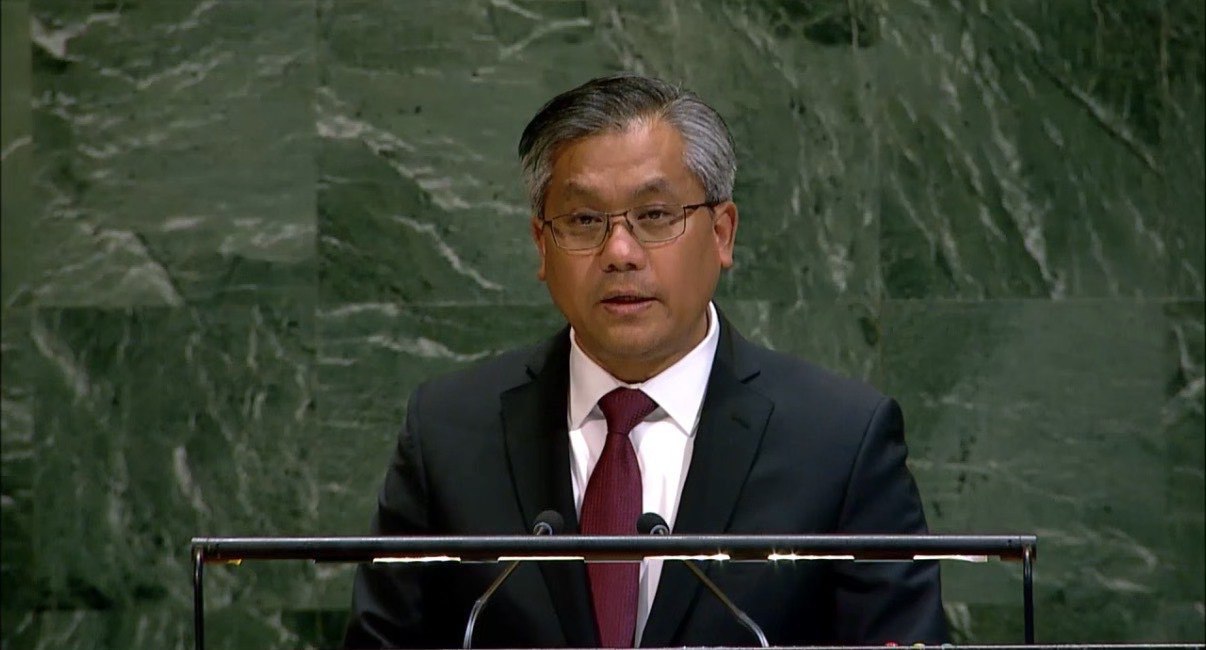
The continued presence of Ambassador Kyaw Moe Tun, Myanmar’s Permanent Representative to the U.N., on the global stage in New York at the U.N. headquarters underscores the limits of that support.
Since the 2021 coup, Myanmar’s military generals have repeatedly claimed to be the country’s legitimate rulers. But at the U.N., that claim has been rejected in practice for five consecutive years.
On Dec. 12, during the 80th session of the U.N. General Assembly, member states once again adopted the report of the Credentials Committee by consensus, allowing Kyaw Moe Tun to continue serving as Myanmar’s Permanent Representative without a vote.
In previous years, the regime could absorb this diplomatic setback by portraying it as temporary or procedural. In 2025, however, the context is different. The regime is preparing for elections widely regarded by Myanmar’s pro-democracy movement and much of the international community as neither free nor fair.
The U.N’s continued refusal to seat a regime-appointed representative at this moment sends a clear political signal: any government emerging from an electoral process deemed illegitimate by the international community is unlikely to gain recognition at the U.N.
As things stand, Kyaw Moe Tun is expected to remain Myanmar’s Permanent Representative to the U.N. through the end of the current General Assembly session, extending into 2026, unless a fundamentally different political settlement occurs.
U.N. member states submit credentials for their ambassadors at the start of each General Assembly session. These are reviewed by the nine-member Credentials Committee, which includes China, Russia, and the United States, alongside six rotating members. Each committee member has one vote; there is no veto power in this process.
When only one set of credentials is submitted, approval is routine. When competing submissions exist—as has been the case for Myanmar since 2021, with claims from both the regime in Naypyidaw and the parallel pro-democracy administration National Unity Government (NUG)—the committee has several options: accept one submission, reject both and leave the seat vacant; or defer a final decision while allowing the previously recognized representative to continue.
Since 2021, the committee has repeatedly chosen the third option. Its reports have then been adopted by the General Assembly without objection, meaning no vote was required.
This approach neither formally recognizes the NUG nor accepts the regime’s claim, but it effectively blocks the regime from occupying Myanmar’s U.N. seat while preserving Kyaw Moe Tun’s speaking rights.
China and Russia, despite their diplomatic support for the regime in Naypyidaw, have not pushed the credentials issue to a contested vote—either in the Credentials Committee or in the General Assembly.
One key reason is arithmetic. If the matter were put to an open vote in the General Assembly, the regime’s nominee would almost certainly lose, given the broad reluctance among U.N. member states to legitimize the military after it seized power by ousting the democratically-elected National League for Democracy (NLD) party led by Aung San Suu Kyi.
For Beijing and Moscow, forcing such a vote would risk an unmistakable public defeat. The current strategy—allowing deferral by consensus—avoids that outcome while still preserving their broader bilateral relationships with the regime in Naypyidaw.
China’s regional engagement with Myanmar has intensified since 2024, including high-level diplomatic visits and expanded political coordination with the military authorities. Beijing has consistently emphasized stability and non-interference, while maintaining working relations with the regime.
However, this support has not translated into an open challenge to Kyaw Moe Tun’s credentials at the U.N. On the multilateral stage, China continues to favor procedural deferral rather than direct confrontation, reflecting its preference to manage the Myanmar issue quietly rather than risk isolation in the General Assembly.
Kyaw Moe Tun’s continued presence at the U.N. provides an important platform for raising awareness of atrocities committed by the military and for amplifying the voices of Myanmar’s pro-democracy movement.
It also denies the regime a powerful symbol of international legitimacy.
At the same time, U.N. representation alone cannot deliver accountability. This limitation was evident in December 2022, when the Security Council adopted Resolution 2669—the first resolution on Myanmar in more than seven decades.
The resolution called for an end to violence, the release of political prisoners, including jailed State Councillor Aung San Suu Kyi, respect for democratic principles, and unimpeded humanitarian access.
China, Russia, and India abstained, while the remaining members voted in favor.
Because Resolution 2669 contains no enforcement mechanisms, the regime has ignored it with impunity. Any attempt to impose binding measures—such as sanctions or referral to international judicial bodies—would almost certainly face resistance or veto from China or Russia.
The continued recognition of Ambassador Kyaw Moe Tun at the U.N. should be seen as a meaningful diplomatic achievement for Myanmar’s resistance to the 2021 coup. It demonstrates that, despite strong backing from powerful allies, the military has failed to secure international legitimacy.
Yet this success also highlights a deeper shortcoming. While Myanmar’s democratic representatives retain a voice at the U.N., concrete international action capable of restraining the regime or delivering justice or accountability remains out of reach.
In that gap between representation and enforcement lies the unresolved challenge facing both the U.N. system and Myanmar’s pro-democracy movement.