


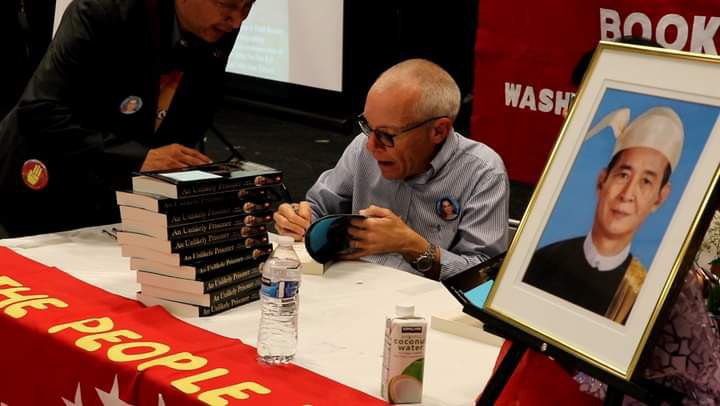
Former National League for Democracy (NLD) party economic policy advisor and political prisoner Sean Turnell is calling on the international community to demand “proof of life” for jailed Myanmar leader Aung San Suu Kyi, while fiercely condemning the military regime for driving the country’s economy into a state of “monetary disaster” since the military coup on Feb. 1, 2021.
Turnell, who spent 650 days in Myanmar’s prison system following the 2021 coup and documented in his book An Unlikely Prisoner, told DVB about his final meeting with Aung San Suu Kyi in Naypyidaw Prison four years ago.
He described her as physically well, despite having lost a significant amount of weight. He noted her morale remained exceptionally high, and she was primarily concerned with the welfare and confidence of her allies rather than her own safety.
Aung San Suu Kyi’s final words to Turnell were a direct and urgent plea: “Sean, tell the story. Get the story out. Don’t let the rest of the world forget Myanmar.”
Turnell expressed deep concern over the regime’s refusal to provide tangible proof of life amid her reported isolation over the last four years since he saw her last.
He called the regime’s extreme secrecy “incredibly irrational,” noting that their fear of an 80-year-old Suu Kyi illustrates that the international community is dealing with “frightened, insecure weaklings” rather than a powerful military apparatus.
An economy distorted for war
Beyond his insights into Suu Kyi’s condition, Turnell provided a grim assessment of Myanmar’s collapsing economy. He categorized the regime’s economic policies as driven by “utter irrationality” and “incompetence,” noting that every sector—from health to education—has been gutted to exclusively fund the military’s war effort.
He highlighted the regime’s recent military conscription mandate—enforced for all males aged 18 to 35 in 2024—as a critical breaking point, labeling it a “disaster for the economy.”
The law has triggered a massive, desperate brain drain. As young males and females flee the country to avoid the draft, businesses are left completely paralyzed by a severe shortage of skilled labor.
Further exacerbating the crisis is the collapse of the Central Bank of Myanmar’s independence.
Turnell explained that the regime is entirely funding its operations by printing money, leading directly to a collapsed kyat and skyrocketing inflation that has trapped citizens in a crisis of soaring commodity prices.
The rise of extractive exploitation
Turnell also issued a stark warning regarding the complete disappearance of Western Foreign Direct Investment (FDI). He noted that the responsible investment mechanisms established under the NLD administration from 2016-21 have been replaced entirely by capital from China and Russia.
He described this new wave of investment as purely “extractive and opportunistic,” pointing to operations like Chinese rare-earth mining companies that are actively strip-mining the country without any interest in building local institutions or developing human capital.
While acknowledging that international sanctions will not force the regime to change its behaviour, Turnell argued they remain absolutely essential.
By starving the regime of foreign exchange, the international community can significantly limit the military’s ability to purchase the advanced weaponry and air-delivered munitions it is using to fight the resistance.
A federal alternative
Despite the grim economic landscape, Turnell expressed strong optimism regarding the country’s democratic opposition.
He praised the National Unity Government (NUG) and allied federal democratic groups for developing sound “fiscal federalism” proposals, which he believes offer a viable, responsible alternative to the military.
Addressing the people of Myanmar directly, Turnell offered a message of enduring solidarity: “You are not alone… keep up the fight. This regime is not as strong as it seems sometimes. It will fall.”
Stay tuned to DVB English News for our upcoming Newsroom interview with Sean Turnell. Follow and subscribe on DVB English News YouTube, Spotify, Apple Podcasts, Audible, or Amazon Music.