


Guest contributor
*Winter Berry
I used to think the worst atrocities belonged to history books, documentaries, and old photographs.
I never imagined that one day I would witness the aftermath of genocide with my own eyes. But I did.
For me, that was in Rakhine State, Myanmar, in 2017.
I’m from Yangon and I grew up far from the armed conflict, forced displacement, or constant fear of violence that affected ethnic communities across the country.
In 2017, I worked for an international humanitarian organization. I believed I understood what was happening in my country.
I thought I knew what was right and what was wrong. I know now that I didn’t.
On August 25, 2017, the office of the State Counsellor Aung San Suu Kyi and state-run media outlets began flooding the general public with official statements saying that security outposts in the northern part of Rakhine State had been attacked by Muslim extremists.
Those who died were heroes who had given their lives in the line of duty, and the government was taking necessary action to protect the country and defend national sovereignty.
A day or two later, I saw photographs and reports from international media documenting how Rohingya people had to flee the most horrific violence perpetrated by the Myanmar military.
Women were carrying their children. Men were carrying elderly parents. Families were walking for days to cross the border to safety in Bangladesh.
At the same time, the Myanmar government, formed after Aung San Suu Kyi’s National League for Democracy (NLD) party’s landmark victory in the 2015 election.
Its supporters were pushing a completely different story on Facebook and in national newspapers.
They accused Rohingya villagers of burning down their own homes to get international sympathy and implied the whole population of Rohingya were illegal immigrants who came to take our land.
I believed them. I didn’t question it. Why would I? They were coming from the government I had trusted, the government I had voted for, the government I had believed represented the change we had waited so many years for, and our best hope for true democracy.
Two months after the attacks, in October 2017, I was assigned to go to Rakhine State on a humanitarian mission. I had visited Rakhine State several times before.
It is a stunningly beautiful place, and the journey from Sittwe, the capital of Rakhine State, toward the villages is especially beautiful.
Large rice fields stretched along the road, with mountains in the distance.
When we first departed from Sittwe, I could see the green fields and the life around the city.
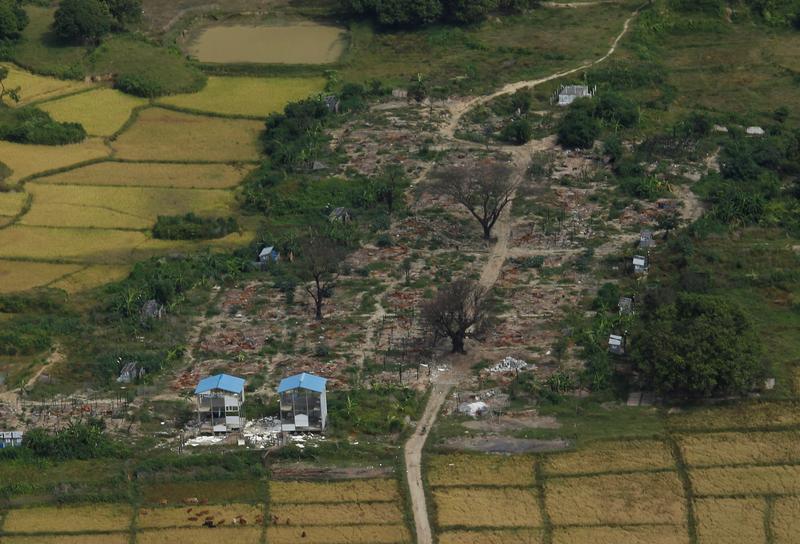
The further north we went, the more those colors disappeared. What was green became grey. And then there was almost nothing left but ashes.
I saw black ash stretching across fields, reaching almost to the tops of trees. Entire villages had been burned to the ground. Village after village after village.
When I arrived in Rohingya villages that still stood, I heard stories of graphic violence. But seeing it personally was something I was not prepared for.
I remember looking at it and thinking, how could this be even real?
These were people’s homes. Their memories. Their lives. And everything was gone.
Later that day, I went to Ale Than Kyaw beach in Maungdaw Township, where hundreds, perhaps thousands, of Rohingya survivors were stranded on the beach under the burning hot sun.
Their tents, pieced together from mats and whatever clothing they were able to bring, were scattered on the ground, and when asked, they said they were waiting to cross into Bangladesh.
I stood there looking at the water. It was enormous and endless. And then I looked behind me.
There were tents. There were women, men, the elderly, and children. They looked fearful, exhausted, and grieving.
I will never forget one woman. I don’t remember her name. We couldn’t speak because we didn’t share the same language, but she was holding her child on her hip.
She looked at me and invited me inside her makeshift tent, which was barely standing.
She had just survived something I could barely comprehend. She had lost everything.
And yet she was the one offering what little shelter she had. She offered kindness to me, a stranger who believed so many things about people like her.
On the way back home, I couldn’t stop thinking about everything I had seen.
I kept asking myself: How could these people possibly burn down their own homes just to risk their lives crossing a dangerous sea?
How could I have believed that they were doing this for “international attention”?
Why should mothers, fathers, children, and newborn babies have to die simply because they are Rohingya?
It was then that I learned my government was spreading coordinated misinformation.
If this isn’t genocide, I thought, then what is? If this isn’t some of the worst of humanity, then what is?
I vividly remember the destruction. It was the exact kind of thing I had only seen in history books.
Except this isn’t history. This is today. It was real. And I was right there.
And that realization still hurts. It hurts because I know I was not the only one.
For many of us in Myanmar, the stories we believed were ones we had been taught.
We were given one version of events, repeated over and over until it became what we believed to be the truth.
Even today, there are many who still reject the existence of the Rohingya, and repeat the same narratives of those genocide perpetrators that the Rohingya are Bengali and not indigenous to Myanmar.
And some of them are the same people who now call themselves revolutionaries resisting the junta, while still carrying the very same hatred and denial that made the Rohingya’s suffering so easy to ignore.
I’m not saying this to attack them. I say it because I know what it is like to be wrong.
I was there. I believed it too. And I know how difficult it can be to question something you have been taught your entire life.
But resisting a military dictatorship is not enough if we do not also confront the thinking that allows oppression to happen.
We have to question what we were taught. We have to be willing to see people as human beings before we see them as a religion, an ethnicity, a nationality, or a political threat, because sometimes, we are not just witnessing atrocities.
We are part of a society that allows it to happen.
And this is also why I worry about other ethnic minorities in Myanmar.
Once we accept that one group can be denied existence, displaced, or killed because of who they are, it becomes much easier to repeat the same thing to someone else.
And in many parts of Myanmar, it is already happening.
Whatever our politics are, whatever side we are on, whatever we believe about the future of Myanmar, I hope we never lose our ability to recognize suffering when it is right in front of us.
And to the so-called “international community,” the community of U.N. member states, I want to remind each and every one that the Rohingya genocide is not something that began or ended in 2017.
It was decades in the making, and the people who survived are still living with it.
Many remain in overcrowded refugee camps in Cox’s Bazar, Bangladesh, and elsewhere, with a future that offers them very few choices.
Hundreds of thousands remain inside Rakhine State and are facing violence, fear, and insecurity every day.
We often talk about history as if we have learned our lessons. We build institutions, write conventions, and commemorate atrocities.
We teach our children about the horrors of the past.
And yet, we turn a blind eye when people are being forced from their homes, still being denied basic rights, and still being killed.
So all I want to ask is, please don’t look away. Please don’t close your eyes and ears.
Because what we might call history in the future is perhaps another atrocity we failed to stop today.
*Winter Berry is a professional pseudonym. She is from Myanmar and is a Communications Specialist with Fortify Rights, an award-winning human rights organization.
DVB publishes a diversity of opinions that does not reflect DVB editorial policy. We’d like to hear what you think about this or any of our stories: [email protected]