


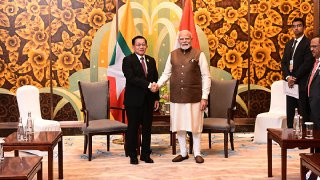
India will send teams to monitor a general election in Myanmar scheduled to begin on Dec. 28, regime media reported on Monday, as New Delhi signals support for a vote that has already been derided by critics as a sham.
Regime leader Min Aung Hlaing met with India’s Prime Minister Narendra Modi on Sunday on the sidelines of the Shanghai Cooperation Organization (SCO) summit in China, a rare international engagement for the general who had largely been shunned by foreign leaders since leading a military coup in 2021.
“At the meeting, they exchanged views on measures to ensure peace and stability in the border regions of both countries, trade promotion, enhancement of friendship and cooperation,” regime media reported.
The military’s ouster of Aung San Suu Kyi’s National League for Democracy (NLD) four years ago, on a pretext of election fraud, has triggered a devastating civil war that has engulfed the country.
Myanmar plans to hold the initial phase of the first general election since the coup in 102 out of a total 330 constituencies on Dec. 28, as part of voting that the regime’s interim administration is seeking to conduct in areas currently held by opposition armed groups.
In a statement on Sunday, India’s foreign ministry said that Prime Minister Narendra Modi hoped the upcoming elections in Myanmar would be “held in a fair and inclusive manner involving all stakeholders”.
A day earlier, Min Aung Hlaing also met with Chinese President Xi Jinping and the two leaders discussed Beijing’s support for the preparations for the polls, regime media reported.
The planned election would occur amid a raging conflict that may make it difficult to conduct. During a nationwide census last year to create voter rolls, regime authorities managed to survey only 145 of the country’s 330 townships.
So far, nine pro-military political parties have registered to contest elections nationwide and 55 parties have signed up at the provincial level, having secured approval from the regime’s Union Election Commission (UEC).
But with parties opposed to the military either excluded or boycotting the polls, western governments and human rights groups see the election as an attempt by the generals to tighten their grip on power by paving the way for proxies to rule.
REUTERS