


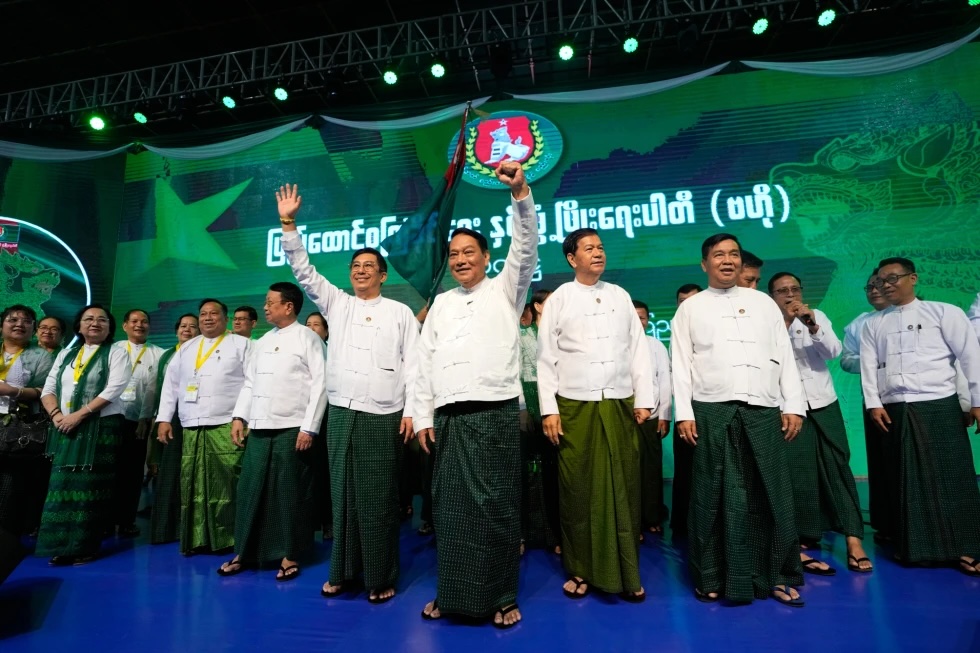
Final results in the military’s 2025-26 elections were released by the Union Election Commission (UEC) on Jan. 28-29. It reported that the Union Solidarity and Development Party (USDP) won a majority of seats in Myanmar’s Pyindungsu Hluttaw, or bicameral legislature, during polls which began on Dec. 28 and ended on Jan. 25.
Htin Kyaw Aye, an independent Myanmar election analyst, told DVB that a USDP victory was predetermined by the military regime, which seized power during the 2021 military coup that reversed the results of the 2020 election landslide victory of Aung San Suu Kyi’s National League for Democracy (NLD) party.
The USDP won 231 out of 263 seats in the Pyithu Hluttaw, or lower house of parliament, and 56 out of 79 seats in the Amyotha Hluttaw, or upper house, following three rounds of voting on Dec. 28, Jan. 11, and Jan. 25, according to the UEC results.
The three-phased election was carried out by the UEC in 263 constituencies for the Pyithu Hluttaw and 73 constituencies for the Ayotha Hluttaw under the First-Past-The-Post (FPTP) electoral system. A Proportional Representation (PR) electoral system was also introduced for the first time.
“The new electoral system introduced by the [UEC] in this election is designed specifically to favour the [USDP],” Htin Kyaw Aye told DVB.
Under FPTP, the candidate with the most votes wins the seat in the constituency, while under PR, seats are allocated based on a total number of votes a political party receives nationwide.
The UEC announced in June that it would be introducing PR into Myanmar’s FPTP electoral system to reflect both direct majority wins and proportional party representation.
“Even though the [UEC] said that they introduced the PR system for inclusion of minority parties, actually they put multiple barriers [up] for these parties to win seats,” Htin Kyaw Aye told DVB.
“These ‘barriers’ included the use of a single ballot for both FPTP and PR systems, the division of smaller electoral blocks for the PR system, and not actually ensuring proportionality between FPTP and PR systems, allowing the majority party to gain more seats even with less [number of] votes,” he added.
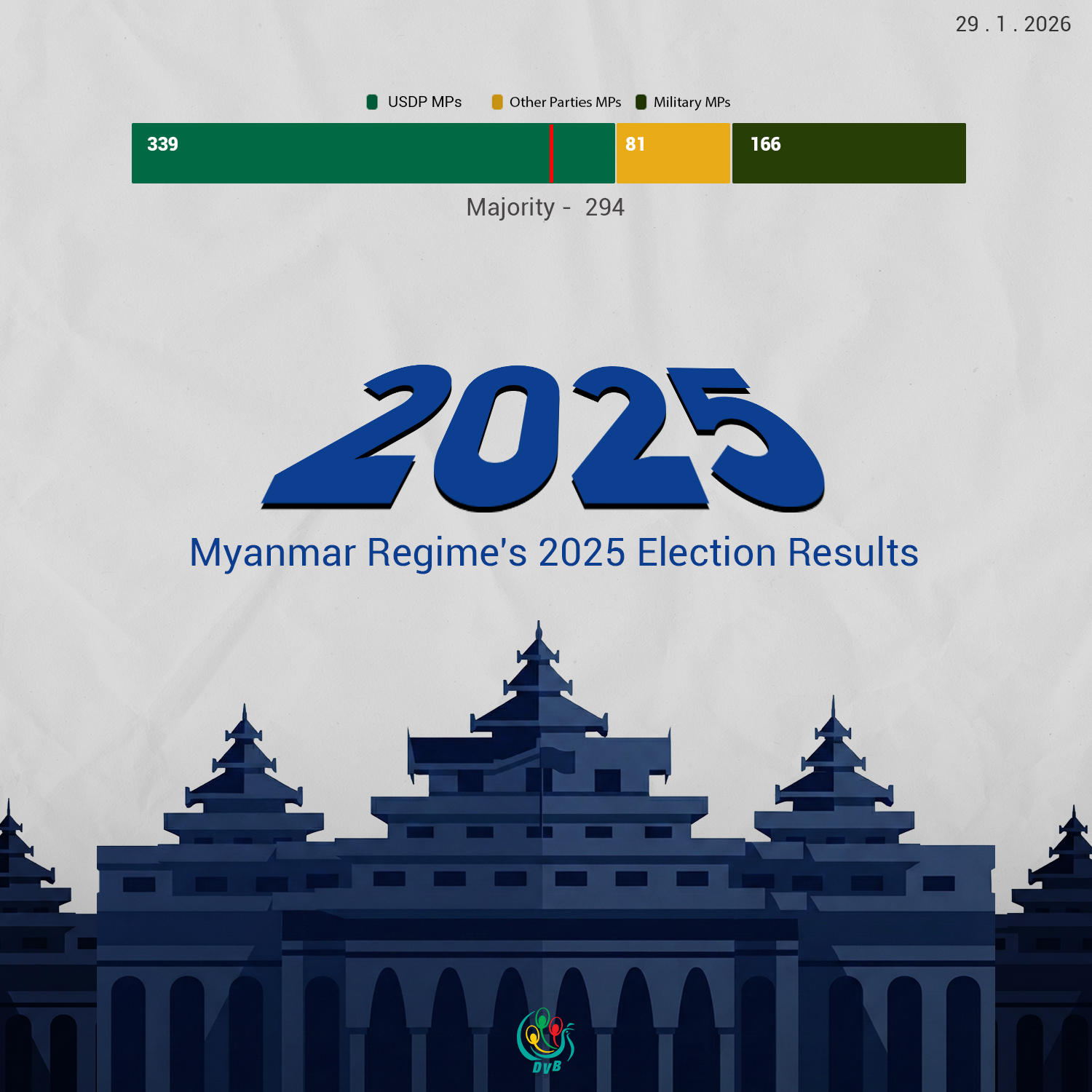
In the Pyitthu Hluttaw, the available 32 seats not won by the USDP went to the Shan and Nationalities Democratic Party (SNDP), which won seven. The Pa-O National Organization (PNO) and the Mon Unity Party (MUP) won five seats each. The National Unity Party (NUP) and the Naga National Party (NNP) won four each.
The Danu National Democracy Party (DNDP), the Kachin State People’s Party (KSPP), the Karen National Democratic Party (KNDP), the Rakhine Nationalities Party (RNP), the Shan-ni Solidarity Party (SSP) and the Inn National League Party (INLP), as well as an independent candidate, won one seat each.
In the Amyotha Hluttaw, the available 23 seats not won by the USDSP went to the NUP with 10, the People’s Party with four, the KNDP and the PNO with two each.
The SNDP, the KSPP, the SSP, as well as the Phalon-Sawaw Democratic Party (PSDP) and the Pa-O National Unity Party (PNUP), won one seat each.
Under the 2008 Constitution, if a political party wins 294 of 586 seats from 263 townships nationwide it can appoint the president. The military is allotted 25 per cent of all seats, or 166, in the legislature
The USDP, established by a previous military regime in 2010, governed Myanmar from 2011-16 during the country’s touted “transition to democracy” before handing over power peacefully to the NLD.
Khin Yi, a former Myanmar Police Chief and government minister, is the current USDP chairperson. Several other former high-ranking military officers are members of the party.
Over 4,900 parliamentary candidates from 57 political parties, including independent candidates, contested the military’s 2025-26 elections. The USDP ran 1,018 candidates nationwide. It was one of six parties capable of running a national campaign.
Voting took place in 263 of Myanmar’s 330 townships with 102 in the first phase, 100 in the second phase, and 61 in the final phase of voting. Polls were unable to be held in 67 townships, according to the UEC.
Voter turnout was around 55 per cent, regime media reported. This is lower than the 70 per cent voter turnout in the previous two elections in 2015 and 2020, considered free-and-fair by international observers.
The regime in Naypyidaw announced on Jan. 29 that it has extended martial law in 63 townships located in Shan, Arakan, Chin, Kachin, Karenni and Karen states, as well as Sagaing, Magway and Mandalay regions, for another 90 days.
Regime leader Senior General Min Aung Hlaing announced martial law in the 63 townships after dropping the four-year-long state of emergency in place since the 2021 coup on July 31, 2025. This paved the way for elections in Myanmar, as polls can be held after a state of emergency is lifted, according to the constitution.
The U.N. Office for the Coordination of Humanitarian Affairs (UNOCHA) in Myanmar reported on Jan. 27 that the humanitarian crisis has continued to worsen due to the conflict that erupted after the 2021 coup. It added that there are now an estimated 3.6 million people displaced from their homes in Myanmar.