


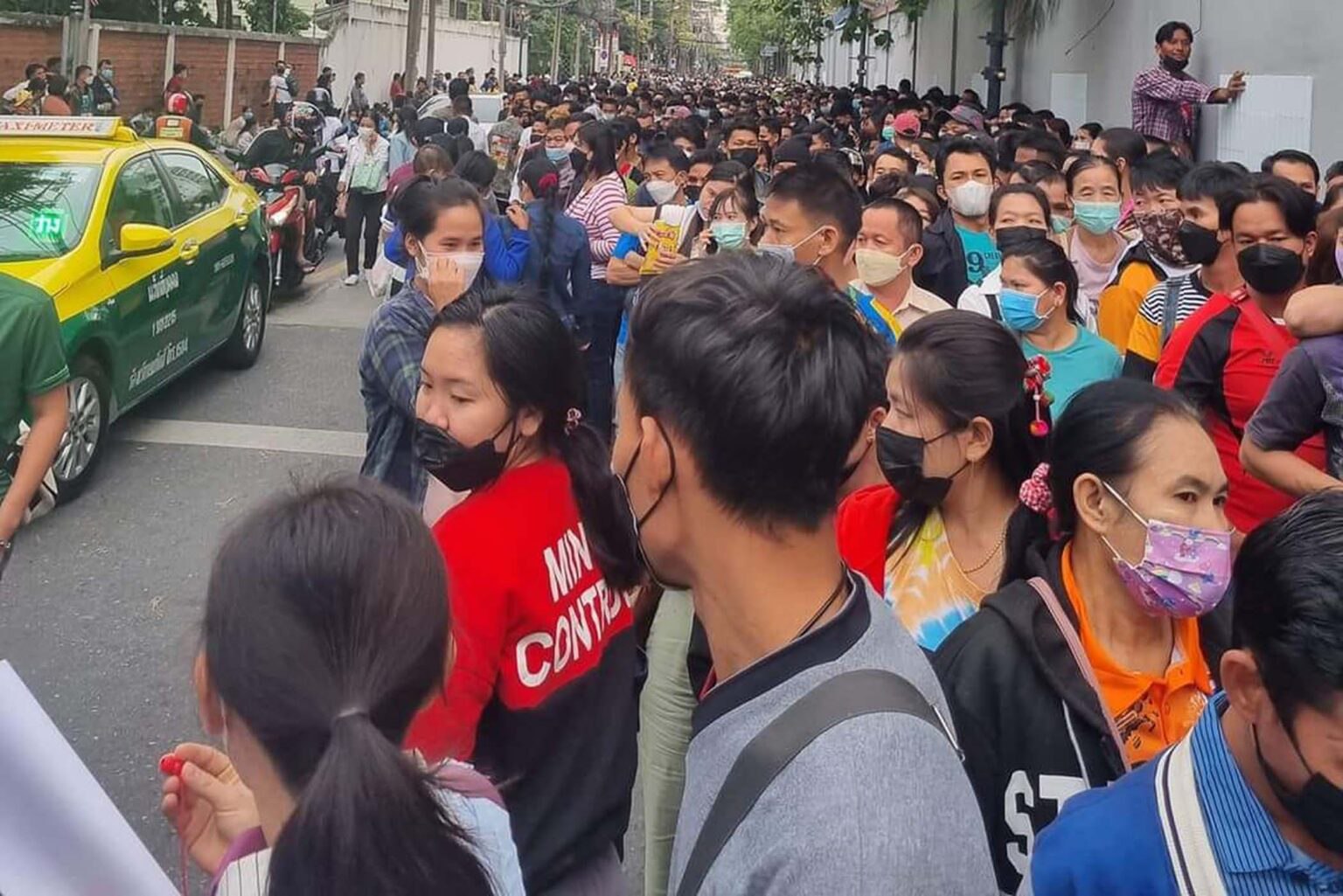
Myanmar citizens living in Thailand told DVB they will not participate in advance polling for the regime elections scheduled to begin on Dec. 28.
“We have no desire to vote because we do not recognize this election or the military’s [legitimacy as a government],” a migrant worker in Thailand told DVB on condition of anonymity.
On Thursday, Myanmar embassies in Thailand, Malaysia, South Korea, India, Germany, and the U.S. announced that citizens overseas can register for advanced voting Aug. 21 to Sept. 8.
The regime stated that Myanmar nationals living in these countries could register by filling out a “Form 15,” an application form available online at the Ministry of Foreign Affairs and Myanmar Embassy websites, or at the consular counters at its embassies.
The instructions state that the “Form 15” can be submitted online, or in person, or by mail, to the relevant embassies with detailed information, including name, current address, email, and phone or WhatsApp numbers, as well as a valid passport attached to the form.
The regime has not yet specified when advanced ballots will be issued to registered Myanmar nationals voting overseas.
The Union Election Commission (UEC) announced that the first phase of voting will take place in 102 townships on Dec. 28.
“We’ve been talking to each other and raising awareness [about how we can] oppose the elections,” a student from Myanmar in South Korea told DVB.
Many Myanmar nationals expressed concern that embassies are likely to impose stricter measures on passport extensions and other related documents, if they do not vote.
The regime’s embassy in Bangkok, Thailand, has restricted passport renewals for students in short-term language schools, and non-accredited educational institutions, which has reportedly forced many to return to Myanmar.
It stated the measure was to prevent “misuse” of education visas, but rights groups and migrant communities view it as a way for the regime to increase pressure on those trying to avoid military conscription, which was enforced on Feb. 10, 2024.
“I am worried about not being able to extend my passport [in the future], but so far I haven’t seen a direct threat linking it to voting,” a Myanmar student living in Thailand told DVB.
The 2014 Myanmar Population and Housing Census found that 2.02 million citizens, or roughly four percent of the total population, were living abroad. Since the 2021 coup, that number has sharply increased to around 25 percent of the country’s 54 million people, according to U.N. estimates.
On July 31, Japan’s Ministry of Foreign Affairs issued a statement urging the regime to release all political prisoners, and engage in dialogue with opposition groups before holding elections.
On July 11, the Association of Southeast Asian Nations (ASEAN) Foreign Ministers’ Meeting in Kuala Lumpur, Malaysia, declared that elections in Myanmar were “not a priority” and stressed that the regime should implement the ASEAN Five-Point Consensus, which demands the release of all political prisoners and dialogue with anti-regime groups.
On June 10, the U.N. Special Envoy for Myanmar Julie Bishop warned the General Assembly that elections without any political reforms in Myanmar, or an end to the conflict since the 2021 military coup, risks deepening instability.
Myanmar’s previous two general elections in 2020 and 2015 were landslide victories for Aung San Suu Kyi’s National League for Democracy (NLD). Suu Kyi, Myanmar’s State Counsellor, was jailed along with President Win Myint during the military coup on Feb. 1, 2021. They’ve been held incommunicado by the regime since then.
The NLD refused to re-register with the UEC for the regime elections, as most of its members are either in prison, in hiding, or have died in the custody of the military, or its prison authorities.
Regime leader Min Aung Hlaing has accused the NLD of voter fraud in the 2020 elections and has cited this several times as the reason his military seized power in 2021.
Fifty-eight political parties have registered with the UEC and 10 of them, including the pro-military proxy Union Solidarity and Development Party (USDP), will contest polls nationwide.
The USDP governed Myanmar under a hybrid military regime from 2010-15 until it faced overwhelming defeats to the NLD in the two previous elections.