


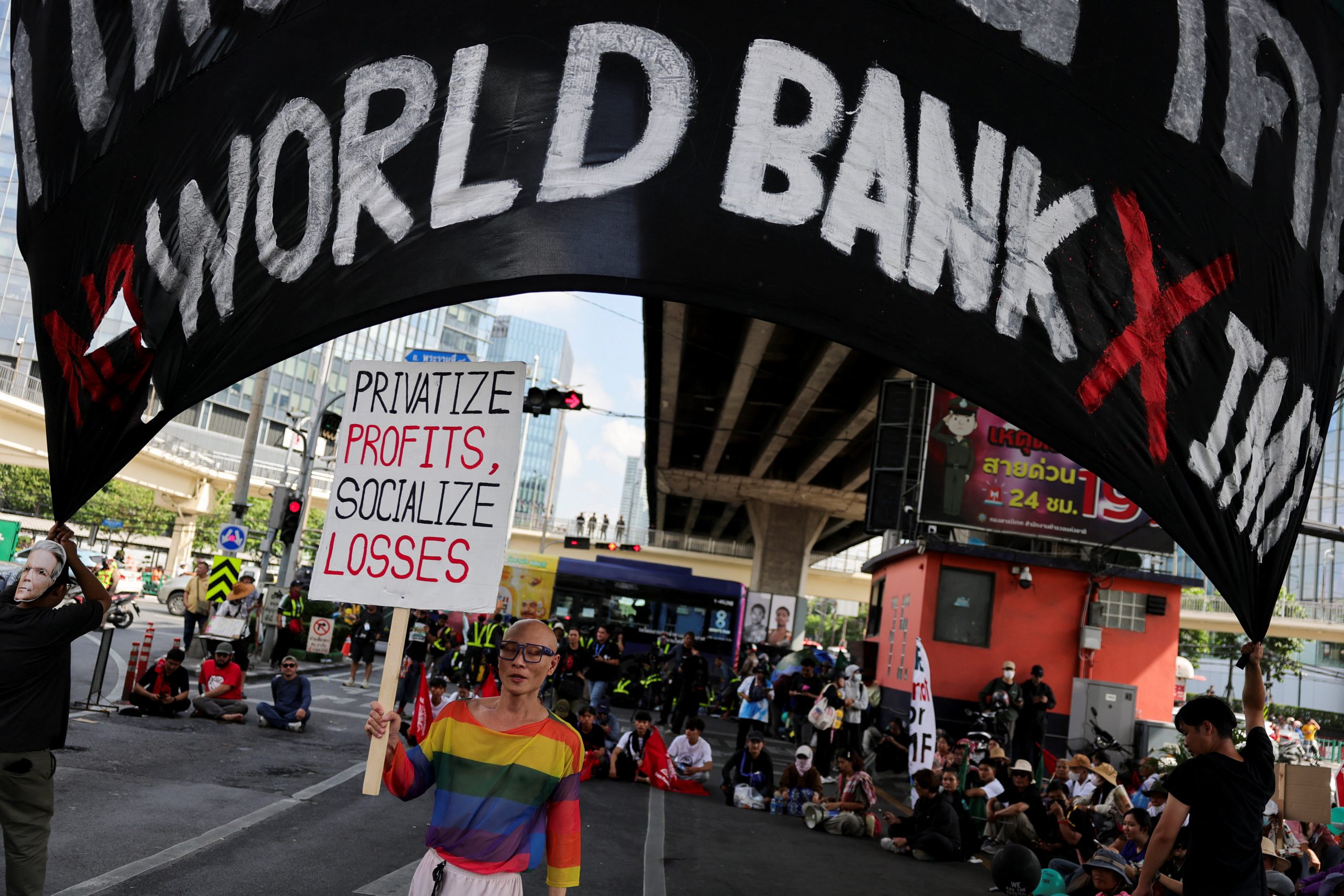
A delegation of Myanmar civil society organizations (CSOs) attending the 2026 IMF–World Bank Annual Meetings in Bangkok, Thailand, released a joint statement demanding that the World Bank Group establish a “formal dialogue” under its 2026–2030 Fragility, Conflict, and Violence (FCV) Strategy on Thursday.
The CSOs urged the institution to partner directly with local resistance and democratic governance networks across Myanmar rather than the regime in Naypyidaw.
“The bank must engage with civil society operating outside military control to give input into the operationalization of the 2026-2030 strategy into the Myanmar context. So, the bank can implement its humanitarian responses through third parties with integrity, safeguards and meaningful objectives,” said Khin Ohmar, the founder of Progressive Voice.
During an Oct. 12 townhall meeting, the delegation directly questioned World Bank Group President Ajay Banga over the Bank’s failure to engage non-regime opposition groups to ensure aid is distributed equitably without being weaponized.
The World Bank has maintained an active presence in Myanmar since 2010—when the country held its first multi-party parliamentary elections—but scaled down its in-country programming following the 2021 military coup.
Over the last five years, the Bank has operated six humanitarian and resilience projects executed through third-party international humanitarian organizations.
Research group Nyan Lynn Thit Analytica emphasized that the Bank must co-deliver basic health and social services alongside local resistance and civil society groups capable of maintaining accountability, contrasting them with the regime accused of weaponizing aid distribution.
Pointing to disaster response following the March 2025 earthquake—which killed at least 4,477 people nationwide—the delegation cited rapid local aid delivery within 48 hours as proof that independent civil networks represent a reliable, accountable lifeline for vulnerable communities.
Additionally, Nyan Lynn Thit Analytica highlighted that over 100,000 youth have been forced into military conscription since the regime began enforcing the law in February 2024 while schools and clinics have been increasingly bombed by the regime.
“The Bank cannot reach these children and youth through junta-controlled systems. [It] must work with the local governance actors and civil society that are capable of co-delivering such services with safeguards and accountability,” said Et, program manager at Nyan Lynn Thit Analytica.