


The regime’s Union Election Commission (UEC) has scheduled elections in 274 out of Myanmar’s 330 townships with voting to take place in three phases: Dec. 28, Jan. 11, and Jan. 25, 2026. The National League for Democracy (NLD) party, which won landslide victories in the 2015 and 2020 elections, deemed free and fair by international election observers, was dissolved by the UEC for not re-registering.
State Counsellor Aung San Suu Kyi and President Win Myint have been held in detention since the military coup on Feb. 1, 2021. The NLD has stated that 102 party members, including two members of parliament elected in 2020, have been killed since 2021. It added that 1,905 of its members have been arrested, including 144 members of parliament elected in 2020.
Several NLD members, who were not arrested or killed by the military, have joined the National Unity Government (NUG). Both the NLD and the NUG have rejected the regime’s 2025-26 elections.
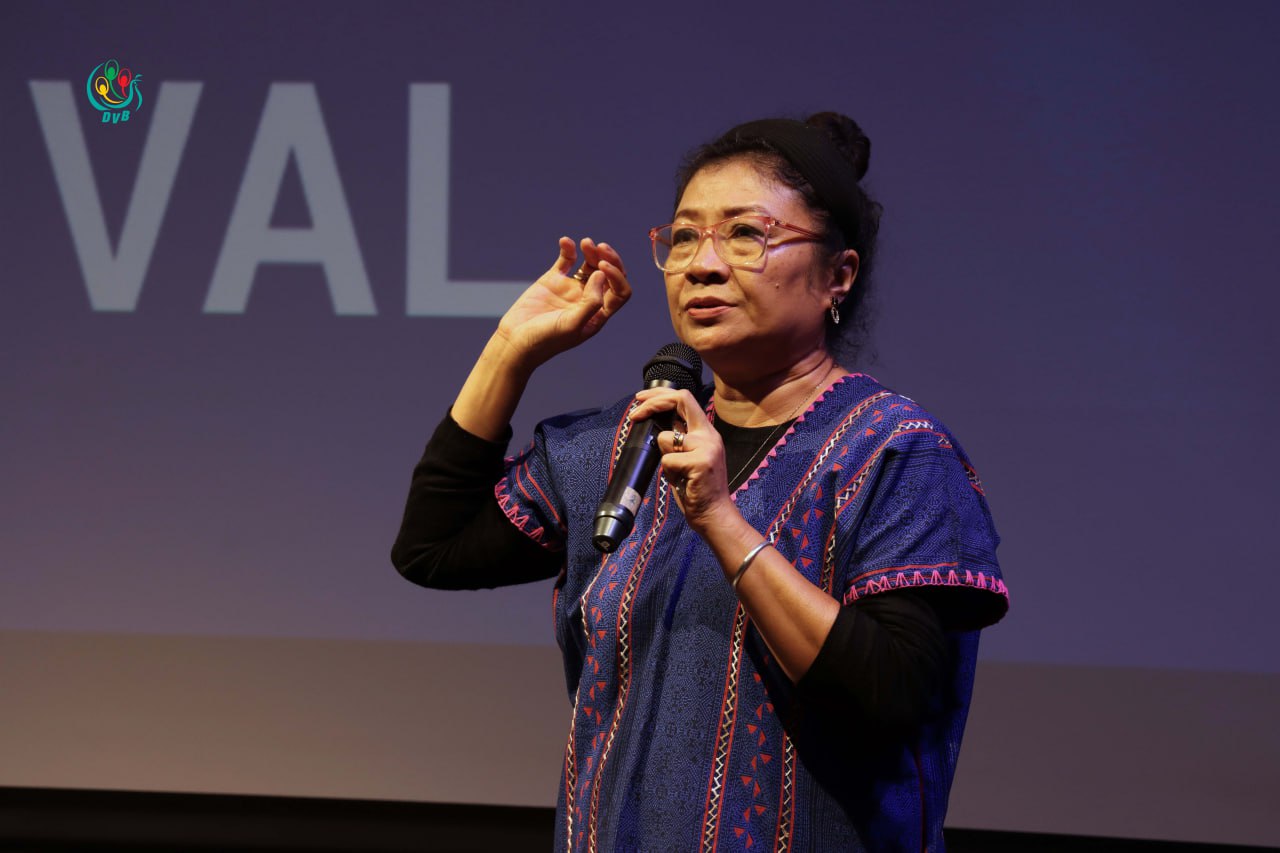
Naw Susanna Hla Hla Soe was an NLD member of parliament re-elected in 2020 but ousted from her job during the 2021 coup. She served from 2021-25 as the NUG Minister of Women, Youth and Children’s Affairs.
“I hope the international community understands the real situation. This [election] is not free and fair. And this is just [military] taking legitimacy. So do not fall into the trap and stand with the people. Listen to the voice of the people,” Naw Susanna Hla Hla Soe told DVB, adding that she’s now retired but will still advise the NUG.

Members of the Burma Affairs and Conflict Study (BACS), a research organization based in Thailand, spoke to DVB about its new report on the regime elections called Respect Myanmar.
“The majority of our people are forced to leave the country, with millions now in Thailand. We believe their voices reflect the true situation inside Myanmar. Furthermore, they can speak more freely about political issues here without the immediate fear for their security that they would face back home,” said Kristen, the BACS director.
BACS researchers visited 14 cities in 11 provinces in Thailand and conducted interviews and group discussions with 209 Myanmar migrant workers.
According to the Respect Myanmar report, 98 percent of Myanmar citizens in Thailand will not vote in the regime elections. The remaining 2 percent may vote, but believe the election will be neither free nor fair.
“While there is a firm desire not to vote, there are also pressures, current hardships, and fears about how much worse things might get,” said Lwan Wai, a BACS field researcher.
Respect Myanmar also highlights a growing fear that the international community might recognize the results of the regime elections deemed a sham by most western countries. This would be a major step for the regime, which seized power in 2021, in gaining international legitimacy.
Read more and check out our photos

The U.N. Human Rights Chief Volker Türk warned that holding elections during “conflict, intimidation and arbitrary arrests” in Myanmar gives no space for meaningful citizen participation.
“These elections are clearly taking place in an environment of violence and repression,” Türk, the U.N. High Commissioner for Human Rights, stated in a press release on Dec. 23. “There are no conditions for the exercise of the rights of freedom of expression, association or peaceful assembly.”
The U.N. has also raised concerns over the introduction of electronic-only voting combined with expanded surveillance, including artificial intelligence and biometric tracking. It warned this would further erode trust in the electoral process.
Stéphane Dujarric, the U.N. Secretary-General spokesperson, told media at U.N. headquarters that the Special Envoy for Myanmar Julie Bishop recently completed her third visit to Naypyidaw, where she met with regime leader Min Aung Hlaing.
Dujarric added that Bishop continues to call for a cessation of violence to enable humanitarian response and recovery following the March 28 earthquake. She’s reportedly working toward a “Myanmar-led, inclusive and peaceful solution.”
Bishop also briefed the U.N. Security Council with Othman Hashim, the Association of Southeast Asian Nations (ASEAN) 2025 Chair Malaysia Special Envoy for Myanmar, in a closed-door meeting on Dec. 22.
The 60-day electoral campaign ends today amid heightened security in Myanmar. Candidates, voters, and poll workers fear the threat of election violence. At least 267 people have been charged under the new Election Protection Law, 49 have been arrested and nine have been convicted, since it was enacted on July 29.
“It is unacceptable to use coercive power or authority to force people to vote. Whether people decide to vote or not, and whether they like or dislike an electoral system that urges them to vote, should be their choice.” an independent election observer told DVB on the condition of anonymity.
Watch our regime election special on DVB English News YouTube or Spotify. Listen to it wherever you get podcasts. Follow & Subscribe.