


Guest contributor
James Shwe
Myanmar’s pro-democracy movement is being dragged into scandal-driven arguments at the exact moment the junta is locking in a new “civilian” shell, expanding regional re-engagement channels, and working with international partners to evade sanctions.
In late February two stories dominated Myanmar discourse: the surrender of Bo Nagar and the corruption controversy that led to the resignation of Kyi Pyar.
Bo Nagar surrendered on February 18 and was reportedly transported by military helicopter to the Northwestern Command headquarters—an outcome that looks less like a chaotic collapse and more like a managed extraction that rewards the junta with intelligence and propaganda value.
Days later, Kyi Pyar resigned amid a public corruption controversy, feeding the junta’s favorite poison: the belief that every democratic institution is just another corrupt faction.
Whether these distractions were manufactured or simply exploited, their effect is identical: our limited attention shifts from systems to personalities, from strategy to outrage, and from institution-building to infighting. That is the junta’s preferred battlefield.
While we argue, the generals legislate permanence
The junta’s post-election machine is moving quickly toward a new parliament and a new “civilian” front. Myanmar’s new parliament is scheduled to convene on March 16 (lower house) and March 18 (upper house).
Reporting indicates retired brigadier general Khin Yi is positioned to become speaker—a reminder that the new “civilian” structure is still supervised by generals.
But the most consequential move is the architecture of permanent control. On February 3, Min Aung Hlaing enacted the Union Consultative Council (UCC) law.
Rights monitors assess the UCC as an extra-constitutional mechanism to cement military dominance across governance and security—no matter who wears the ceremonial titles.
This is how military regimes “modernize”: not by democratizing, but by becoming administratively legible enough for outsiders to re-engage.
The ASEAN normalization pipeline and Western opportunists
While Myanmar debates scandal, regional re-engagement is becoming routine. The clearest warning sign comes from the Philippines, the 2026 ASEAN Chair.
In a late February interview with Nikkei Asia, Philippine Foreign Affairs Secretary Maria Theresa Lazaro revealed that ASEAN is deliberating a shift toward a “permanent” special envoy for Myanmar, replacing the current rotating system.
A “permanent envoy” sounds like a harmless bureaucratic upgrade, but in practice, it institutionalizes routine engagement with Naypyidaw, creating a diplomatic pipeline that treats the junta like a normal, albeit troubled, government.
Lazaro did note that ASEAN has not endorsed the junta’s sham elections and revealed that her request to check on the health of detained civilian leader Aung San Suu Kyi was politely denied.
But engaging a “multi-stakeholder” process while installing a permanent envoy framework allows ASEAN to slowly reintegrate the junta into the regional fold.
This regional softening gives cover to Western opportunists. Reuters previously reported that Myanmar signed deals with Washington lobbyists—including DCI Group and the McKeon Group—aimed at rebuilding U.S. relations and building ties with Congress.
That is reputational laundering: turning atrocity into “access,” and turning access into profit.
The jet fuel pipeline: How the junta evades sanctions
While social media focuses on the National Unity Government (NUG) corruption allegations, the junta is successfully building international supply chains to fuel its war machine.
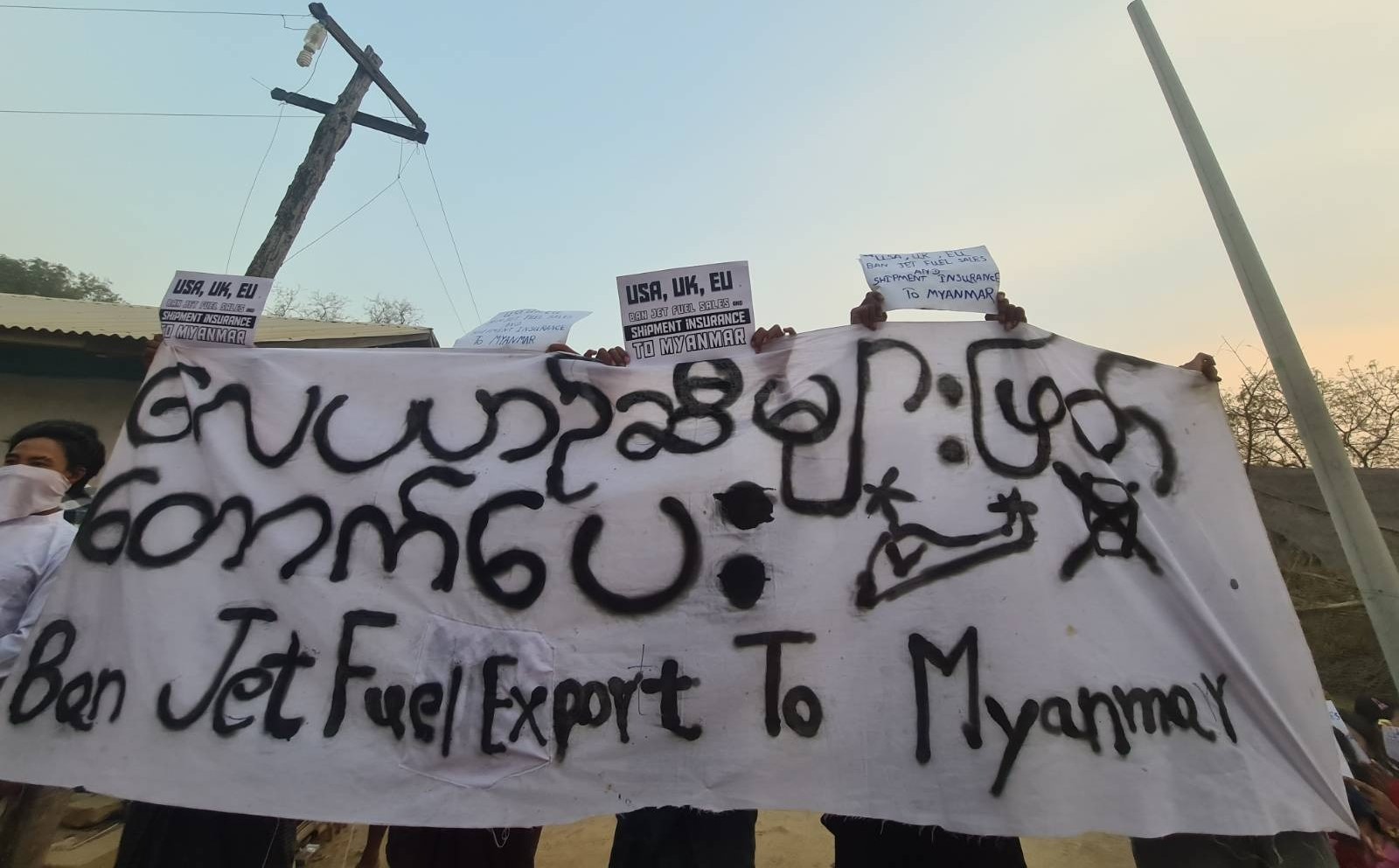
On February 23, the whistleblower group Justice for Myanmar revealed that despite existing Western sanctions, the junta’s jet fuel imports almost doubled between 2024 and 2025, rising from 64,562 to 106,604 metric tons.
It detailed how a shadowy supply chain stretching from Vietnam to Iran is enabling the military’s escalating nationwide airstrikes against civilians.
Yadanar Maung, the group’s spokesperson, rightly pointed out that the involvement of Vietnam highlights the failure of ASEAN to constrain its own members.
The group is now demanding the E.U., U.K., U.S., Canada, and Australia rapidly impose new, coordinated sanctions targeting the state-owned Myanma Petrochemical Enterprise (MPE), as well as specific vessels and owners operating out of Vietnam, the U.A.E., and the Marshall Islands.
The UN, EU, and the battle for accountability
Despite the junta’s evasion tactics, international accountability mechanisms are advancing—and creating diplomatic friction.
Earlier in February, judicial authorities in Timor-Leste opened unprecedented legal proceedings under the principle of universal jurisdiction against 14 senior Myanmar military officials, including Min Aung Hlaing.
This is based on a complaint filed by the Chin Human Rights Organization (CHRO). The junta retaliated by expelling Timor-Leste’s top diplomat from Yangon on February 20.
On February 25, Timor-Leste President José Ramos-Horta met with CHRO and publicly clarified the independence of his country’s judiciary, suggesting Myanmar’s junta had “overreacted and created a storm in a tea cup.”
Ramos-Horta pointedly reminded Min Aung Hlaing of his failure to implement the ASEAN Five-Point Consensus.
Similarly, the E.U. delivered a crucial statement at the U.N. Human Rights Council on February 27.
The E.U. categorically rejected the junta’s recent elections as a sham designed to legitimize the military and condemned the forced conscription of Rohingya civilians.
Crucially, the E.U. threw its full weight behind international accountability, explicitly supporting the genocide case against Myanmar at the International Court of Justice and universal jurisdiction proceedings like those in Timor-Leste.
However, human rights watchdogs are making it clear that accountability cannot only apply to the junta.
On February 25, Burma Campaign UK urged the British government to sanction the Arakan Army (AA), citing a pattern of grave abuses—including summary executions, beheadings, torture, and sexual violence—against both regime soldiers and civilians, particularly the Rohingya.
Mark Farmaner, the group’s director, warned that allowing the AA to commit abuses with impunity “only encourages them to think they can get away with more.”
This underscores that international support for the revolution is strictly conditional on adherence to human rights. All the resistance actors should be well aware of this.
The ultimate distraction: A new Middle East war
As if the junta’s maneuvering was not enough, Myanmar advocates must now face the reality of a massive global distraction. On February 28, the United States and Israel launched major, coordinated airstrikes across Iran, targeting military infrastructure and reportedly striking the compound of Supreme Leader Ali Khamenei.
This new, massive escalation in the Middle East will thoroughly dominate global headlines, U.S. congressional attention, and U.N. Security Council meetings for the foreseeable future.
However, it also presents a tactical opportunity: because the junta relies on an Iran-Vietnam pipeline for its jet fuel, the war could disrupt the military’s supply chains, severely limiting its ability to conduct airstrikes.
But politically, the NUG and the revolution will have a much harder time getting the attention of the U.S. State Department and the broader international community.
With global attention completely fractured, Myanmar’s resistance can no longer afford to squander time on internal scandals.
The unity counter-model: Learning the lessons of Bo Nagar
Against the junta’s strategy of division, regional normalization, and the sudden shift in global attention toward Iran, the democratic movement must project institutional cohesion. If the Bo Nagar disaster showed the fatal flaw of personality-driven warlordism, this week we saw the antidote.
On February 27, the NUG and the Spring Revolution Alliance (SRA) held a formal conference online. Senior officials, including Prime Minister’s Office Minister Zaw Wai Soe and Defense Minister Yee Mon, met with the full SRA leadership committee.
What happened in that meeting represents a mature leap forward for the revolution. According to a public summary by SRA leader Maung Saungkha, the NUG explicitly clarified its policy toward non-NUG armed groups.
Instead of demanding strict subordination—the friction point that led to armed clashes with Bo Nagar’s Burma National Revolutionary Army (BNRA) in Pale Township—the NUG and SRA agreed to a framework of mutual recognition and “alliance.”
Crucially, they committed to building a “reconciled unity” and agreed that any future conflicts between partner organizations must be resolved through negotiation, not fighting.
This is exactly how a federal army is built. The revolution is shifting away from a rigid top-down command structure and toward a coordinated coalition based on mutual respect.
The unity incentive: Make cooperation cheaper than rivalry
But political unity cannot survive on goodwill alone; it must be backed by an incentive structure. The NUG and SRA have laid out the political framework for unity; now, the international community must provide the financial framework to secure it.
U.S. FY2026 appropriations analysis has discussed roughly $121 million USD in Burma-related assistance. If delivered through principled cross-border channels, this can save lives.
However, without smart design, large funding streams can unintentionally fuel the exact kind of fragmentation we saw with Bo Nagar, rewarding whoever competes hardest for donor attention rather than whoever coordinates best.
That is why a unity incentive must be explicitly built into aid programming: prioritize broad-based coalitions, condition larger funding on demonstrable cooperation (joint needs assessments, shared logistics), enforce strict “no benefit to the junta” safeguards, and demand strict adherence to human rights protections.
This does not politicize aid; it prevents the junta from weaponizing fragmentation and ensures assistance strengthens the very alliance structures the NUG and SRA are currently building.
What Myanmar is really being distracted from
Myanmar is not only distracted from news; it is distracted from decisions.
- The junta is building an extra-constitutional system (the UCC) to guarantee permanent control behind a “civilian” façade.
- ASEAN is discussing a “permanent envoy” that will normalize routine diplomatic engagement with Naypyidaw.
- The junta is importing jet fuel through a shadowy supply chain from Vietnam to Iran—a pipeline that could be affected by the sudden outbreak of war against Iran.
- Accountability battles are escalating globally, from the E.U. at the U.N. to Timor-Leste’s universal jurisdiction courts, while rights groups demand sanctions on both the junta and the AA.
- Aid is coming, diplomacy is moving, and unity must be engineered through a real unity incentive embedded in international assistance.
The generals understand attention is a battlefield, and they are fighting to win it. With a new war in the Middle East demanding the world’s focus, our response must be to drag the conversation back to structures—laws, diplomacy, sanctions enforcement, aid design—and to reward verifiable coordination, like the NUG-SRA summit, so visibly that scandal can no longer fracture the revolution on demand.
James Shwe is a Myanmar-born democracy advocate and independent political analyst based in the United States.
DVB publishes a diversity of opinions that does not reflect DVB editorial policy. We’d like to hear what you think about this or any of our stories: [email protected]