


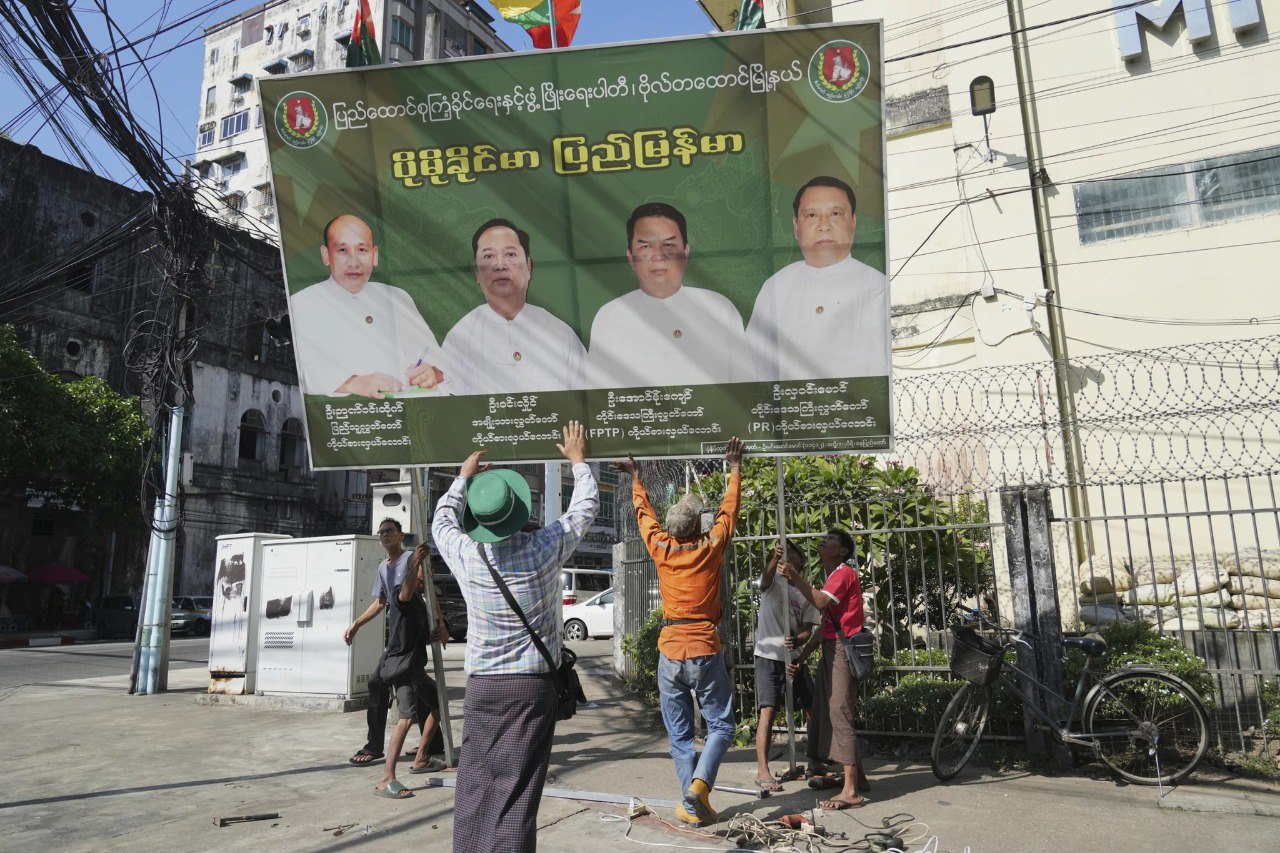
Residents and resistance force members across Myanmar told DVB that most of the 100 townships, where the second round of voting in the military’s elections is set for Jan. 11, have seen heightened conflict during the electoral process.
“There is fighting in different parts of the country between the junta and the revolutionary forces. So, the junta should not expect the elections to be peaceful,” Htin Kyaw Aye, an independent Myanmar election analyst, told DVB. “The junta should expect that the revolutionary forces will conduct attacks in response to this election.”
The regime’s Union Election Commission (UEC) is holding polls in 100 townships in Kachin, Karenni, Karen, and Shan states, as well as Sagaing, Tanintharyi, Bago, Magwe, Mandalay, Mon, Yangon, and Ayeyarwady regions on Jan. 11.
Voting in the capital Naypyidaw was completed during the first phase, as were the limited polls in Chin and Arakan states—restricted to only five townships in total due to ongoing conflict—also concluded on Dec. 28.
In Bago Region, the People’s Defence Force (PDF) told DVB that it tried to undermine the elections by raiding Taw Kywe Inn town in Kyauktaga Township on Friday.
The PDF cut of military reinforcement routes along the Yangon–Mandalay Road. Kyauktaga, not included in the 12 townships scheduled for second phase voting, is located 58 miles (94 km) north of the region’s capital Bago.
Taw Kywe Inn is located 120 miles (193 km) south of Naypyidaw and 133 miles (214 km) north of Yangon.
Voting will take place in 16 townships of Yangon Region, including Bahan, Pabedan, Latha, North Dagon, Dawbon, Pazundaung, Hlaing, Shwepyitha, Htantabin, Hlegu, South Okkalapa, Kyimyindaing, Insein, Kungyangon, Kawhmu, and Coco Islands, also known as Cocokyun, on Jan. 11.
In Karenni State, a member of the Karenni Nationalities Defence Force (KNDF) told DVB that fighting against the military has been ongoing in Demoso and Hpruso townships, which are included in the second round of voting on Jan. 11.
The KNDF member added that resistance forces do not recognize the military-run elections and will continue to fight regime forces. The elections will conclude in Karenni State on Jan. 11. There will be no third round of voting there on Jan. 25 – the final round before all ballots are counted and official results will be released by the UEC.
Loikaw and Bawlakhe, where the first round of voting was held on Dec. 28, are two of four townships, including Demoso and Hpruso, under regime control. The UEC is unable to hold its elections in Hpasawng, Mese and Shadaw townships, which were seized by Karenni resistance forces since the 2021 military coup. Karenni State has a total of seven townships.
In Magway Region, residents of Gangaw Township told DVB that airstrikes injured three people and destroyed monastery buildings in Myinza village on Jan. 7. Gangaw, included in the 11 townships where voting is scheduled on Jan. 11, is located 221 miles (355 km) north of the region’s capital Magway.
In Sagaing Region, at least two civilians were injured and several homes were damaged by an airstrike in Wuntho Township on Jan. 8, residents told DVB. Wuntho, one of 11 Sagaing townships where voting is scheduled on Jan. 11, is located 182 miles (291 km) north of the region’s capital Monywa.
Airstrikes were also reported in Sagaing’s Chaung-U, located 14 miles (23 km) south of Monywa, as well as in Mingin, 91 miles (147 km) northwest of Monywa, Jan. 7-8. Both townships are included in the second round of voting on Jan. 11.
Seventeen townships in Shan State have polls scheduled for the second round of voting. Mandalay and Ayeyarwady regions will have voting in nine townships, while Mon State will have voting in five townships on Jan. 11.
In Myanmar’s northernmost Kachin State and southernmost Tanintharyi Region, voting will take place in three townships each, confined to urban areas under military control. In Karen State, voting will be held in two townships on Jan. 11.
The first phase of the election was held in 102 townships on Dec. 28. A third and final phase of voting is scheduled to take place in 63 townships on Jan. 25.
The UEC has scheduled elections in 265 of Myanmar’s 330 townships. Sixteen townships, primarily in Chin, Arakan, and Karenni states, are being limited to polling in urban areas only, while 65 townships across Sagaing, Magwe, and Kachin will hold no elections at all.
The UEC claimed a voter turnout of 52 per cent—amounting to roughly six million ballots cast—though analysts noted this was significantly lower than the 70 percent turnout seen in the 2015 and 2020 elections, which were won by the National League for Democracy (NLD) led by Aung San Suu Kyi.
Senior NLD leaders, including Suu Kyi and President Win Myint, have been held in detention by the military since the coup on Feb. 1, 2021. Both are now serving lengthy prison sentences handed down by regime courts.
The NLD was disbanded by the UEC in 2023 for not re-registering despite the fact most members have fled underground or into exile to avoid arrest and prosecution by the regime in Naypyidaw.
Preliminary results released by the UEC following the end of phase one voting shows the military-proxy Union Solidarity and Development Party (USDP) winning 88 out of 96 seats in the Pyithu Hluttaw, or lower house of parliament, and 10 out of 18 seats in the Amyotha Hluttaw, or upper house.
The USDP governed Myanmar from 2010-15 under a hybrid military regime but lost to the NLD in back-to-back landslide election victories in 2015 and 2020, the results of which were overturned in the 2021 coup.
“The results of these elections, either the first phase or successive ones, we do not consider to be credible, representative or meaningful. They’re not a step toward a democratic transition or return to a return to peace. This is very much a process managed by the military for its own benefit,” said Amael Vier, an electoral analyst at the Asian Network for Free Elections (ANFREL).
The National Unity Government (NUG), which represents lawmakers ousted in the 2021 coup, along with the Women’s League of Burma (WLB), which is a coalition of women’s organizations working for gender equity, and Progressive Voice (PV), a human rights advocacy group, have all called on citizens to boycott the military’s “sham” elections.
The ASEAN Parliamentarians for Human Rights (APHR), along with members of the European Parliament and the Special Advisory Council for Myanmar (SAC-M), an independent group of international human rights experts, rejected the regime elections and urged the international community not to recognize the results on Dec. 29.