


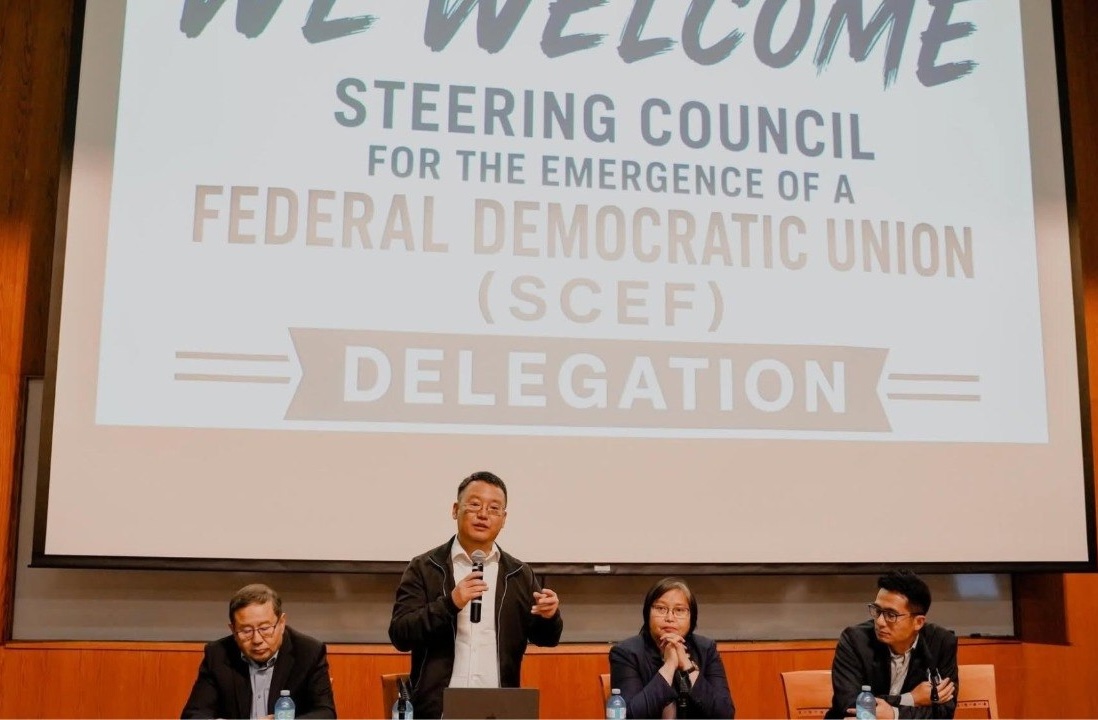
Myanmar’s new Steering Council is an interim body meant to guide the revolution toward a federal democratic union—not a replacement for the NUG, ethnic nationalities, or a future elected government.
Guest contributor
James Shwe
More than five years after the military coup, Myanmar’s people continue to pay an unbearable price: airstrikes, displacement, arrests, destroyed homes, ruined schools and clinics, and a collapsing economy. Yet the military has not regained the legitimacy it lost when it overturned the people’s vote in 2021.
The resistance has endured because it is broader than any one organization. It is carried by ethnic revolutionary organizations, the People’s Defense Force, elected representatives, striking civil servants, women, youth, civil society, local administrators, and communities across the country.
That diversity is a strength. But it also poses a difficult question: How can the resistance coordinate its political, military, and federal goals without repeating Myanmar’s old system of centralized power?
The answer being developed is the Steering Council for the Emergence of a Federal Democratic Union, or SCEF.
The name explains its purpose
SCEF’s name tells the public what it is—and what it is not.
It is a Steering Council. Its role is to guide, coordinate, and keep the revolution moving in a common direction. It is not a final government or a new institution claiming all authority.
It is for the emergence of a federal democratic union. This matters just as much. Myanmar has not arrived at federal democracy.
The country remains in a revolutionary struggle, and the work ahead is enormous: ending military rule, protecting civilians, establishing federal arrangements, creating civilian control of armed forces, delivering justice to victims, drafting a new constitution, and eventually holding free elections.
A federal democratic union cannot simply be declared. It must be built through agreement, participation, and shared power.
SCEF is not the federal democratic union. It is the interim body meant to steer Myanmar toward one.
SCEF is not replacing the NUG
The National Unity Government remains a vital democratic institution. Since the coup, it has carried the people’s democratic mandate, represented Myanmar internationally, supported public services and the Civil Disobedience Movement, and worked toward a federal democratic future.
But the NUG was never meant to be the sole source of authority in a future federal Myanmar. Ethnic revolutionary organizations administer and defend territory.
Local bodies provide services. Resistance forces operate across the country. Women, youth, civil society, and affected communities have all shaped this revolution.
SCEF recognizes this reality. It brings the NUG and the Committee Representing Pyidaungsu Hluttaw (CRPH) together with major ethnic revolutionary organizations—including the Kachin, the Karen, the Chin, and the Karenni—in a collective framework built on three pillars: states and ethnic revolutionary organizations; the people and democratic representatives; and women.
The NUG is not being removed. It is being integrated into a broader model of collective leadership and shared sovereignty.
The simplest explanation is this:
The NUG is a key democratic institution. SCEF is the common table where the NUG, ethnic revolutionary organizations, and other pillars of the revolution coordinate the next stage.
Not a centralized government
SCEF is not a government that replaces ethnic administrations, local authorities, or community institutions in liberated areas. It is an interim coordinating body for a period in which Myanmar has not yet completed its transition.
Its task is to align political, military, federal, administrative, and diplomatic work; reduce fragmentation; and prepare for federal transitional arrangements.
Its stated objectives include removing the military from politics, abolishing the 2008 Constitution, putting armed forces under elected civilian command, creating a new federal democratic constitution, and pursuing transitional justice.
The public should expect coordination—not slogans. SCEF should improve joint strategy, present clearer common positions internationally, help prevent a political vacuum, and prepare for the day when the military no longer controls Myanmar’s future.
Unity requires accountability
SCEF’s success depends on whether it practices the federal values it promotes.
Myanmar cannot replace military centralization with another centralized authority. A real federal democracy requires shared sovereignty between the Union and states or federal units, respect for ethnic equality and self-determination, meaningful participation by women, and institutions accountable to the people.
The public has every right to ask how decisions will be made, how the three pillars will function, whether women will have real authority, how communities will be consulted, and what prevents the return of top-down rule.
These are not attacks. They are necessary demands for accountability.
Reject sabotage, not criticism
The junta will attack SCEF because a coordinated resistance threatens its survival. Its propaganda will claim that the NUG is being weakened, ethnic organizations are being controlled, the resistance is divided, or federalism will destroy the country.
These are familiar divide-and-rule tactics.
But negative propaganda may also come from people who fear losing political relevance, status, access, or influence in a more inclusive movement. Some will portray every disagreement as a crisis, spread anonymous rumors, or attack individuals rather than engage with policy.
There is a clear difference between criticism and sabotage.
Criticism asks: How will SCEF be transparent, inclusive, accountable, and federal in practice?
Sabotage spreads unverified claims, manufactures division, turns compromise into betrayal, and undermines public confidence because some individuals fear that collective leadership leaves less room for personal influence.
The public should reject both blind loyalty and reflexive cynicism. Support SCEF, but demand results. Defend unity, but do not silence accountability.
Share verified information from official SCEF, NUG, ethnic revolutionary organization, and credible independent-media sources—not anonymous posts designed to create distrust.
What people can do
People inside and outside Myanmar can strengthen this transition by supporting verified humanitarian and community-led programs for displaced people, health care, education, civil society, and CDM families.
Diaspora communities should urge governments to engage with Myanmar’s democratic and federal resistance institutions—not legitimize the military’s political façade. Advocacy should press for cross-border humanitarian aid, sanctions on military revenue and arms networks, refugee protection, and accountability for atrocity crimes.
People should also advocate directly to SCEF. Women’s groups, youth networks, ethnic communities, survivor groups, civil society, and diaspora professionals should bring forward proposals and insist that federal democracy is built with the people, not merely announced in their name.
SCEF should be judged by whether it lives up to its name. It must steer the revolution with discipline and collective leadership toward the emergence of a federal democratic union that Myanmar has not yet achieved.
It is not the destination. But if it remains accountable, resists division, and protects shared sovereignty, SCEF can help guide Myanmar toward the democratic federal future for which its people have sacrificed so much.
Myanmar’s future will not be secured by another claim to power. It will be secured by a shared commitment to build a union in which power belongs to the people—and no army can take it away again.
James H. Shwe is an independent policy analyst and writer on Myanmar and Southeast Asian affairs based in California. He is not affiliated with the National Unity Government or the Steering Council for the Emergence of a Federal Democratic Union.
DVB publishes a diversity of opinions that do not reflect DVB editorial policy. We’d like to hear what you think about this or any of our stories: [email protected]