


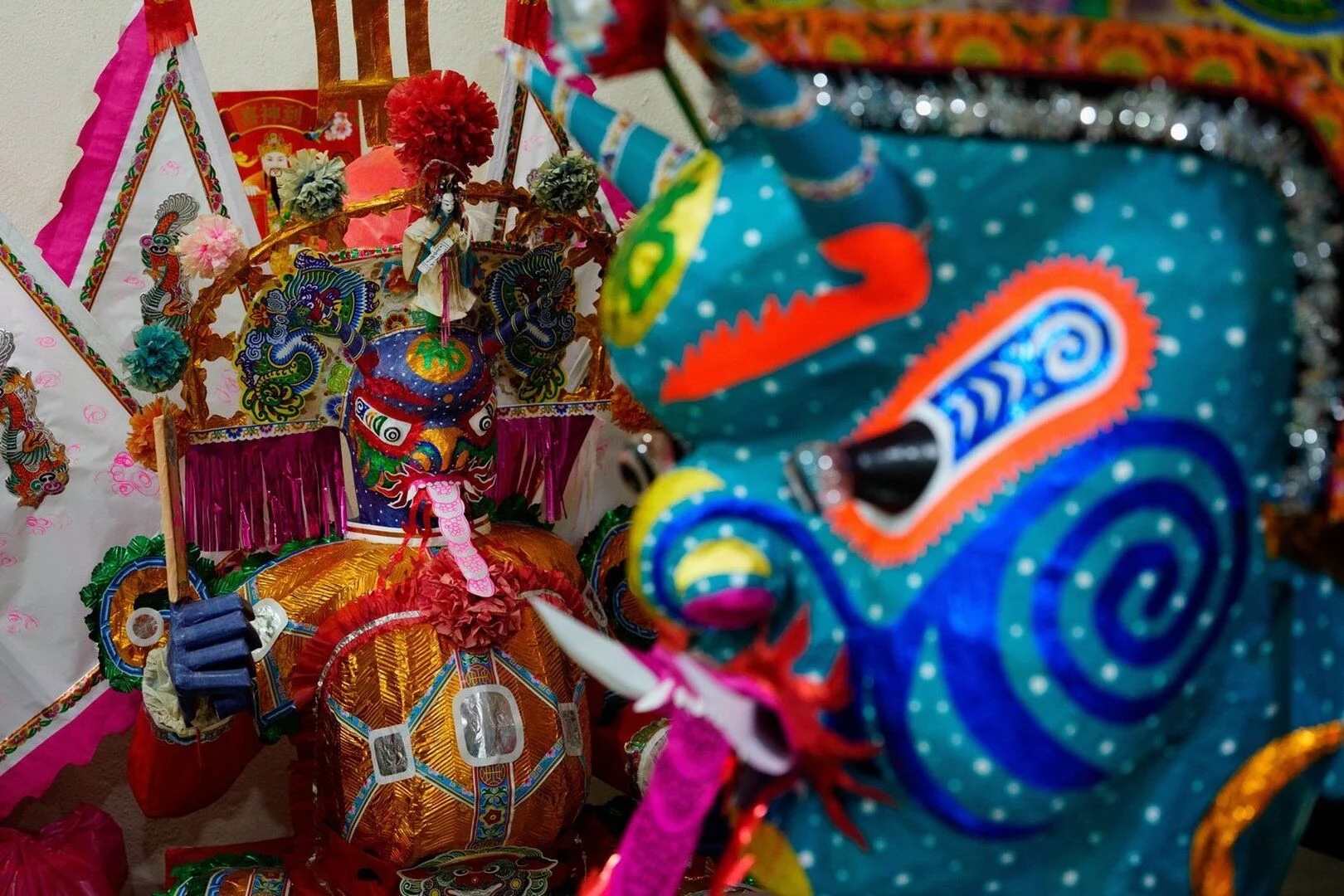
It’s that time of year when the living make room for the dead. Malaysia’s Hungry Ghost Festival is held during the seventh month of the Chinese lunar calendar, which this year began in mid-August.
“It is centered around the worship of Da Shi Ye, also known as the Guardian God of Ghosts, and has become one of the major traditional Chinese religious celebrations in Bukit Mertajam,” said Lee Kim Fong, general affairs coordinator for the event.
The city is in Malaysia’s northern state of Penang, about 200 miles (320 km) north of Kuala Lumpur.
“It dates back to 1888, when there was a serious plague in Bukit Mertajam,” Lee said. “After that, our ancestors began worshipping Da Shi Ye.”
For 15 days, devotees pray and make offerings before a towering paper-and-bamboo effigy of Da Shi Ye. The celebration culminates in the ceremonial burning of the effigy, symbolically sending the deity back to the spirit world.
Lee estimated that more than 10,000 people attended the burning ceremony this year, with crowds sometimes reaching 20,000.
“The main purpose is to look after wandering spirits, especially spirits who have no one to worship or make offerings to them,” Lee said. “Some may have died in accidents or may have no family members to pray for them.”
Similar celebrations are held in Hong Kong, Singapore and Taiwan. Devotees travel to Bukit Mertajam from across Malaysia as well as Singapore, Indonesia and Thailand.
A towering effigy stands at the center of the celebration
The Da Shi Ye effigy in Bukit Mertajam is traditionally made about five centimeters (two inches) taller each year. In 2026, it reached 8.9 meters (about 29 feet).
Ng Chi Wong, 69, has spent more than four decades crafting the figures. He said completing the towering effigy takes about a month and a half, with a team of seven or eight people working on it.
“We have the measurements and a general idea of the structure, but there are no formal drawings,” Ng said. “Most of the design and construction details are already in our minds.”
The artisans begin with the head, the part that requires the most work, before building the main frame and shaping the body. The outer layers are then added and painted.
Ng said that the process has undergone some small improvements over time. Yet the craft requires more than technical skill.
“You also need to understand the tradition and the beliefs behind it,” he said.
The festival honors spirits with no one to remember them
Lim Han Cong, a University of Malaya master’s graduate in Chinese studies, described the Hungry Ghost Festival as a counterpart to another traditional Chinese observance: Qingming, or Tomb-Sweeping Day, when families honor their ancestors at their graves.
While Qingming focuses primarily on one’s own ancestors, the Hungry Ghost Festival extends offerings to wandering spirits and the unclaimed dead. “This tradition reflects a synthesis of Buddhist, Taoist and Chinese folk religious beliefs,” Lim said.
In Taoist ceremonies during the festival, priests recite sacred scriptures and perform rites to help the deceased find peace and salvation. Such practices are intended to provide comfort, nourishment and liberation to those who have no descendants to care for them.
“At its core, the Ghost Festival expresses the belief that the living and the dead remain connected through enduring moral and emotional bonds,” Lim said. “The living, therefore, have a responsibility to honor, support and help the deceased attain peace.”
An old tradition finds new roles in Malaysia
Offerings and rituals like those held in Bukit Mertajam eventually took on a broader community role. Starting in the 1970s, Malaysian Chinese celebrations incorporated charitable activities such as auctions of blessed offerings and fundraising campaigns for schools.
“As a result, the Ghost Festival in Malaysia has evolved beyond a festival devoted solely to honoring the dead,” Lim said. “It has also become an important platform for strengthening community solidarity.”
That broader role is also evident in Bukit Mertajam. Money raised through fundraising efforts helps the organizing committee provide assistance to people with medical needs and support Chinese-language education.
Alongside that community work, organizers are looking for new ways to broaden access to the tradition. Participation is no longer limited to those who can make it to Bukit Mertajam.
“We introduced online worship for devotees who are overseas or unable to return,” Lee said. “So they can still take part in the prayers and make offerings.”
A professional team documented the celebration from Aug. 14 through Aug. 29. Organizers plan to upload the footage to Facebook so people around the world can see the Da Shi Ye festival in Penang.
“This is a Chinese tradition that has been passed down for more than a hundred years,” Lee said. “As descendants of the Chinese community, we have a responsibility to preserve it.”
AP