


Keeping Ambassador Kyaw Moe Tun at the United Nations is not a procedural convenience. It is the minimum defence of Myanmar’s democratic will against a military that seized power illegally and continues to face allegations of grave international crimes.
Guest contributor
Salai Za Uk Ling
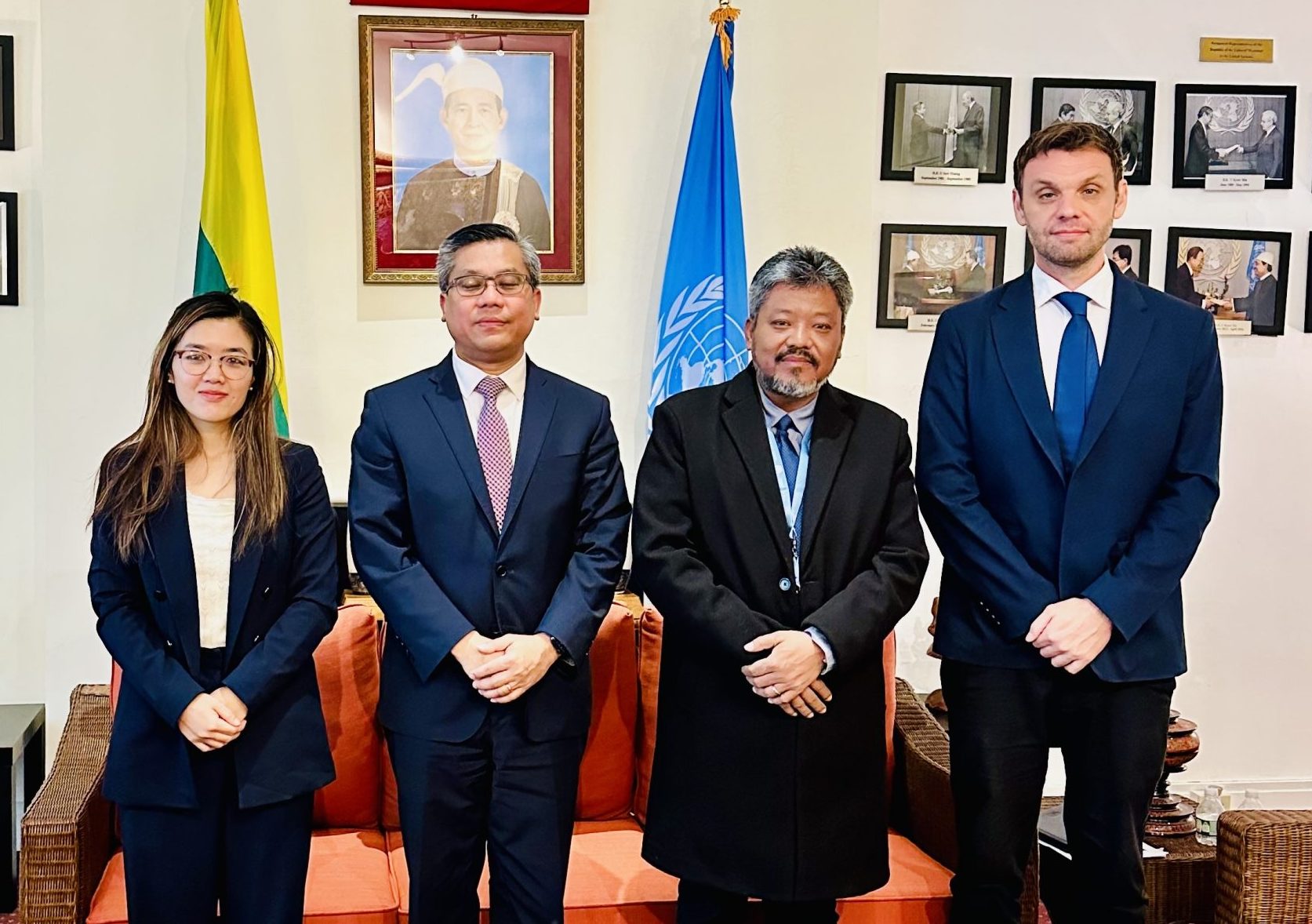
On March 30, 2023, I visited Ambassador Kyaw Moe Tun at the Myanmar permanent mission’s residence in New York with a delegation from the Chin Human Rights Organization.
He received and hosted us warmly, and we spoke in person about Myanmar. What stayed with me was not the ceremony of the setting, but the responsibility he carried.
At a time when the military was trying to make its seizure of power appear irreversible, Myanmar’s representative at the United Nations remained answerable not to the generals, but to the people whose votes they had overturned.
I do not mention this encounter to place any diplomat beyond scrutiny. It reminded me that representation is not an abstract question.
It determines who speaks in Myanmar’s name while communities are bombed, villages are burned, political prisoners are tortured and millions are displaced.
The upcoming contest over the U.N. seat is therefore not an administrative quarrel between rival officials.
It is a struggle over whether guns can manufacture legitimacy, whether atrocities can be converted into diplomatic privilege, and whether the U.N. will uphold the principles it repeatedly invokes.
Kyaw Moe Tun’s defining act came on Feb. 26 2021, when he appealed before the U.N. General Assembly for the strongest possible international action against the Feb. 1 military coup and ended with the three finger salute to honour Myanmar’s democratic resistance.
He placed his office on the side of the people who had voted, the elected institutions that had been displaced, and the civilians being shot for opposing the coup.
Since then, he has ensured that Myanmar’s name is not spoken at the U.N. only by those responsible for the violence.
Member states must retain Kyaw Moe Tun as Myanmar’s representative for the 81st U.N. General Assembly and reject any nominee produced by the coup or by the military controlled political order established in its aftermath.
This is not about granting one individual a permanent entitlement to the seat. It is about refusing to reward an illegal seizure of power with international recognition.
On Feb. 3, 2021—two days after the military seized power—U.N. Secretary-General António Guterres made an unequivocal commitment.
“We will do everything we can to mobilize all the key actors and the international community to put enough pressure on Myanmar to make sure that this coup fails,” he told The Washington Post.
He added that it was “absolutely unacceptable to reverse the results of the election and the will of the people.” Those words amounted to a promise by the head of the U.N. to Myanmar’s people.
More than five years later, that promise remains unfulfilled. Keeping Kyaw Moe Tun in Myanmar’s seat cannot by itself make the coup fail.
But it is one concrete and immediately available way to ensure that the world does not recognise the illegal seizure of power or legitimize its direct political product, the junta and the administration it has constructed around itself.
Handing the seat to a military nominee would allow the coup to succeed at the U.N. even as Myanmar’s people continue to resist it at immense human cost.
The military authorities understand this. Their attempt to revoke Kyaw Moe Tun’s status, accuse him of illegal activity and seek action against him reveals how much his presence matters.
Control obtained through force is not the same as lawful authority, and the U.N. credentials process does not require member states to pretend otherwise.
Each General Assembly session appoints a nine member Credentials Committee, which examines the credentials submitted for national representatives and reports to the U.N.
Under Rules 27 to 29, representatives may sit provisionally until a decision is made.
When rival authorities claim a state’s seat, General Assembly resolution 396 of 1950 directs that the issue be considered in light of the purposes and principles of the U.N. Charter and the circumstances of each case.
Credentials are therefore not an automatic reward for whoever occupies government buildings. Democratic legitimacy, constitutional order and the conduct of the claimant matter.
Since 2021, the Credentials Committee has repeatedly deferred a final decision, and the General Assembly has adopted its reports. Kyaw Moe Tun has consequently remained in Myanmar’s seat.
Deferral does not formally recognise the National Unity Government, and we should not claim that it does.
But it has prevented the military from acquiring through diplomacy the legitimacy it could not obtain from Myanmar’s people.
The approaching accountability decisions make the question even more consequential.
The International Court of Justice completed merits hearings in January and is considering Myanmar’s responsibility under the Genocide Convention for its treatment of the Rohingya.
At the International Criminal Court, judges are considering the Prosecutor’s request for an arrest warrant against Min Aung Hlaing for alleged crimes against humanity against the Rohingya.
Neither outcome should be prejudged, and the two courts address different forms of responsibility.
But it would be indefensible for the U.N. to confer Myanmar’s diplomatic legitimacy upon an administration led by a man facing an ICC arrest warrant request while the world’s highest court considers allegations arising from the treatment of the Rohingya by the military he headed as its commander-in-chief.
The accountability proceedings primarily concern atrocities committed before the 2021 coup. Myanmar has not yet begun to reckon fully with the crimes committed against an entire nation since then.
U.N. investigators continue to report evidence of conduct that may amount to war crimes and crimes against humanity, while the Independent Investigative Mechanism for Myanmar preserves evidence for future prosecutions.
Those seeking Myanmar’s seat are not ordinary successors following a lawful transfer of power.
Alleged perpetrators should face investigation and justice, not receive diplomatic credentials as the prize for surviving their own coup.
The Human Rights Council has repeatedly condemned the removal of the elected government, demanded an end to violence and renewed international accountability mechanisms.
Yet the unresolved representation question has helped paralyse Myanmar’s Universal Periodic Review.
The third cycle outcome was never adopted after the coup, while the fourth review was moved from January 2025 to January 2027 and civil society submissions were suspended until further notice.
The junta must not represent Myanmar in the UPR, but excluding the junta must not mean excluding Myanmar’s people from scrutiny and protection.
The Council should establish a lawful procedure allowing the review to proceed with evidence from civil society, legitimate democratic representatives, U.N. experts and accountability mechanisms.
Member states cannot defend one principle in Geneva and abandon it in New York.
Governments that condemn the coup, reject its violence and refuse to accept elections conducted under repression cannot approach credentials as though the identity and conduct of Myanmar’s proposed representative were irrelevant.
For Myanmar’s people, Kyaw Moe Tun represents continuity with the democratic mandate expressed in 2020, but his meaning has grown beyond that election.
He has become a symbol of the Spring Revolution’s refusal to surrender sovereignty to armed coercion.
Myanmar’s future must be federal, democratic, inclusive and accountable to all its peoples, including ethnic and religious minorities that have endured military violence for generations.
Representation at the U.N. should protect that future, not foreclose it.
The General Assembly should retain Kyaw Moe Tun and reject any military nominee.
It should also move beyond annual deferral toward a coherent U.N. wide policy that allows Myanmar’s legitimate representatives to participate meaningfully across U.N. bodies while ensuring that human rights processes do not remain paralysed.
Myanmar’s seat does not belong to the generals. It belongs to the people of Myanmar.
The Secretary-General said the U.N. would do everything it could to make the coup fail. The institution now owes it to Myanmar’s people to give those words meaning.
Until they can freely choose a government that genuinely represents them, keeping Kyaw Moe Tun in that seat is the minimum obligation of a U.N. that still claims to stand for peace, human rights and the sovereign equality of peoples.
Salai Za Uk Ling is the Executive Director of Chin Human Rights Organization.
DVB publishes a diversity of opinions that do not reflect DVB’s editorial policy. We’d like to hear what you think about this or any of our stories: [email protected]