


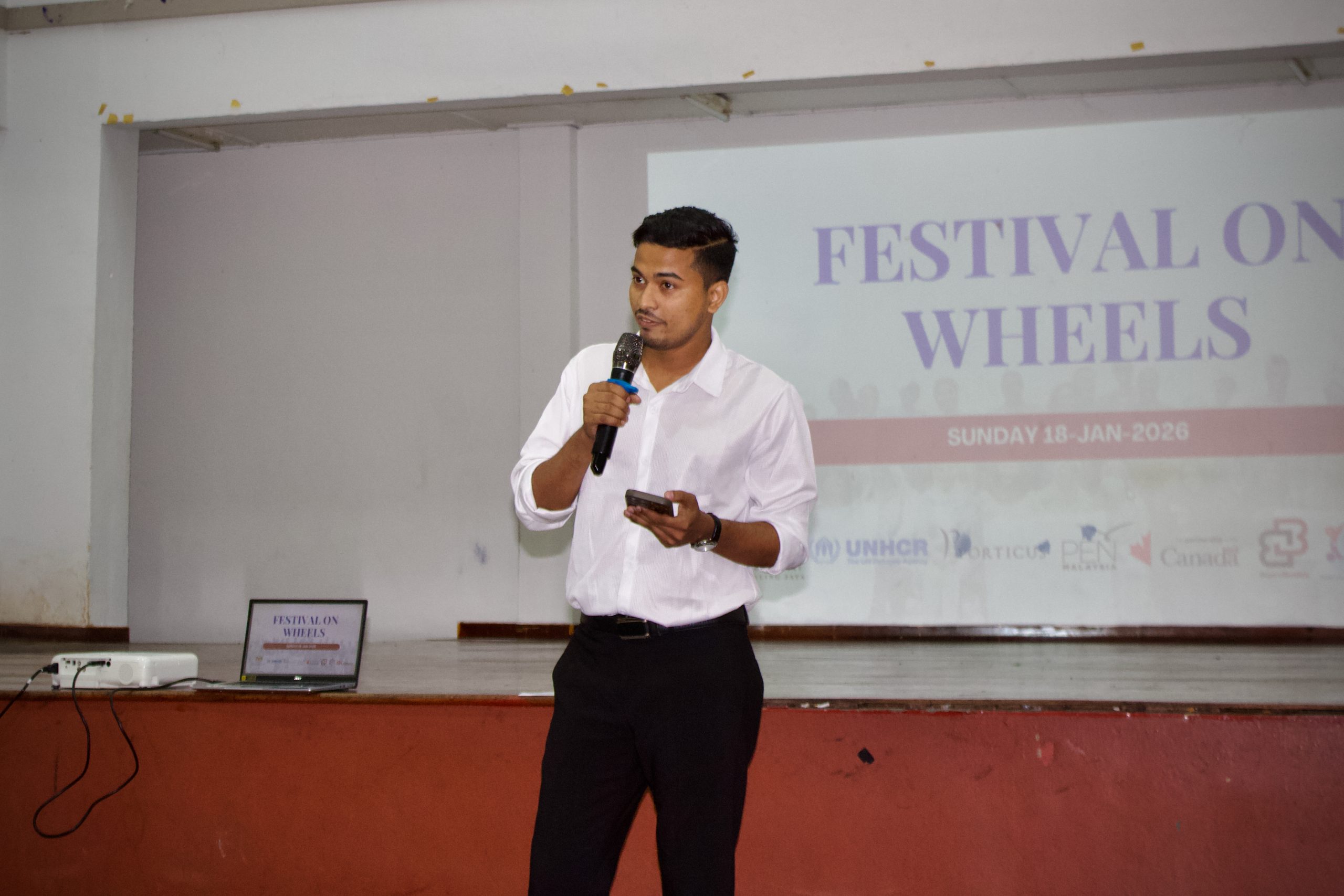
Guest contributor
Pacifist Farooq
Since May this year, the hatred against the refugees in Malaysia, especially Rohingya refugees have become more organized and has surged tremendously.
False claims and information are spread widely. Social media feeds are flooded with hateful comments. This online hatred has already been translated into real world incidents.
Schools that the Rohingya students attend are facing intimidation and closure. The Rohingya people are being evicted from the villages.
As a Rohingya refugee living in Malaysia, I have watched this transformation with deep concern not just as a member of the community being targeted, but as someone who has spent years working in education and advocacy.
I escaped the genocide in Myanmar hoping to find safety. Instead, many Rohingya today are living with another form of fear, fear of being simply for who they are.
I faced fear and discrimination before, but I have never felt this useless, worthless and dehumanised as I do now. The comments, “you are not welcome”, on my social media post echoes in my head twenty four by seven. This is very disappointing and traumatising.
As far as I have observed, this growing hatred stems from a lack of understanding about refugees, biased and sensational media coverage, the spread of false information, and racism.
The first reason why hatred towards the Rohingya is increasing is that many Malaysians have had limited opportunities to learn about refugees, why they fled their countries, or the legal circumstances under which they live.
There have also been very few public education programmes by government agencies or civil society organisations to help people understand the differences between refugees, asylum seekers, and undocumented migrants.
For many Malaysians, what comes to their mind immediately when they hear the word “refugee” is only Rohingya. Many are unaware that there are other refugees from different ethnic groups of Myanmar and other countries.
As a result, most locals mistakenly assume that all UNHCR card holders are Rohingya, when in fact the refugee population in Malaysia is far more diverse.
Even when other refugees beg or commit crimes, the locals always mention Rohingya as captions in their social media posts. There is a video of Burmese Muslim girl, widely shared on social media platforms, speaking pure Burmese begging in Kuala Lumpur’s shopping district of Bukit Bintang who was chased by the anti-Rohingya content creators.
She was asked if she was Rohingya. She replied, “ No”, but the content creators were not trusting her and insisted that she was a Rohingya. In another case, a chin refugee, his name clearly written as Slai Than Naing in his UNHCR card and passport, was arrested for driving a motorcycle by the police, but when it was covered by the news. He was labelled as Rohingya simply for holding the UNHCR card.
There are also cases that some non-Rohingya, especially Myanmar Muslims from Mawlamyine and other regions of Myanmar, used to mention themselves as Rohingya because Rohingya was once sympathised by the Malaysians.
This is also true with the Palestinians where beggars from Arabic speaking countries such as Morocco and Egypt use Palestinian flag and claim as Palestinians to beg from people in Malaysia.
Some of them were unmasked by a Palestinian. There are hundreds of examples where the other refugees from Myanmar committed crimes but the social media users mentioned Rohingya just because the individuals were holding UNHCR cards where ethnic name was not mentioned.
Rohingya refugees are always blamed for problems related to all refugee and migrant communities.
Malaysia is hosting refugees from many countries and ethnic backgrounds which includes various communities from Myanmar such as Chin, Kachin, Karen, Rakhine, Mon, and others, along with the refugees from Pakistan, Syria, Yemen, Somalia, Afghanistan, and several other countries.
However, whenever crimes of undocumented migrants or refugees are reported, the public conversation frequently singles out the Rohingya, regardless of the actual identity of those involved.
I’m not denying that the Rohingya don’t commit crimes, of course they do. Crimes do exist in every community. However, individual crimes shouldn’t be used to judge the whole community.
Malaysians are not also aware of the diversity within the refugee population, rather they are full of misinformation such as refugees get subsidies from the government, refugees are taking over the local jobs and Rohingya are always involved in the crimes.
A few weeks ago, I was interviewed by a Chinese Malaysian run newspaper. Some of the interviewer’s questions are very ignorant. His first question was, “Why are so many Rohingya involved in crimes?” I was like “show me evidence. Show me proof.”
He had no answer. I then showed the police reports that say 0.02 per cent of Rohingya have committed crimes since 2024. That is only 89 Rohingya individuals. This does not support the stereotype that Rohingya are disproportionately involved in crime.
Another question he asked was, “Why do Malays hate Rohingya despite being Muslims themselves?” My answer was, “It’s not only Malays. Racist attitudes can be found among individuals from all the three major Malaysian communities.”
At the same time, I have met very good, kind and supportive Malaysians from all three major communities.
Second, the news media’s double standards in reporting on refugees issues and events has played a significant role in spreading negative stereotypes and hostility toward the Rohingya community in Malaysia.
When reporting on incidents involving other refugees or migrants from Myanmar and other countries, media outlets often use neutral terms such as “UNHCR card holders”, “Myanmar citizens” or “Pakistani citizens” rather than highlighting their ethnic identities.
However, when it comes to the Rohingya, many media reports frequently emphasize the ethnic group “Rohingya” in headlines and stories, often in a sensational manner to attract greater public attention and engagement.
In addition, news reports about refugees use images of Rohingya refugees all the time which has created the impression that they are the only refugee community in Malaysia. This has contributed a lot to prejudice and reinforced negative perceptions of an already vulnerable community.
My point is that If the media chooses not to emphasize the ethnic identities of other refugee or migrant groups, why should the Rohingya be treated differently?
It is not only the media that contributes to this issue; government official statements also play a role. Whenever the topic of refugees arises, the name “Rohingya” is often mentioned as if there are no other refugee communities in Malaysia, or as if Rohingya refugees receive special privileges compared to others.
Recently, government officials announced plans to consider allowing refugees to work in certain sectors, including difficult, dirty, and dangerous (3D) jobs.
However, if such a policy were to be implemented, the opportunity would apply not only to Rohingya refugees but also to other refugee communities. Therefore, it raises the question: why specifically mention the Rohingya instead of using a more accurate and inclusive term such as “refugees”?
Much of the anger directed toward the Rohingya community in Malaysia appears to stem from misunderstandings, misinformation, and sensationalized reporting by certain media outlets.
One example often cited is that Rohingya own shop and do business without license in Selayang Pasar Borong market. As someone who has been living near Selayang Pasar Borong for about 2 years and who walks through the area almost every day, my observations are different from many of the claims being circulated.
The people living and working around the market are predominantly Burmese Muslims and mixed-race individuals, not Rohingya. Rohingya people may make up only about two per cent of the population there.
And the photograph used in the petition of Change.org to remove Rohingya from Malaysia also does not accurately reflect the reality on the ground, as the people shown in the picture are not Rohingya but Kapya (Burmese mixed-race individuals).
Distorting a situation and using a photo without proper context has created misunderstandings and put an entire community at risk.
In many cases, media outlets and news agencies are using sensational headlines and misusing the name of the Rohingya deliberately to gain likes, comments, and to reach a larger audience.
This has contributed significantly to the spread of misinformation and negative stereotypes. For example, there were reports that all the foreigners including refugees and migrant workers in Malaysia owed more than 30 million Malaysia Ringgit to government hospitals.
However, some media outlets published headlines claiming that the Rohingya owed more than 30 million rinngit, even though the original information referred to all foreigners, not just the Rohingya.
This misleading narrative was later repeated by a professor from the University of Malaya, which has gone across social media. However, some of these false claims were debunked by the AFP news agency.
Third, Racism plays a significant role. The Rohingya are frequently labeled not just as foreigners but as people who belong to nowhere. Discrimination is normalised by dehumanizing language online and makes it easier for people to justify hostility.
Even when we say that we don’t discriminate based on skin colour, we do by default unintentionally. It is a generational problem. Belonging to darker skin is a crime the Rohingya has committed against their will. Or there are other refugees from Myanmar but Rohingya are always singled out and subjected to greater scrutiny.
The main reason behind this hatred is the election periods in Malaysia. I believe much of this hostility is deliberately cultivated and exploited for political gain.
As I have studied, before refugees became a prominent political issue, election campaigns often focused on ethnic divisions: Malays vs Chinese and Indians.
Today, refugees have increasingly become another target in political narratives, with some politicians using them to create fear and division.
And many of those who are campaigning against the refugees are members of political parties or are politically motivated. Some content creators are also reportedly paid to produce content that fuels hostility towards refugees.
At the same time, several Malaysians who support refugee rights have been collecting evidence and documenting these coordinated campaigns.
Because the anti-Rohingya sentiment was not being sold enough lately, some of the political figures have returned to their old playbook, pitting Malay against Indian and Chinese.
The recent remarks by the Perikatan Nasional election director Sanusi Nor has gone viral. In an election campaign, he said, “Indians have India. The Chinese have China. Cambodians have Cambodia. Thais have Thailand. What about the Malays? Malays have only this place.”
For decades, the Rohingya have been used as political scapegoats in Myanmar. Now, many of us feel that our community is once again being drawn into political narratives in Malaysia.
It is deeply painful that a people who are living through the genocide continue to be used as political targets rather than being seen as human beings deserving of dignity and protection.
Another sad reality is that anti-Rohingya rhetoric is not limited to the host community.
When some Malaysians are showing hatred against the Rohingya, some refugees and migrants from Myanmar are not sitting idly but fueling the hate by pretending as Malaysian with fake locked social media accounts while others with their real identity.
This incident has again proved that even if the people of Myanmar don’t like the junta, we love its legacy and agenda it has outlined. The Junta may lose the ground, but it has successfully won the people of Myanmar in planting hatred and racism against the Rohingya.
Even if there were no junta in the future, there would be very little change for Rohingya in Myanmar. In rebuilding the country, the mindset of the public is the main.
Burmese people may win hundreds of revolutions, but if we can not change our mindsets, we can never build a civilised and prosperous country.
History shows that revolutions alone do not guarantee lasting progress. Many countries have emerged from authoritarian rule only to face new cycles of division because deeper social attitudes remained unchanged. Myanmar people should learn from those experiences if we hope to build a truly inclusive future for all its people.
What some people from Myanmar who spread hate speech against the Rohingya fail to consider is this: if Malaysia were to succeed in driving out the Rohingya, what makes them believe the country would then show greater sympathy toward other refugees from Myanmar?
To conclude, the rise of anti-Rohingya sentiment has already had a harmful impact on the Rohingya community, affecting their safety, dignity, mental health and livelihood.
Everyone who believes in justice, fairness, and social cohesion should be concerned about the growing normalisation of hatred and discrimination against a vulnerable refugee population.
Many non-governmental organizations, civil society organisations, and community-based groups have been working to challenge misinformation and promote awareness.
However, these efforts alone are not enough. The Malaysian government must take meaningful steps to address the growing hostility, promote accurate public understanding of refugees, and protect social harmony before the situation becomes more difficult to reverse.
Pacifist Farooq is a Rohingya poet, activist, and author of A Lost Bird Between Genocide and Displacement. He is now based in Malaysia.
DVB publishes a diversity of opinions that does not reflect DVB editorial policy. We’d like to hear what you think about this or any of our stories: [email protected]