


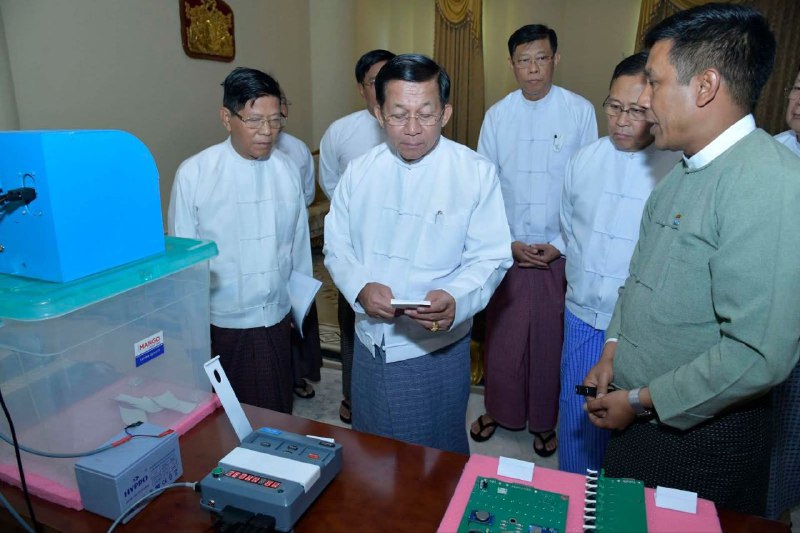
The regime’s Union Election Commission (UEC) announced on Monday that its general elections will begin on Dec. 28, with specific dates for polls in January 2026 to be announced later. Nay Phone Latt, the National Unity Government (NUG) Prime Minister’s Office spokesperson, spoke to DVB about the regime elections in an exclusive interview on Aug. 17.
“We call this upcoming process an illegal, sham election. It’s not because we oppose elections itself, but because the authority to organize elections belongs to a legitimate government entrusted by the people — not the military, which seized power illegally. The regime lacks both legitimacy and capability. They don’t have the ability to hold such an election. We already have the results of the 2020 election,” he told DVB.
In 2020, Aung San Suu Kyi’s National League for Democracy (NLD) party won a second landslide victory after it came to power with an overwhelming majority in 2015. It was accused of voter fraud by pro-military parties in 2020 and ousted from the government in a coup d’état orchestrated by Senior General Min Aung Hlaing before parliament could convene on Feb. 1, 2021. His regime then usurped state power in Naypyidaw.
“They are changing laws, suspending some and enforcing others, showing that they intend to push ahead at any cost. But will the people accept it? Just look back at [2021], when the military tried to seize power. People across the country took to the streets and made it clear they rejected military rule,” said Nay Phone Latt.
The regime has designated 330 constituencies for the Pyithu Hluttaw, or lower house of parliament, under a first-past-the-post (FPTP) winner takes all electoral system, and 110 Amyotha Hluttaw, or Upper House, constituencies through a combination of FPTP and proportional representation (PR). This is the distribution of seats that corresponds closely with the proportion of the total votes cast for each party. It announced the list of constituencies in each state and region on Aug. 16.
On July 31, Min Aung Hlaing imposed martial law on 63 townships in Shan, Arakan, Chin, Kachin, Karenni and Karen states, as well as Sagaing, Magway and Mandalay regions, which were either fully or partially under resistance control.
The Karenni Interim Executive Council (IEC), a provisional government set up by resistance groups in 2023, told DVB that regime elections would be “impossible” in Karenni State due to the fact that there are at least 210,000 residents living in Internally Displaced Persons (IDP) camps in areas under Karenni resistance control, which include Demoso, Shadaw, Hpruso and Mese townships.
The Karenni State capital Loikaw, as well as Bawlakhe, and Hpasawng townships are under regime control. Even there, the IEC claimed that the election would only be possible through online voting as physical polling stations would be too dangerous to operate. Karenni has a total of seven constituencies.
The Chin Brotherhood, one of the two main factions of the Chin resistance, told DVB that the regime election is “not a solution” to the country’s crisis since the 2021 coup. The regime controls the Chinland capital Hakha and Tedim Township in the north of the state. It also maintains partial control of Thantlang Township, which is where the Chin National Front (CNF) headquarters is located along the Myanmar-India border.
Chin resistance forces control Kanpetlet, Tonzang, Mindat, Matupi and Falam townships. Paletwa in southern Chinland was seized by the Arakan Army (AA) in January 2024. Chinland has a total of nine constituencies.
The AA spokesperson Khaing Thukha told media at a press conference on Aug. 11 that the ethnic armed group will not allow regime elections to take place in territory under its control, claiming that it would not be “beneficial” for people living in Arakan State.
The AA controls 14 townships in Arakan, while Sittwe, the port town of Kyaukphyu, and the island of Manaung, are under regime control. The UEC announced a total of 17 constituencies in Arakan. The 2020 general elections were not held in Pauktaw, Ponnagyun, Rathedaung, Buthidaung, Maungdaw, Kyauktaw, Minbya, Myebon and Mrauk-U townships due to fighting between the Myanmar military and the AA.
Sources close to Naypyidaw told DVB that the regime requested assistance to hold its elections in northern and eastern Shan State during its meeting with the United Wa State Army (UWSA) and the National Democratic Alliance Army (NDAA), which are two ethnic armed groups not aligned with the nationwide resistance to the 2021 coup, on Aug. 6-7.
The pro-regime Pa-O National Organization (PNO), also not aligned with any resistance group, reportedly pledged assistance to Naypyidaw in allowing it to hold its elections in southern Shan.
Shan State is home to the Pa-O, Palaung (Ta’ang), Danu, and Kokang Self-Administered Zones (SAZ), which are ruled by ethnic armed groups, along with the Wa Self-Administered Division ruled by the UWSA. To date, it has a total of 24 constituencies. But that number may change.
In northern Shan, Namtu, Mabein, Kutkai, Namkham, Hsenwi, Kunlong, Namhsan, Manton, Hopang, Laukkai, Konkyan, Momeik, Kyaukme, Hsipaw, as well as the Eastern Shan State Special Region 4 administrative center of Mongla, are among the 63 townships under martial law.
The Myanmar National Democratic Alliance Army (MNDAA), the Ta’ang National Liberation Army (TNLA), and the AA–collectively known as the Brotherhood Alliance–handed over Hopang and Panlong towns, which it seized in northern Shan during Operation 1027, to the UWSA in January 2024.
The MNDAA controls Laukkai, Konkyan, Hsenwi, and Kunlong in northern Shan. It handed the regional capital Lashio, along with its Northeastern Regional Military Command (RMC) headquarters which it seized in August 2024, back to the regime on April 22 as part of a China-brokered ceasefire deal with Naypyidaw.
The TNLA controls Namtu, Namkham, Namhsan, Manton, Momeik, Kyaukme, and Hsipaw in northern Shan, as well as Mogok in Mandalay Region. Kutkai is jointly controlled by TNLA, MNDAA, and the Kachin Independence Army (KIA). Mabein in northern Shan was seized by the KIA on Jan. 21, 2024. It also controls six townships in Kachin State, which has a total of 18 constituencies.
The Karen National Union (KNU) has seven brigades across Thaton District of Mon State, Taungoo and Nyaunglebin Districts of Bago Region, Myeik-Dawei District of Tanintharyi Region, as well as Hpapun (Mutraw), Kawkareik (Dooplaya) and Hpa-An Districts of Karen State.
The Institute for Strategy and Policy (ISP – Myanmar) reported that KNU-led resistance forces have captured at least 200 regime outposts of varying sizes across its territories since the 2021 coup. Karen, Mon, Bago and Tanintharyi have a total of 55 constituencies.
The UEC announced 45 constituencies in Yangon Region but not yet for neighbouring Ayeyarwady Region, which are both under regime control. Constituencies in the capital Naypyidaw have not yet been announced.
“Even though the regime has announced constituencies and townships where it claims it will hold voting, in reality, they cannot do so in many areas controlled by the resistance, including the NUG and allied groups. In those territories, there is no way this sham election can take place,” Nay Phone Latt told DVB.
“We will continue expanding our territorial control, and at the same time, we are working with various organizations to show the international community that this election is illegitimate.”
The NUG under its armed wing, the People’s Defence Force (PDF), either fully or partially controls 15 townships in Sagaing, Magway and Mandalay regions, which have a total of 90 constituencies.
Fifty-eight political parties have registered with the UEC and 10 of them, including the pro-military proxy Union Solidarity and Development Party (USDP), will contest polls nationwide. The USDP governed Myanmar under a hybrid military regime from 2010-15 until it faced defeats to the NLD in the 2015 and 2020 general elections.