


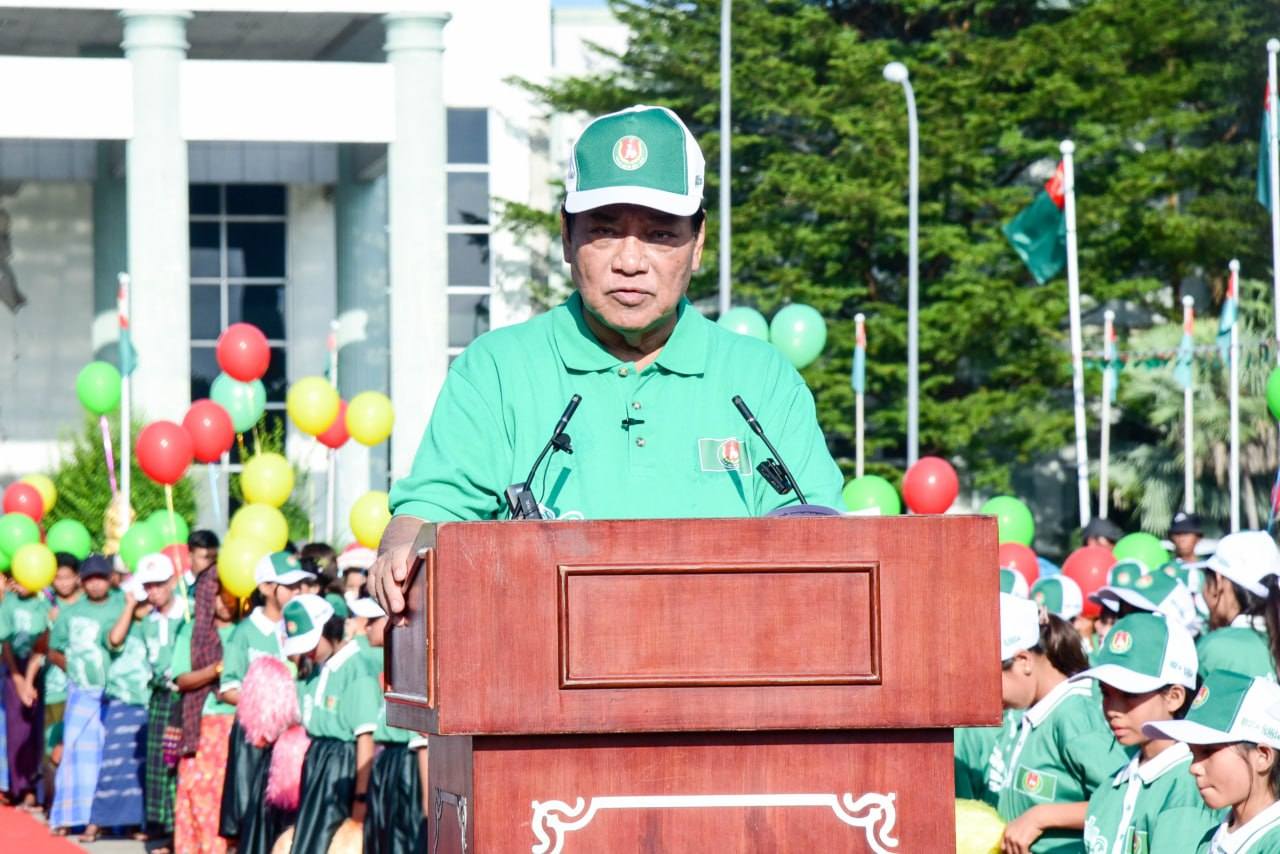
The Union Solidarity and Development Party (USDP) reportedly won 28 seats in the Pyitthu Hluttaw, or lower house of parliament – as well as in state and regional parliaments – as the 60-day regime election campaign period began on Oct 28, according to the Union Election Commission (UEC).
An independent election analyst told DVB on the condition of anonymity that the regime in Naypyidaw, which seized power during a military coup on Feb. 1, 2021 ousting the elected National League for Democracy (NLD) government and jailing State Counsellor Aung San Suu Kyi and President Win Myint, doesn’t really want elections.
The source added that the regime only wants to legitimize itself through its proxy political parties.
Most parliamentary seats gained by the USDP are located in townships of Kachin State and Sagaing Region, which have areas contested between regime and resistance forces.
The regime has launched counteroffensives against the Kachin Independence Army (KIA) in Kachin State, and the People’s Defence Force (PDF) across Sagaing Region.
The KIA seized control of Sumprabum, Injangyang, Chipwi and Tsawlaw in Kachin. The PDF seized control of Htigyaing, Indaw, Pinlebu, Myaung, Pale, Yinmabin, Depayin, Taze, Khin-U and Wetlet townships in Sagaing.
Three other uncontested seats located in Shan State went each to the Shan and Nationalities Democratic Party (SNDP), the Akha National Development Party, and the Wa National Party.
The ousted NLD called on the international community not to support, assist or send observers to the “sham” elections.
Min Aung Hlaing ousted the NLD in the 2021 coup on accusations of voter fraud without having provided any evidence. The NLD was dissolved by the UEC in March 2023 for not re-registering.
The regime’s scheduled elections are set to begin on Dec. 28 and continue into January 2026.
Ko Ko Gyi, the founder and chairperson of the People’s Party, wrote on social media that some of its members had to withdraw their candidacy due to “external pressure” without providing further details. He added that some others were disqualified.
“They were civil servants who had submitted resignation letters. But their resignations were instead classified as dismissals as they coincided with the Civil Disobedience Movement period which resulted in disqualification,” he said.
Ko Ko Gyi will run as a candidate in Yangon’s Lanmadaw Township for the Pyithu Hluttaw, or lower house of parliament. He shared his party’s manifesto on Oct. 28, which highlights addressing “political and military conflicts,” as well as assisting those displaced from their homes.
He also highlights how his party will “ease concerns” among the population related to the military conscription law, which was enforced on Feb. 10, 2024.
An estimated 70,000 males aged 18 to 35 have been conscripted in the first 14 intakes, based on the regime’s plans of 5,000 per batch, according to military defectors,
Thet Thet Khine, the founder and chairperson of the People’s Pioneer Party (PPP), was disqualified by the UEC on Oct. 25 for allegedly violating Section 8(d) of the Amyotha Hluttaw, or upper house of parliament, Election Law. She was among 86 parliamentary candidates who were disqualified by the UEC.
Section 8(d) was added to the Election Law on July 29. It states that a candidate must be free from any improper financial obligations to the state, or to any private individual.
This allows the regime to disqualify any candidate it chooses to, the independent election analyst told DVB.
The UEC has approved 4,877 candidates from 57 political parties for the elections. Only six parties, including the USDP, the PPP, and the People’s Party, will contest polls nationwide.
The regime 2025-26 elections will be held in 274 of Myanmar’s total 330 townships, according to the UEC. The first phase will be held in 102 townships on Dec. 28, the second in 100 townships on Jan. 11, 2026, and the third in 72 townships on an unspecified date.