


Guest contributor
Shafiur Rahman
Throughout 2025, the Arakan Army (AA) has faced a torrent of international scrutiny over its conduct in Arakan (Rakhine) State – scrutiny that is no longer limited to Myanmar’s military.
A series of reports from Human Rights Watch, Fortify Rights, U.N. human rights bodies, and Rohingya organisations like Kaladan Press have laid bare a disturbing pattern of abuse against Rohingya civilians and other ethnic communities living in territory under AA control.
Allegations include forced labour, abductions, arbitrary detention, systematic pillage, and extrajudicial killings, including beheadings, in areas the AA now governs.
These accusations have been bolstered by satellite imagery, survivor testimony, photographic and video evidence, and even admissions from the AA itself, such as the execution of two prisoners of war in January 2025.
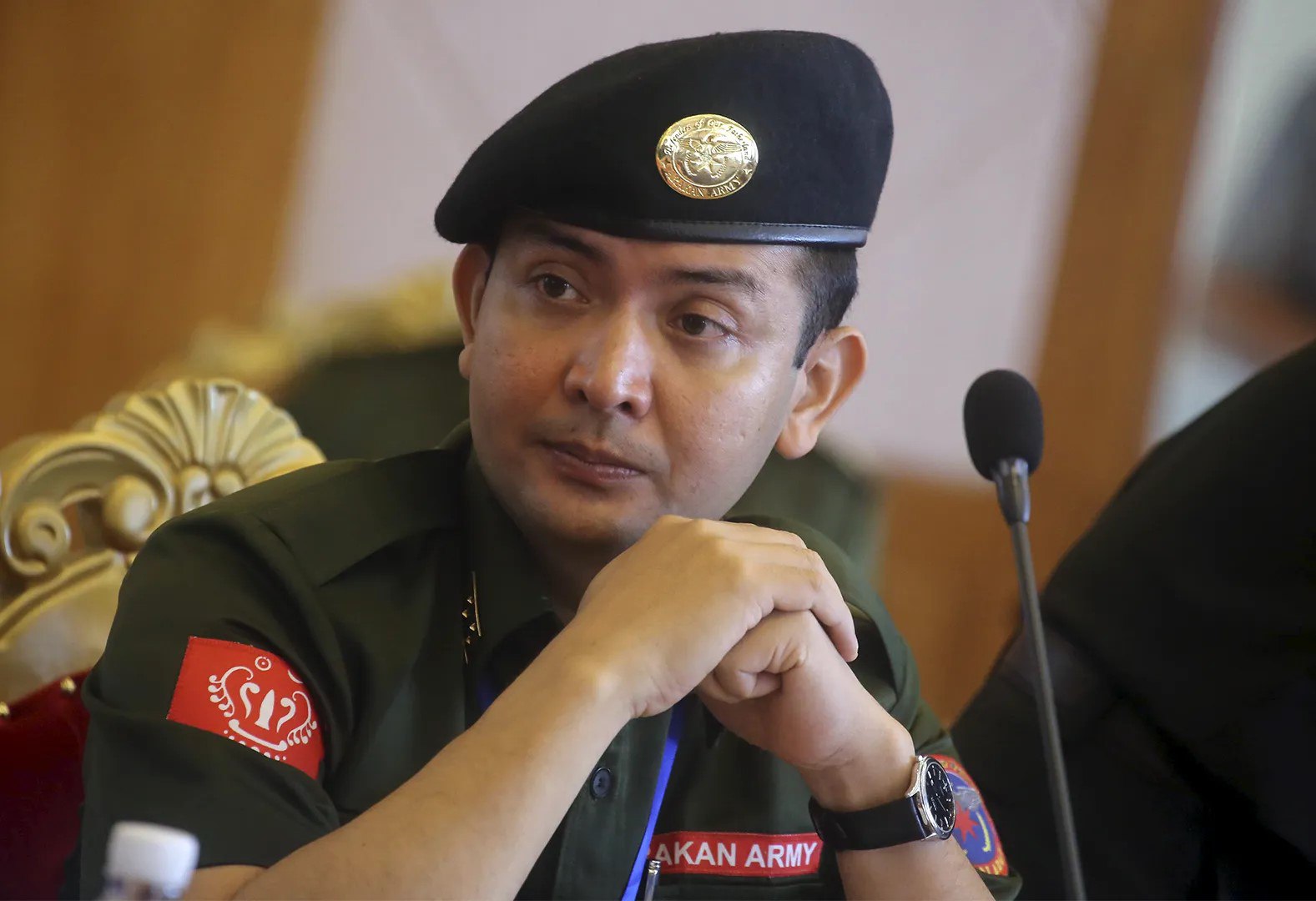
It is in this context that AA General Twan Mrat Naing’s recent interview in The Irrawaddy must be read – not as a gesture of transparency or reckoning, but as a carefully orchestrated counter-narrative.
Rather than acknowledging any wrongdoing, Twan Mrat Naing strikes a posture of grievance and control. He casts himself as a misunderstood statesman, speaks of religious tolerance, casts suspicion on international actors, and seeks to position the AA as the only legitimate authority in Arakan.
Again this is less about explanation than image management, a strategic performance aimed at disarming critics while reaffirming the AA’s claim to power.
Beneath the performance lie four core manoeuvres: total denial of responsibility, deflection to external conspiracies, avoidance of independent scrutiny, and a conditional vision of reconciliation.
Twan Mrat Naing opens with emotive reflections on his return to Arakan – “the sea breeze… was unforgettable.” This is more than sentimentality. It is to humanise his leadership and it is also calculated symbolism.
He casts himself not merely as a military leader, but as a returning sovereign, evoking a mythic homecoming. In doing so, he seeks to portray the AA not as an insurgent force but as a proto-state actor, capable of governing territory, securing communities, and restoring public order.
He emphasises acts of governance: reopening mosques, reconvening elders, regulating local affairs. These gestures suggest an aspiration for legitimate rule.
The AA is being framed here as the alternative to both the military junta and the ousted National League for Democracy (NLD), an entity capable of both military victory and moral leadership.
It is particularly aimed at international actors wary of armed groups, but willing to engage with local authorities who offer “stability.”
Twan Mrat Naing devotes considerable time to blaming Bangladesh’s security agencies for the rise and persistence of armed Rohingya groups like the Arakan Rohingya Salvation Army (ARSA) and the Rohingya Solidarity Organization (RSO).
Twan Mrat Naing accuses Bangladeshi intelligence of having played a foundational role in creating these groups – describing them, metaphorically, as the “midwife” that first brought them into being – and claims they continue to be “recycled” to destabilise the AA political project.
Whether or not these claims hold merit, their function within the interview is clear: to cast the AA as a force under siege, squeezed between a predatory junta on one side and foreign-sponsored militants on the other.
This framing allows the AA to deflect blame for atrocities like the massacre of civilians at Htan Shauk Khan village and recast regional instability as the product of foreign interference, not of its own governance.
No doubt the tactic here is to pre-empt calls for accountability and reframe the AA not as a perpetrator, but as a victim of transnational destabilisation.
Twan Mrat Naing devotes a striking amount of energy to undermining repatriation efforts. He does so not by rejecting the principle outright, but by redefining its terms.
He targets Bangladesh’s interim leader Muhammad Yunus by name, accusing him of “overpromising” a return before Eid, and dismisses such claims as political theatre.
In his telling, the repatriation agenda is not a humanitarian or legal necessity but a geopolitical ploy, one aimed at smuggling in militants, advancing diaspora agendas, and pressuring the AA through the language of Responsibility to Protect (R2P).
He aims to de-legitimise any form of return that does not proceed through AA-controlled channels. He simultaneously neutralises international demands for rights-based repatriation by framing them as naïve or co-opted.
In effect, Twan Mrat Naing is saying that the AA welcomes returnees, but only on its terms, under its vetting, and stripped of any political autonomy. It’s an effort to entrench its gatekeeping power over mobility, identity, and territory.
His thoughts on reconciliation offer a calculated model of managed inclusion that is deeply conditional. While the AA claims credit for preventing communal violence in central Arakan, positioning itself as a neutral arbiter of public order, the terms of this inclusion remain highly restrictive.
He repeatedly invokes “Muslim citizens,” carefully avoiding the collective political identity of Rohingya, and speaks of rights only in the same breath as “responsibilities and loyalty to Myanmar and to the Arakan region.”
Loyalty here is not abstract. It is defined by political quiescence. Those who align with the AA authority, participate in its vision, and stay clear of diaspora networks are included; those who dissent are branded as extremists or pawns.
This tiered model of acceptance mimics the exclusionary practices of previous regimes. It offers an appearance of stability while systematically delegitimising the Rohingya community’s collective identity, historical grievances, and aspiration for non-conditional rights.
True reconciliation would require the AA to move past the denial of the Rohingya identity and offer an open reckoning for its own actions.
Confronted with allegations of massacres, torture, forced labour, and disappearances, Twan Mrat Naing launches a counterattack: he calls them fabrications, part of a disinformation war waged by Rohingya activists, foreign media, and Western governments.
He fixates on details – the placement of helmets in photos, inconsistencies in casualty numbers – to cast doubt on the entire body of allegations.
He points to the mechanics of international pressure, referencing the U.S. and China, to assert that even major global powers are susceptible to the same kind of “accusation campaign.”
This tactic serves to reframe the serious accusations as mere lawfare, suggesting that if established states like the U.S., China, and whoever are vulnerable to these “clauses and mechanisms,” the AA’s plight is simply part of an unavoidable political campaign, thereby minimizing the gravity of the charges.
Twan Mrat Naing’s most telling manoeuvre is his use of a falsified claim of diaspora interference. He brandishes an audio clip as proof that activists were offering Rohingya youth $2,000 USD to “attack in Rakhine.”
This was presented as his strongest evidence that the diaspora was orchestrating militancy. In fact, I am the creator of the video containing that audio, and I can confirm that he completely distorted its meaning.
The voice was that of Rohingya activist Nay San Lwin, urging refugees not to accept a $2,000 USD cash-for-return offer tied to a Bangladesh–Myanmar pilot repatriation scheme.
My reporting in The Diplomat had exposed Bangladesh’s role in pushing this offer; the junta too was keen to see it implemented. But the point was simple: refugees were being pressured to trade away their right to their original homes.
It had nothing to do with violence, and nothing to do with the AA. By twisting this into “proof” of militant conspiracy, Twan Mrat Naing revealed the fragility of his defence and his deliberate falsification.
In the end, his narrative is less a response to accountability than an attempt to outmanoeuvre it.
Taken as a whole, Twan Mrat Naing’s interview is not a roadmap to reconciliation but a manifesto for control. He speaks the language of “citizenship, rights and responsibilities,” but only as a conditional bargain – rights as rewards for loyalty, identity erased or diluted to “Muslim citizens,” and dissent treated as extremism.
This is hard to describe as pluralism. It is a managed inclusion that mirrors the exclusionary logic of Myanmar’s military and successive governments.
By denying atrocities, misrepresenting evidence, and refusing independent scrutiny, the AA leader has not offered a credible response to the grave allegations before him.
Furthermore, while he may indeed be factually correct that elements of the Bangladeshi security apparatus actively encourage and exploit armed Rohingya groups like the RSO to undermine the AA, his heavy focus on this external threat serves a primary political purpose: to absolve the AA of responsibility for its own recent abuses and cast his movement as a victim of transnational chaos rather than a contributor.
Far from signalling a break with past persecution, this posture signals continuity. That means a future for the Rohingya defined not by justice or equality, but by conditional subordination to yet another armed authority.
And yet, what his words ultimately reveal is the ideological continuity in Myanmar’s genocidal mindset. Across classes, political parties, and ethnic armed groups, even among those who oppose the junta, there runs a common rejection of the Rohingya as a people, of their ethnic identity, and of their documented historical presence in Arakan as indigenous as the Kachin, Karen, Mon, Chin, Shan, and Rakhine themselves.
The Rohingya do not call themselves by their religion but by their ethnicity, just as every other group in Myanmar does. The AA refusal to acknowledge this, and its framing of repatriation as an act of Rakhine generosity rather than a matter of justice and restitution, is not reconciliation but erasure.
It is a continuation of the very logic of persecution that the International Court of Justice (ICJ) has deemed serious enough to warrant emergency orders to prevent genocide.
Shafiur Rahman is a journalist and documentary filmmaker focusing on the politics of refugee management in South and Southeast Asia. He writes the Rohingya Refugee News newsletter.
DVB publishes a diversity of opinions that does not reflect DVB editorial policy. We’d like to hear what you think about this or any of our stories: [email protected]