


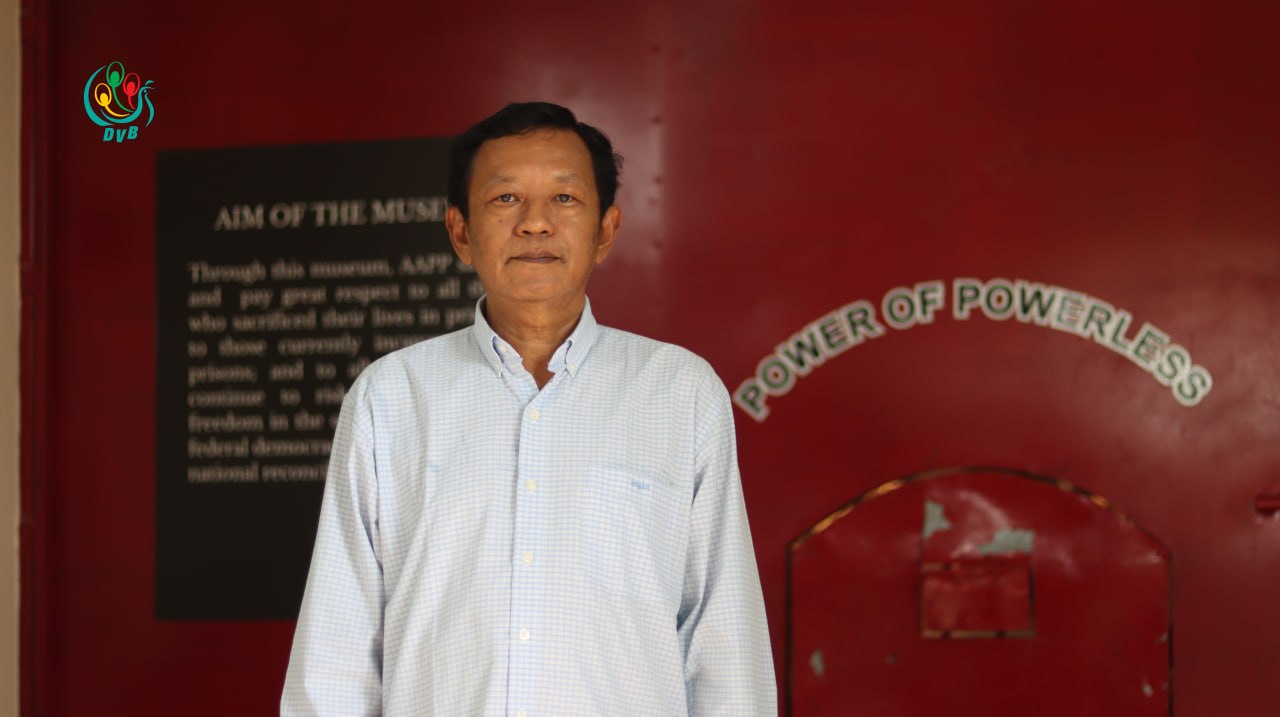
Bo Kyi, the joint secretary and co-founder of the Assistance Association for Political Prisoners (AAPP), has dedicated over two decades to advocating for human rights and documenting abuses against political detainees in Myanmar.
Recently named a recipient of the 2026 Ramon Magsaysay Award—often recognized as Asia’s equivalent of the Nobel Prize—Bo Kyi opened up to DVB about the worsening crisis in Myanmar’s prisons, the severe risks of ground-level documentation under military rule, and why releasing all political prisoners is the non-negotiable first step toward peace.
Reflecting on receiving this year’s Magsaysay Award, Bo Kyi expressed deep surprise and humility, emphasizing that the honor belongs entirely to the people of Myanmar and those being held behind bars by the regime.
“When the Ramon Magsaysay Award Foundation first reached out, I was included in the nomination—I was really surprised,” Bo Kyi told DVB.
“Before I was released from prison years ago, a friend who remained behind made a request: ‘After you get out, do something for us, because we feel forgotten.’ This award ensures that political prisoners are not forgotten. It belongs to the Burmese people and political prisoners who are still fighting against injustice, fighting for dignity, democracy, and human rights.”
Unprecedented Repression Post-2021 Coup
While prison conditions under Myanmar’s successive military regimes have historically been harsh, Bo Kyi warned that conditions following the February 2021 military coup are the absolute worst on record.
More than 30,000 individuals have been arrested since the military seized power, including elected leadership, lawmakers, journalists, activists, and civilians.
“The military intentional creates prison as an oppressive mechanism,” Bo Kyi explained.
“Because they regard those who oppose them as enemies rather than citizens, they start torturing, humiliating, and inflicting sexual violence against both women and men. What they are doing constitutes crimes against humanity and war crimes committed on a daily basis.”
Bo Kyi added that former political prisoners face lifelong persecution after release. Under the regime’s Counter-Terrorism Law, authorities routinely seize the homes and properties of activists.
Even after leaving prison, former detainees face constant surveillance, threats of re-arrest, and legal barriers preventing them from securing passports or continuing their education abroad.
Severe overcrowding, starvation, and the deliberate denial of timely medical care have caused a sharp spike in deaths behind bars.
High-Tech Surveillance and Verification Challenges
AAPP’s “Daily Briefing Since Coup” serves as the definitive source of casualty and arrest numbers in Myanmar since the military seized power on Feb. 1, 2021, Bo Kyi detailed the immense operational risks facing ground researchers.
Supported by technical assistance and firewall technologies from authoritarian allies such as China and Russia, the military actively suppresses communication channels.
“To hide what is happening, the military uses the internet as a weapon,” Bo Kyi stated.
“Over 2,000 people have been arrested simply for social media posts. Because of tight security, our published figures are conservative—we currently have a backlog of over 7,000 unverified political prisoner cases. The reality on the ground is significantly higher than what we can publicly report.”
Bo Kyi urged international organizations, the United Nations, and regional bodies like the Association of Southeast Asian Nations (ASEAN) to move beyond rhetorical statements and implement binding enforcement mechanisms.
He called on U.N. Member States to fulfill their Responsibility to Protect (R2P) by referring the military regime to the International Criminal Court (ICC) and enforcing strict targeted sanctions to halt the flow of weapons, financial assets, and aviation fuel used in civilian airstrikes.
“ASEAN and international bodies must stop recognizing the military as a government—they have no political legitimacy,” Bo Kyi told DVB.
“Member states need to review their foreign policies and work directly with key democratic stakeholders, including the National Unity Government and civil society.”
Release as a Barometer for Peace
Reflecting on his personal history as a former political prisoner held in solitary confinement during the 1988 pro-democracy movement, Bo Kyi recalled how the military attempted to break his spirit. Instead, he used his time behind bars to study with imprisoned professors and build intellectual strength.
“Military intelligence told me I would leave prison useless,” Bo Kyi confided to DVB. “In prison, you learn that the military wants to destroy not only your body, but your intellectual thinking. You must cultivate knowledge and resilience.”
In a final message to those currently imprisoned and the broader revolution, Bo Kyi reinforced that political detainees remain the ultimate metric for progress.
“Political prisoners are the barometer for change in Myanmar,” he emphasized.
“Without the release of all political prisoners, including Daw Aung San Suu Kyi, there can be no peace and no national reconciliation. To those still detained: You are not forgotten. Keep your physical and intellectual strength. Justice will prevail.”