


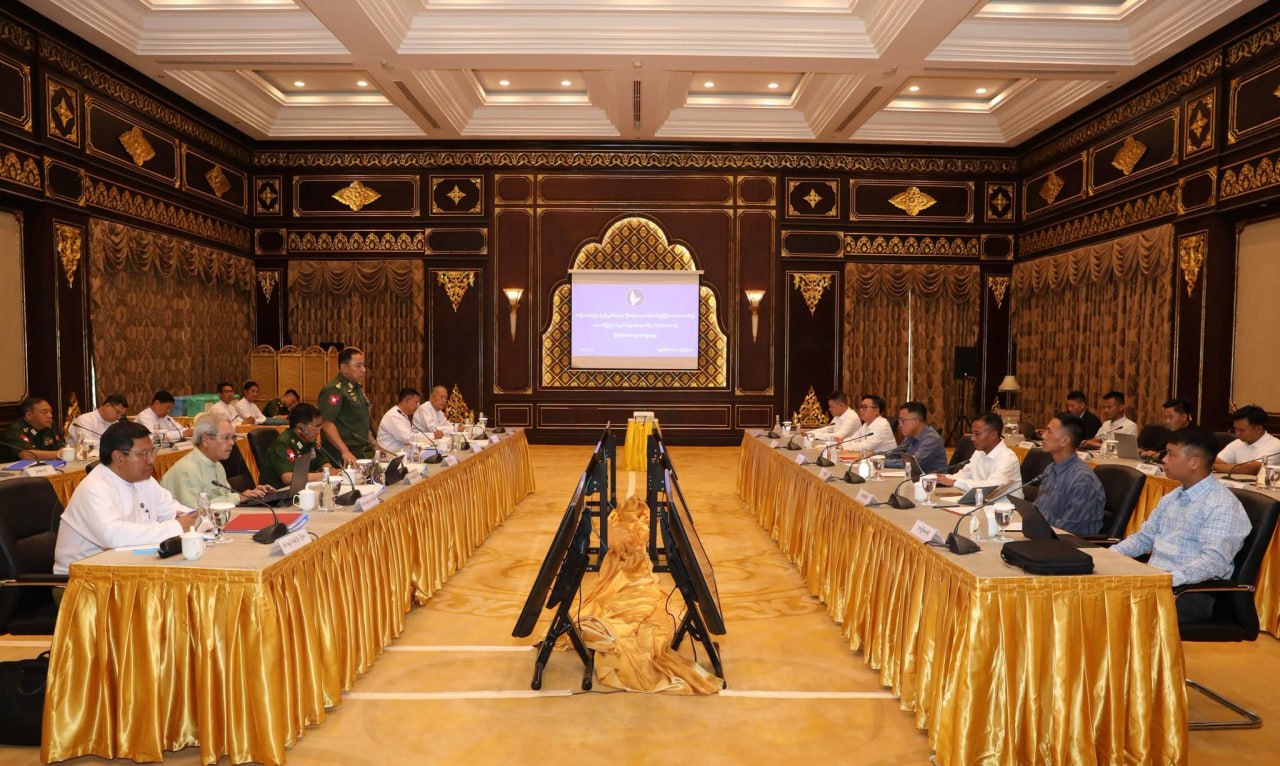
Representatives from the ethnic Palaung armed group, the Ta’ang National Liberation Army (TNLA), met with the regime’s National Solidarity and Peacemaking Negotiation Committee (NSPNC) in Naypyidaw on Sunday to negotiate terms on regional development, healthcare, and territorial stability.
The talks marked a significant diplomatic push by the TNLA, which formally requested that the regime recognize territory currently under its governance as an autonomous “Ta’ang State.”
In exchange, TNLA delegates assured regime negotiators that the proposed state would remain an integral part of the Union of Myanmar and would not attempt to secede. The group did not publicly detail the exact geographical boundaries it proposes for the new state.
Parallel consolidation: MNDAA establishes ‘civilian-led’ administrations
While the TNLA engaged in direct talks in the capital, its former alliance partner, the ethnic Kokang Myanmar National Democratic Alliance Army (MNDAA), executed a major administrative expansion.
The move highlights a broader trend among major Ethnic Armed Organizations (EAOs) in northern Myanmar to institutionalize state-like governance over territories liberated or claimed during recent years of conflict.
A volatile territorial map: From offensive to ceasefire
The TNLA’s political demands follow nearly three years of dramatic territorial shifts across northern Shan State and Mandalay Region.
Northern Shan State & Mandalay Timeline
├── Oct 2023: Launch of 'Operation 1027' by Three Brotherhood Alliance (TNLA, MNDAA, AA)
├── 2024–2025: TNLA captures 12 townships across Shan State and Mandalay Region
├── Late 2025: Regime counteroffensives retake Kyaukme, Hsipaw, and Nawnghkio
├── Oct 28, 2025: TNLA signs China-brokered ceasefire with Naypyidaw
├── Nov 28, 2025: TNLA hands over Mogok and Momeik to regime per ceasefire terms
├── Mar 15, 2026: MNDAA takes full control of Kutkai from TNLA after territorial dispute
└── May 12, 2026: Regime orders TNLA to surrender Namhkam, Namtu, Mongngawt, and Monglon
The TNLA initially gained massive ground alongside the MNDAA and Arakan Army (AA) during Operation 1027, capturing the constitutionally recognized Palaung Self-Administered Zone (SAZ)—comprising Namhsan and Manton—alongside Namtu, Namhkam, Mongngawt, Monglon, Kutkai, Momeik, Kyaukme, Hsipaw, Nawnghkio, and Mogok in Mandalay Region.
However, maintaining control over this expansive footprint proved challenging:
- 2025 Regime counteroffensives: Regime forces recaptured Kyaukme, Hsipaw, and Nawnghkio, prompting the TNLA to sign a China-mediated ceasefire on October 28, 2025. Under those terms, the TNLA surrendered control of Mogok and Momeik on November 28, 2025.
- Inter-Alliance Friction: On March 15, the MNDAA seized full control of Kutkai—located 47 miles north of Lashio—from the TNLA following a tense inter-group territorial dispute in mid-February.
- Naypyidaw Withdrawal Orders: During talks in Kunming, China, on May 12, regime negotiators explicitly demanded that the TNLA relinquish four additional towns: Namhkam, Namtu, Mongngawt, and Monglon.
Tactical realignments in northern Shan
The TNLA’s decision to negotiate in Naypyidaw reflects a pragmatic political pivot. Following Min Aung Hlaing’s inauguration as president by a pro-military parliament on April 10, the TNLA joined the ethnic Wa armed group, the United Wa State Army (UWSA), and the Mongla-based National Democratic Alliance Army (NDAA), in sending formal congratulations to Min Aung Hlaing following his inauguration as Myanmar’s president on April 10.
By seeking official recognition for a “Ta’ang State” while maintaining a China-backed ceasefire, the TNLA appears focused on consolidating its core administrative holdings in Namhsan and Manton, even as Naypyidaw continues to press for further territorial concessions along critical northern trade routes.