


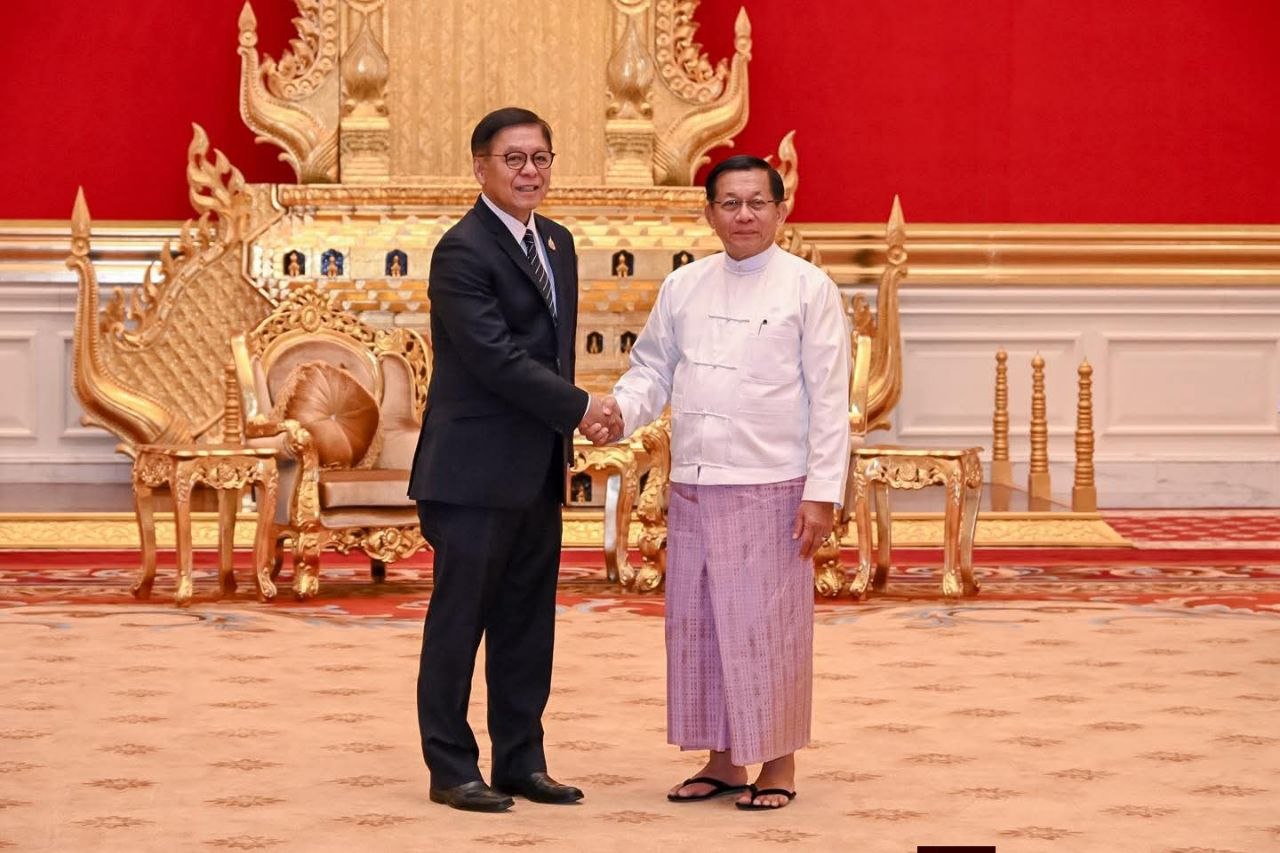
In a major diplomatic development signaling a shift in Southeast Asian regional engagement, Myanmar regime leader Min Aung Hlaing is set to meet with Thai Prime Minister Anutin Charnvirakul in Bangkok Aug. 6-7.
The visit will mark Min Aung Hlaing’s second official trip to an Association of Southeast Asian Nations (ASEAN) member state since being inaugurated as president by a pro-military parliament on April 10, following tightly controlled elections.
The upcoming bilateral summit comes as Thailand pushes a “dual-track” approach to address pressing border crises, even as internal debate deepens over ASEAN’s long-stalled peace plan.
A ‘dual-track’ border focus: Scams, drugs, and security
Speaking to reporters in Manila, Thai Foreign Minister and Deputy Prime Minister Sihasak Phuangketkeow confirmed the August bilateral sit-down, emphasizing that Bangkok must pragmatically manage urgent national security issues stemming from its shared 1,501-mile (2,416 km) border with Myanmar.
Key priorities for the bilateral talks include:
- Transnational Crime & Scam Networks: Dismantling industrial-scale cyber scam centers operating along the border that exploit thousands of foreign traffic victims.
- Narcotics Trafficking: Stemming the flow of illicit drugs pouring through porous border corridors.
- Conflict Facilitation: Exploring whether Thailand can help facilitate informal dialogue between Naypyidaw and ethnic armed organizations (EAOs) stationed along the border zone.
While Sihasak stated he will explicitly remind Min Aung Hlaing of his commitments under ASEAN’s Five-Point Consensus, he managed expectations regarding any sudden political breakthroughs.
“Our point was that we have to be realistic,” Sihasak noted. “It’s not going to happen overnight. Some progress will come incrementally.”
Resistance and rejection
The upcoming summit takes place against a backdrop of open resistance to regional diplomatic frameworks from Naypyidaw itself. O
n July 9, Myanmar’s pro-military parliament—dominated by the proxy Union Solidarity and Development Party (USDP)—officially labeled ASEAN’s Five-Point Consensus “irrelevant,” further highlighting the gap between ASEAN expectations and regime policy.
Despite this pushback, regional diplomats are seeking ways to restructure their engagement. Speaking in Manila on July 21, Philippine Special Envoy Ma. Theresa P. Lazaro—representing the 2026 ASEAN Chair—announced that the regional bloc is actively considering appointing a permanent special envoy to Myanmar.
Lazaro conceded that ASEAN’s traditional yearly rotation system, tied to the rotating chairmanship, has “not really been effective” in maintaining long-term political momentum.
Backlash over ‘informal’ engagement
The diplomatic push has exposed deep fractures within the regional bloc and civil society:
Recent Regional Engagement Timeline
├── July 9, 2026: USDP-led parliament declares 5PC "irrelevant"
├── July 12, 2026: Special Envoy Lazaro holds informal talks with regime FM Tin Maung Swe in Bangkok
├── Mid-July 2026: Lazaro meets separately with NUG & SCEF resistance representatives in Pattaya
└── July 21, 2026: ASEAN considers permanent special envoy appointment to replace yearly rotation
Lazaro drew heavy criticism after breaking a five-year precedent on July 12 by holding informal face-to-face talks in Bangkok with regime Foreign Minister Tin Maung Swe, before holding separate consultations in Pattaya with opposition figures from the National Unity Government (NUG) and the Steering Council for the Emergence of a Federal Democratic Union (SCEF).
Rights groups, including ASEAN Parliamentarians for Human Rights (APHR) and the Special Advisory Council for Myanmar (SAC-M), strongly condemned the direct meeting with the regime foreign minister, warning that engaging senior regime representatives rewards military atrocities while eroding ASEAN’s own peace roadmap.
In response, Lazaro forcefully defended the bloc’s diplomatic maneuvers, slamming her critics for spreading what she termed “malicious and misleading” distortions of regional peace efforts, maintaining that direct, multi-stakeholder dialogue remains the only viable path to de-escalation.