


Undocumented single mothers in Mae Sot raise children in the face of abuse and abandonment, but experts say creative education could offer a path to break the toxic cycle
Text and photos by Clemens Choy and Sara Bapat
MAE SOT, Thailand – Ms Thi Dar Aye lightly presses a branch from the Thanaka tree onto a rounded stone slab, grinding it down in circles, pausing to sprinkle water. Gradually, a thick yellow paste forms.
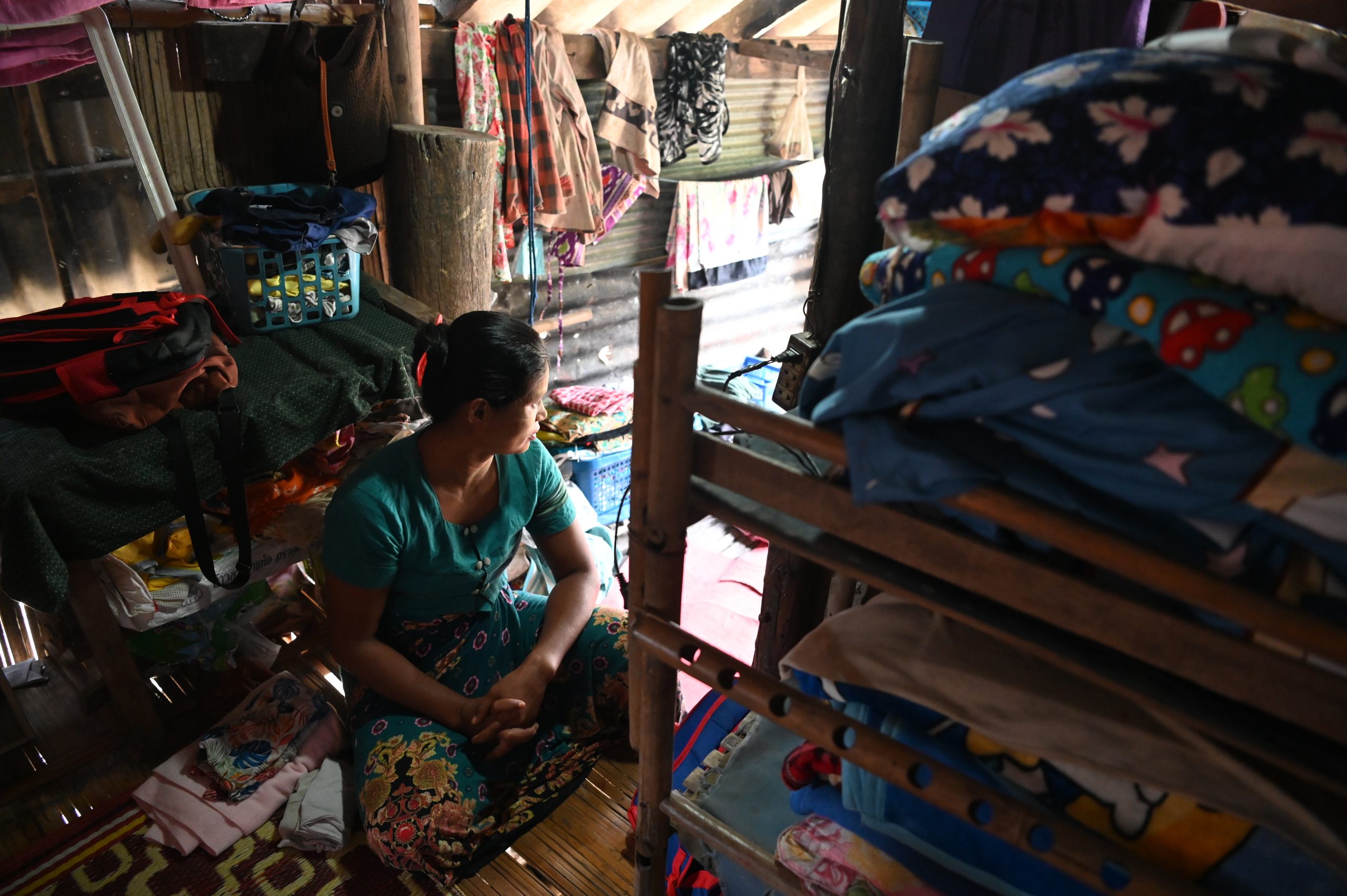
She calls out to her five-year-old twins who come running into the kitchen, the only place in her tiny hut illuminated by the sun. With her finger, Ms Thi Dar Aye swipes a dollop of Thanaka paste from her stone slab, glistening gold under the sunlight. She gently glides it over her eldest son’s cheeks and forehead.
Now, it is her youngest son’s turn. Ms Thi Dar Aye’s eldest scampers back into the shadows of the hut, darting past laundry baskets packed to the brim and a line of school uniforms hanging from their zinc roof.
After tending to her children’s skin, other responsibilities pile on – laundry to wash, meals to cook, uniforms to prepare, and two young boys to send off to school, all on her own.
Ms Thi Dar Aye is only one of the many undocumented Burmese single mothers who fled to Thailand.
According to Global Child Advocates (GCA), a non-governmental organisation that supports vulnerable parents and children, over 85 per cent of the families they help are single-mother households.
Women in the single-mother community are often cheated on, abandoned, or abused by their husbands, says GCA – the last of which Ms Thi Dar Aye knows all too well.
Ms Thi Dar Aye’s ex-husband left when her children were only four months old.
“He asked me to sit and eat dinner together, but I told him that I would eat later as I had chores to do. He got angry and threw away all the meals I prepared. We got into an argument and he started beating me till I bled,” Ms Thi Dar Aye recalled.
The incident took place a day after her son came back from the hospital after being sick for 15 days. According to her, her ex-husband was having an affair with another woman while she was taking care of her son in the hospital.
A few months after the incident, her ex-husband married another woman, leaving her and their children to fend for themselves.
Owing to the fact that many Burmese migrants are undocumented, marriage is largely symbolic and is not recognised by the law.
Dr Khin Mar Mar Khin, a Burmese anthropologist at the University of Oxford, said that in Burmese culture, men are expected to be dominant, while women are supposed to be submissive. With years of military and authoritarian rule in Myanmar, many men grow up in a system where obedience, fear, and violence become normal means to exert control.
She added: “In Myanmar, men may not be perceived as ‘manly’ if they are not associated with the military. So what some do is to extend their masculinity by indulging in alcohol and using violence towards their spouses. Men have to be tough, non-emotional and aggressive.”
Ms Thi Dar Aye remembers her ex-husband’s father telling him that he does not need to give any support to his family after he leaves.
“You don’t need to help, because when my wife had kids, I also left her just like that,” she remembers him saying. He also encouraged him to drink alcohol and talk back to me, she added.
Her husband left her with debt amounting to 27,750 baht (S$1,115 or $885 USD). But finding work has not been easy for Ms Thi Dar Aye. Most jobs available to Burmese migrants in Mae Sot involve physical labour, such as planting rice or picking corn.
“Before, I could still pick the corn,” she said, pressing her hand lightly against her stomach. “But after my C-section, my belly hurts when I carry anything heavy.”
Eventually she found work at a small shop, where she earned around 100 to 150 baht depending on how much she sold at the shop.
But every day began before dawn. She would rise at 3 a.m. and head to work. By 6:30 a.m., she was back home, getting the twins ready to go to school and feeding them curry she had brought back from the shop. She would walk them to school and by 8:00 a.m. sharp, she was back at work, returning only in the evening to pick them up.
However, Ms Thi Dar Aye eventually lost her job due to poor footfall.
Finding a helping hand
The financial strain is evident. As an undocumented migrant, Ms Thi Dar Aye cannot access the support that Thai citizens receive.
In 2020, she was rushed to the emergency centre at Mae Tao Clinic after she was injured during an incident of abuse by her ex-husband.
A staff member at the clinic told Ms Thi Dar Aye about GCA. She reached out to the non-profit, who helped enroll her children into a Thai school and provided essentials such as food and housing assistance.
Yet even with that support, extra costs can quickly become overwhelming, said Ms Thi Dar Aye.
Affording clothes and shoes for school is already very difficult, she said. “Now the school tells us we need to buy sports attire for the kids. I told them I don’t have enough money for this. I just hope that I will get a job as soon as possible,” she said.
Today, she has found another job in construction, earning 200 baht per day.
GCA also helps provide unemployed mothers with opportunities to earn their own revenue. One such woman is Ms Myint Myint San, who fled Myawaddy eight years ago after enduring a troubled marriage.
In Mae Sot, she thought she had found love again and remarried – but her hopes were shattered when her second husband had an affair with another woman while she was pregnant, leaving her and her two children to fend for themselves.
She now works at Sojourn Studio, a social enterprise that creates porcelain jewellery and ornaments. She has been working there for the past two years.
“The job gives me stability,” she said. “If I do rice planting, I can only work during the season. Here, I can work all year round.” Her income allows her to send a small stipend to her family in Myanmar.
But working does more than put food on the table for her – it gives her a sense of pride and control over her own life, helping her to maintain her dignity. “I want other women to work too,” she said. “If not, they will keep facing difficulty.”
Although a vast majority of single parent families among the migrant Burmese population in Mae Sot involve single mothers, there is also a small margin of single fathers who face similar struggles.
Mr Aung Aung’s wife left him to live with another man a year and a half after they had their second child. She took their eldest with her, without Mr Aung Aung’s knowledge.
Prior to this, Mr Aung Aung claimed that his ex-wife started to display a change in behaviour after their marriage.
“She started coming back home late, she started drinking alcohol, and shortly after we got married, she went outside and found another husband,” Mr Aung Aung said.
When Mr Aung Aung finally found his eldest child, his ex-wife refused to let her leave. Concerned about his daughter’s safety while living with another man, he sought help from the village elder. Only then did he manage to bring her home.
In 2022, he received news that he had contracted kidney disease and had to stop work. He was barely able to walk, only managing to take five steps at a time.
Unable to earn an income, the family struggled to find food and proper housing. He then approached GCA, who provided his family with food and helped them to find safe housing.
The hidden toll on children
Under immense economic pressure, family stress can escalate, at times spilling over into physical or emotional harm towards children — even in intact families.
University of Oxford’s Dr Khin Mar Mar Khin says that in Burmese families, a lot of pressure is placed on children to become successful, to lift families out of economic insecurity.
She also adds that Myanmar’s unstable political climate also enhances the psychological trauma faced by children, with Burmese livelihoods often threatened by displacement as a result of military rule, and broken families.
In Mae Sot, the Early Childhood Development Centre (ECDC) cares for children while their parents work.
Staff pay close attention to children’s behaviour, looking out for signs of emotional and physical abuse that may result from family instability. This can include hitting others or swearing. Ms Naw Paw Day Nyar, director of the programme, said many parents do not realise the impact of their behaviour.
“Hitting is common because it’s how they were raised, but they don’t know that it’s not okay. And sometimes it’s emotional abuse without them knowing,” she said. “They might not hit their children, but they use fear, harsh words or threats as a way to discipline them.”
Breaking the cycle through education
Mr Daniel Nyan, GCA’s Asia director, holds parenting classes twice a year. Topics include positive parenting, psychological security, and attachment cycles, the last being a concept explaining how parents’ actions can directly shape a child’s sense of security.
“These are basic things that people in other countries may learn in their school system or in family settings. But for many parents here, they are quite shocked to learn about ideas like attachment cycles, even among those who are well-educated,” Mr Nyan said.
Dr Khin Mar Mar Khin said that the biggest problem Burmese society faces is a lack of education, adding that parents need to unlearn certain beliefs cultivated under military rule and dictatorship.
For education to be more effective and accessible, she suggests using art forms like music and songs as mediums to convey messages. She advocates for more informal, creative education to help the Burmese cope with trauma.
“People are sitting on an explosive ball of emotions. They worry about their family, if they will be arrested or killed. In Burmese culture, they don’t trust or talk to others about their lives. That’s why I feel that through artistic expression, they would be able to release some tension from the dictatorship,” she said.


This article is part of a package produced by a group of final-year undergraduates from Nanyang Technological University’s Wee Kim Wee School of Communication and Information, for the programme Going Overseas For Advanced Reporting, or Gofar. They reported from a town called Mae Sot at the Myanmar-Thailand border in July and August 2025. There, they met migrants and refugees displaced by six decades of civil war in Myanmar and are rebuilding their lives in Thailand.