


By *Alambara
An investigation into the Thanlyin refinery project and its role in reducing the military regime’s dependence on imported aviation fuel.
Myanmar’s military is moving to produce its own Jet A-1 aviation fuel
Myanmar’s military regime is moving to produce Jet A-1 aviation fuel domestically, with Chinese companies supplying the design, equipment and infrastructure for the project, a DVB investigation has found.
A review of publicly available company records, government statements, corporate websites and vessel-tracking data shows that the Thanlyin refinery, on the outskirts of Yangon, is being revived specifically to reduce the military’s reliance on imported jet fuel, a dependence that has made it vulnerable to international sanctions, foreign-currency shortages and swings in the global fuel market.
As fighting has intensified across Myanmar, aviation fuel has become one of the military’s most important strategic resources, alongside weapons and ammunition.
The air force increasingly provides close air support to ground troops, transports personnel and equipment, and strikes ground targets, including in civilian-populated areas. The fuel that keeps those aircraft flying has become critical to sustaining the regime’s air operations.
The project involves the state-owned Myanma Petrochemical Enterprise (MPE) and companies linked to the military’s existing aviation-fuel supply network.
DVB also found that several Chinese companies are involved in the project’s engineering, equipment manufacturing, construction, installation and pipeline infrastructure.
Aviation-fuel imports more than double in a year
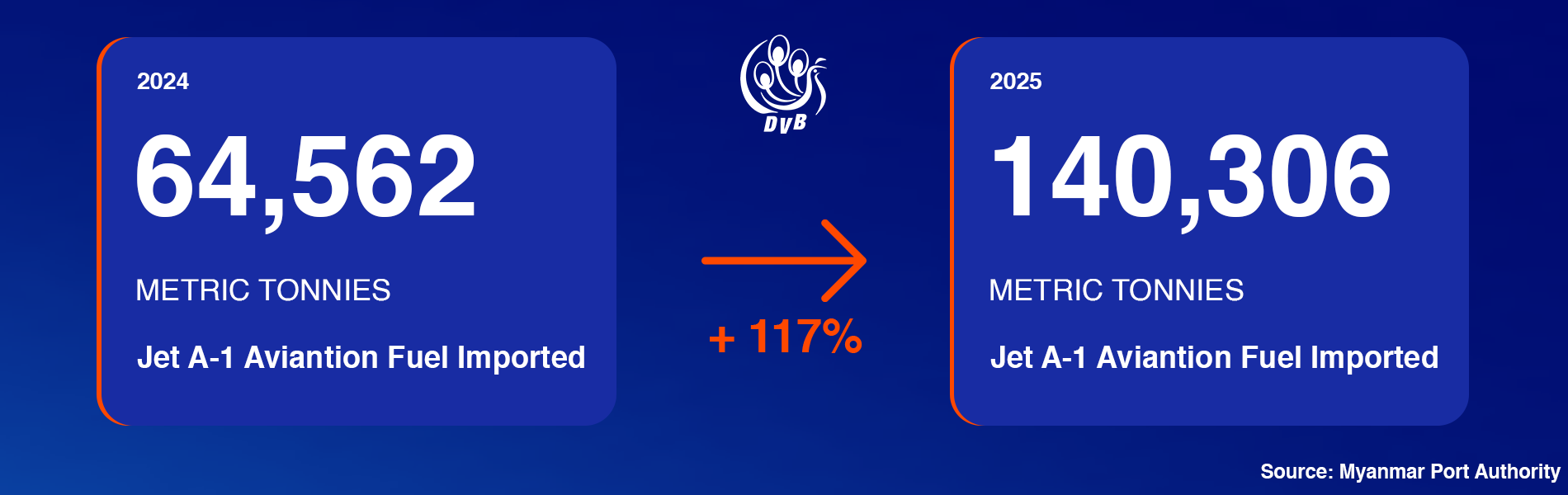
Myanmar imported 64,562 metric tonnes of aviation fuel in 2024, according to data from the regime-controlled Myanmar Port Authority.
That figure rose to 140,306 metric tonnes in 2025, an increase of 75,744 tonnes, or roughly 117 percent, in a single year. Imports in 2025 were approximately 2.17 times the 2024 level.
Research by Amnesty International into Myanmar’s aviation-fuel supply chain identifies two main types entering the country, aviation gasoline, also known as Avgas, and Jet A-1. Jet A-1, which can be used by both military and civilian jet aircraft, is the main type imported.
Following the 2021 military coup, several countries imposed sanctions on companies, business figures and regime-controlled entities involved in supplying aviation fuel to Myanmar.
Human rights organisations have documented how participants in the supply chain have attempted to circumvent those measures, changing company names, using new intermediaries and obscuring information about vessel, cargo and corporate ownership.
Myanmar’s limited refining capacity
Myanmar has three main oil refineries, all overseen by MPE under the Ministry of Electricity and Energy (MoEE). They are the No. 1 Refinery (Thanlyin), the No. 2 Refinery (Chauk), and the Petrochemical Complex (Thanbayarkan).
Only Thanbayarkan is currently operating. Thanlyin and Chauk remain shut down.
According to the MoEE, Thanbayarkan can process about 300,000 gallons a day but runs for only around 14 days each month, a constraint the ministry has attributed to limited crude-oil supply rather than scheduled maintenance.
Myanmar would need to refine at least eight million tonnes of crude oil annually to meet total domestic demand for petroleum products, according to figures cited in project documents.
Current domestic refining capacity is estimated at only around three percent of that requirement. That benchmark covers all refined petroleum products, not aviation fuel specifically.
Jet A-1 self-sufficiency is a narrower, though related, goal. The country remains heavily dependent on imported petroleum products and aviation fuel, requiring large amounts of foreign currency at a time when the military authorities are under international sanctions.
A refinery shut since 2017, ordered back into service
Since seizing power, military regime leader Min Aung Hlaing has introduced measures to control foreign-currency spending and restrict imports, and has ordered the revival of several industrial and energy projects suspended under previous governments. The Thanlyin refinery is among them.
Construction of the No. 1 Refinery (Thanlyin) began in 1925 under British colonial rule and was expanded in several later stages. Operations were suspended in 2017 because of inadequate crude-oil supplies, ageing infrastructure and concerns over product quality.
Beginning in late 2023, Min Aung Hlaing publicly called for the facility to be restored as quickly as possible. Repair work and equipment installation later began, divided into two phases.
The first phase is designed to process 500,000 tonnes of feedstock annually. Once the second phase is complete, which is scheduled for 2028, total annual processing capacity is expected to reach three million tonnes.
The MoEE estimates the completed project could meet about 43 per cent of Myanmar’s total demand for petroleum products.
How the refinery would produce Jet A-1
Official regime statements describe the project as an effort to improve domestic fuel self-sufficiency in general. But DVB’s review of the project’s technical specifications and installed equipment indicates that Jet A-1 production is a major, specifically-engineered component of the development, not an incidental byproduct.
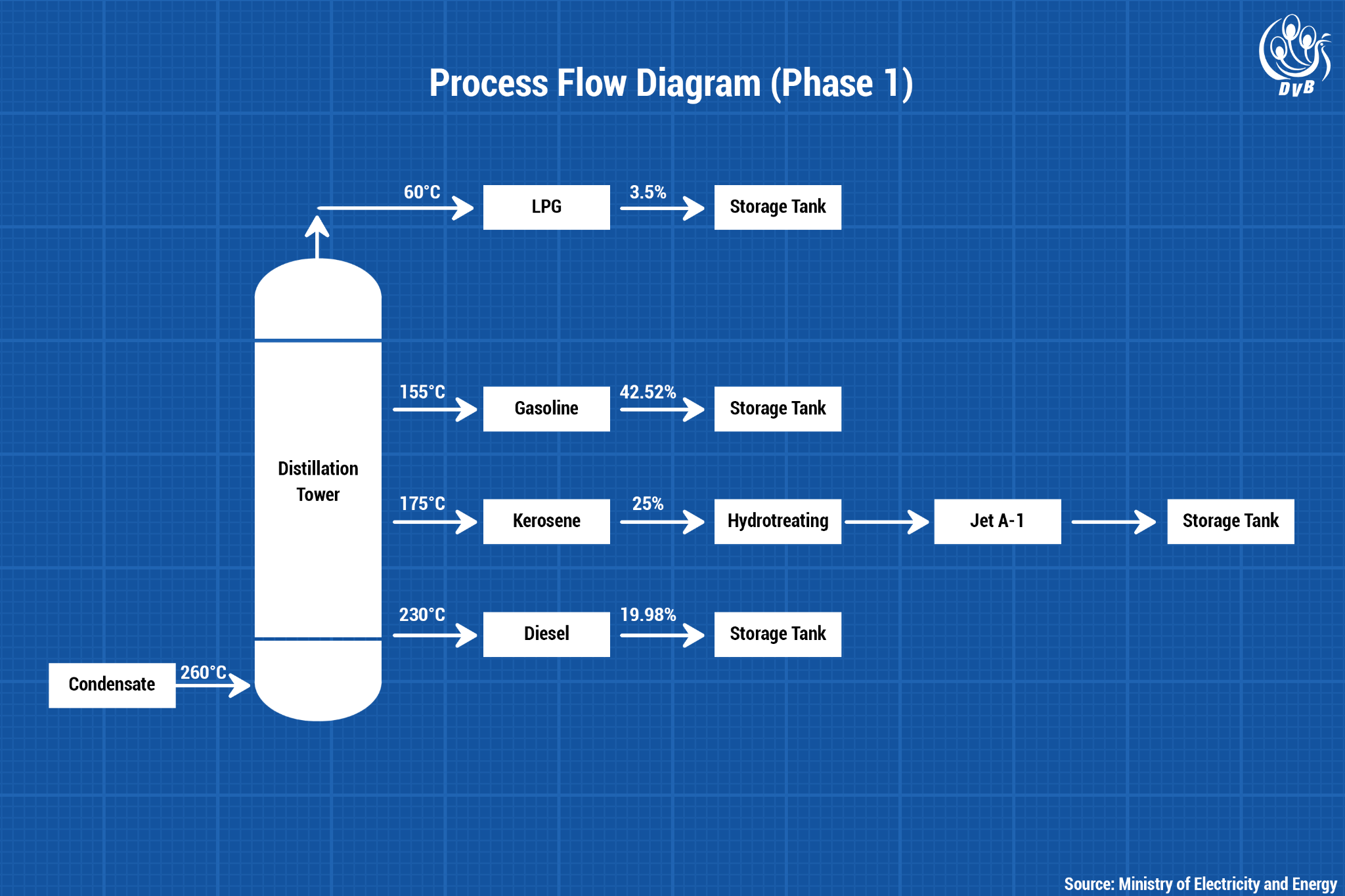
In the first phase, condensate from the offshore Zawtika gas field is expected to be the main feedstock. The condensate would be separated and processed into liquefied petroleum gas (LPG), gasoline, kerosene and diesel.
The kerosene would then undergo hydrotreating, a refining process that removes sulphur and other unwanted compounds, to produce Jet A-1. DVB has not been able to independently verify whether the fuel produced would meet international aviation-fuel quality standards.
A new company with ties to the military’s existing fuel network
The Thanlyin project is led by Thanlyin Refinery Company Limited and Thanlyin Petrochemical Company Limited. Thalyin Petrochemical Company Limited is a joint venture between Thanlyin Refinery Company Limited and MPE.
Records from Myanmar’s Directorate of Investment and Company Administration (DICA) show that Thanlyin Refinery Company Limited was registered in November 2024 as a private company, while Thanlyin Petrochemical Company Limited was registered in December 2025 under the 1950 Special Company Act, as a private company limited by shares.
This is a load-bearing finding. According to research by Justice for Myanmar, the directors of Thanlyin Petrochemical Company Limited include Myint Mo Kyaw Zin, a director of Asia Sun Energy Company Limited, and Yin Yin Aung, a director of National Energy Prime Aviation Services Company Limited (NEPAS).
Amnesty International and Justice For Myanmar have identified both Asia Sun Energy and NEPAS as participants in the military regime’s aviation-fuel supply chain.
In other words, the corporate structure of the entity building the Thanlyin Refinery project overlaps directly with the network that already supplies fuel to the military’s jets.
That link, more than any single piece of equipment, is what connects a nominally civilian refinery project to the military’s existing fuel-procurement apparatus, and suggests the project may not be intended solely for civilian petroleum production.
A Singapore-registered contractor with a Chinese parent
The project’s engineering, procurement, construction, operations and maintenance (EPC-OM) contract was awarded to Peiyang Chemical Engineering Service Corporation Pte. Ltd. (PCCS), a Singapore-registered subsidiary of Peiyang Chemical Equipment Co., Ltd., based in Tianjin, China.
According to company statements, PCCS built two of the project’s main processing facilities. The first is an Atmospheric Distillation Unit, or ADU, which heats and separates condensate and other feedstock into different fuel products.
The second is a Jet Fuel Refining Unit integrated with a hydrogen-generation unit, intended to treat kerosene and produce Jet A-1.
DVB contacted Myint Mo Kyaw Zin, Yin Yin Aung and Peiyang Chemical Engineering Service Corporation Pte. Ltd. to ask about their roles in the refinery project. None had responded by the time of reporting.
Equipment tracked from Tianjin to Thilawa
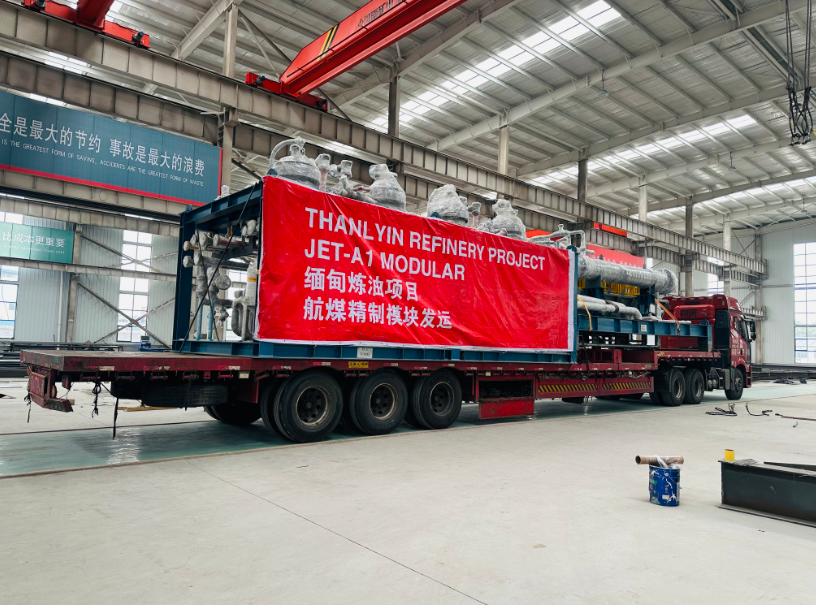
The Thanlyin refinery is a modular facility, meaning its major components are manufactured off-site and later assembled at the project site. Key equipment for the refining and Jet A-1 units was manufactured at a company facility in Tianjin before being shipped to Myanmar.
Photographs and information published by PCCS indicate that components for the Jet A-1 production unit were delivered to Tianjin port around mid-October 2025.
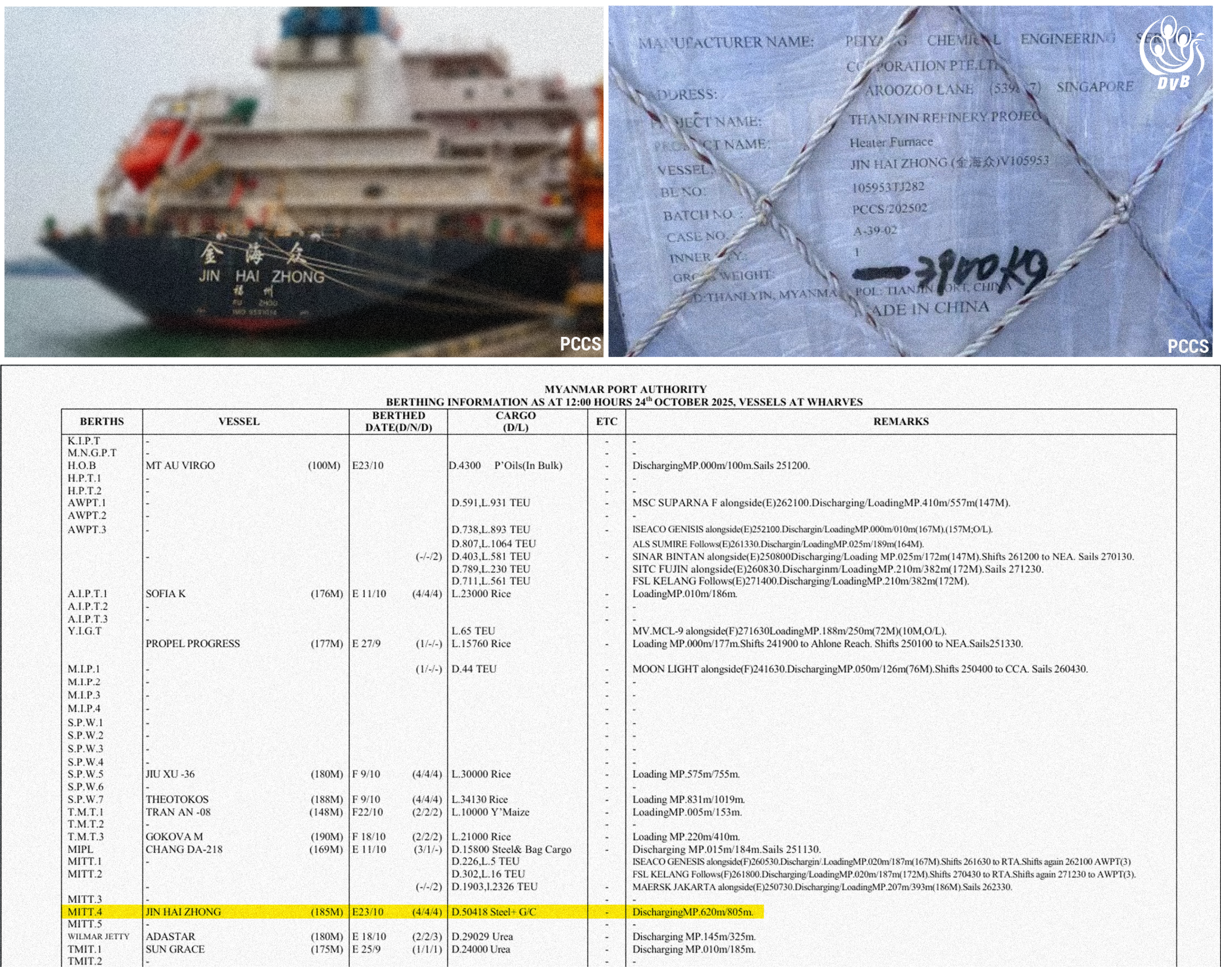
DVB cross-referenced the company’s own statements against vessel-movement records and found the equipment was carried aboard a Chinese cargo vessel, the Jin Hai Zhong, which departed Tianjin and arrived at Thilawa port, Yangon Region, on October 23, 2025, where cargo-handling operations were recorded. The date and route match PCCS’s published shipment timetable.
Jet A-1 production targeted for October 2026
Installation work continued after the equipment arrived. Project information reviewed by DVB states that, by July 2026, installation was complete for the Atmospheric Distillation Unit, identified as Unit 201, the Jet A-1 production facility, identified as Unit 202, and the project’s utility units.
The first phase was originally due to finish by the end of 2025. Delays pushed the target to September 2026. Under the revised schedule, the refinery is expected to begin producing gasoline, kerosene and diesel that month, followed by Jet A-1 in October.
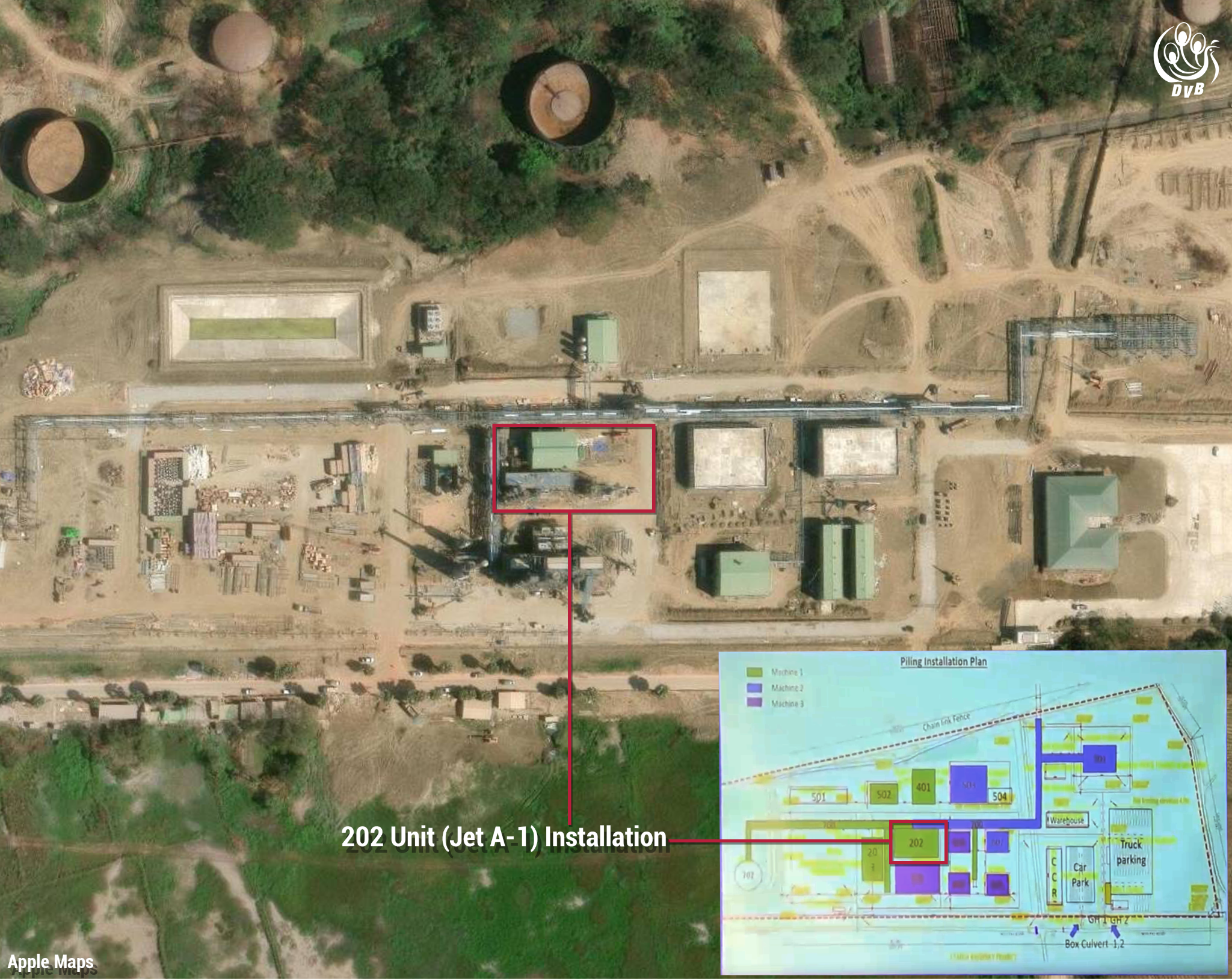
PCCS says the first phase is designed to produce 150,000 tonnes of Jet A-1 annually. Once both phases are complete, total annual Jet A-1 production is expected to reach nearly 250,000 tonnes, meaning the much larger second phase, which triples the refinery’s overall crude-processing capacity, is expected to add comparatively little additional jet-fuel output.
Project statements indicate that phase is oriented mainly toward RON 92 and RON 95 gasoline and premium diesel rather than aviation fuel, a distinction addressed further below. Project statements claim the combined Jet A-1 volume would be sufficient to meet all of Myanmar’s domestic aviation-fuel demand. DVB has not been able to independently verify that assessment or the calculations behind it.
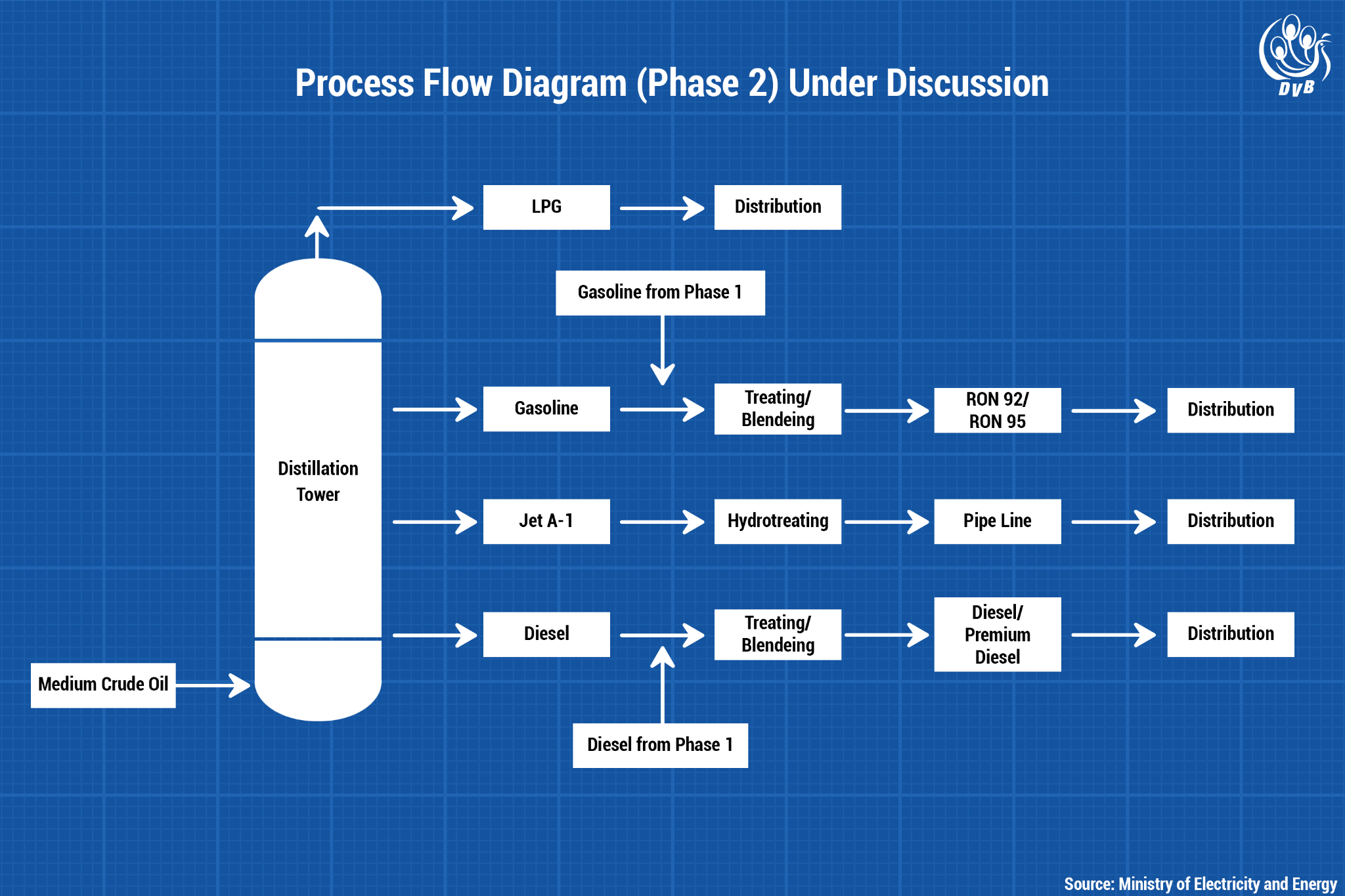
Shanghai Hanxing Energy, a Chinese company, is reportedly involved in design work for the second phase, which is expected to use medium crude oil as feedstock and produce RON 92 and RON 95 gasoline as well as premium diesel. The completed refinery is planned to reach an annual processing capacity of three million tonnes.
Pipelines, roads and a terminal linking refinery to port
Producing aviation fuel is only part of the project. The military authorities also need infrastructure to store, transport and distribute it. According to the MoEE, new pipelines have been installed to move aviation fuel and other petroleum products from Thanlyin to storage facilities in the Thilawa area, and a new road has been built connecting the refinery to the storage terminals.
The ministry said a reserve pipeline had also been installed to carry aviation fuel to a jetty, for cases where the product needs to move by tanker vessel.
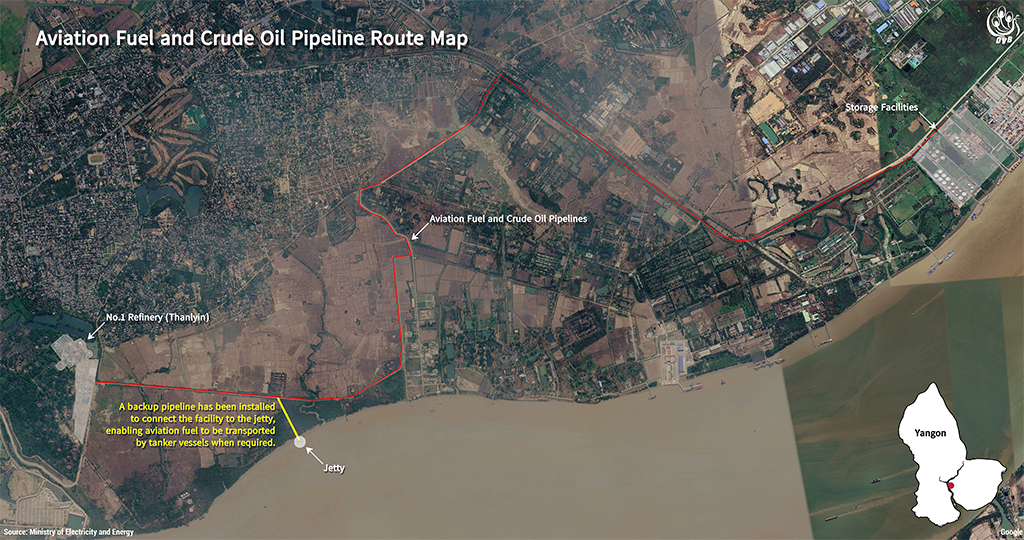
In December 2025, Ko Ko Lwin, then minister of the Ministry of Energy, which has since been folded into the Ministry of Electricity and Energy, inspected the Myan-Oil Terminal linking the Thanlyin refinery with Thilawa port, according to military regime media.
The inspection is further evidence that authorities are building out a system to store, transport and distribute fuel produced at the refinery.
CNPC and Centerway Steel
Project information also indicates that China Petroleum Pipeline Engineering Co., Ltd., a subsidiary of China National Petroleum Corporation (CNPC), has been involved in renovating and constructing fuel-storage tanks and installing pipelines within the refinery compound, while Chinese company Centerway Steel Co., Ltd. supplied the steel pipes used in that work, according to information published on the company’s website.
Taken together, the records show Chinese companies involved across nearly every layer of the project, including plant design, equipment manufacturing, storage tanks, pipelines and distribution infrastructure.
A second Chinese-backed refinery at Thanbayarkan
The military regime has also sought energy cooperation with Russia and countries in the Middle East, but China has emerged as the central participant in several of Myanmar’s major energy projects.
Thanlyin is not the only one. A separate refinery capable of processing up to two million tonnes of crude oil annually is being developed at the Petrochemical Complex (Thanbayarkan) in Minhla Township, Magway Region, led by Sino-Pipeline International (SPI) which is an overseas oil and gas pipeline operator affiliated with CNPC, and expected to process crude delivered through the China-Myanmar crude-oil pipeline.
If both the Thanlyin and Thanbayarkan projects become fully operational, the military regime could significantly reduce the volume of petroleum products and aviation fuel it imports directly from abroad.
“A military target,” rights group warns
Justice for Myanmar condemns the involvement of Chinese companies in the Thanlyin refinery project, which it says risks expanding the military regime’s capacity to refine aviation fuel domestically.
This sustains the junta’s air campaign against Myanmar’s population, which the group says has repeatedly hit schools, hospitals, religious sites and residential areas.
The group said the Chinese companies supporting the project must be aware that aviation fuel is routinely used for military operations and companies could not avoid responsibility for the consequences of subsequent airstrikes, arguing that jet fuel in the regime’s hands has repeatedly proven to be a “deadly commodity.”
Justice For Myanmar has called for comprehensive sanctions on the military’s fuel supply chain, including the formal designation of MPE for expanded targeted sanctions and a ban on the supply of jet fuel.
According to data from the Armed Conflict Location & Event Data Project (ACLED), the military carried out 2,121 air attacks by aircraft during 2025, a 21 per cent increase compared with the 2024 total.
DVB monitoring has also identified a shift in tactics. Rather than deploying a single aircraft against a target, the military has increasingly used two or more aircraft in coordinated bombing missions, which is also likely to increase aviation-fuel consumption.
Radi Ohm, a lecturer who joined Myanmar’s Civil Disobedience Movement (CDM) and now works with a mobile medical team in resistance-controlled areas, said the airstrikes were already causing civilian deaths and injuries even while the military still relies on imported fuel.
“Even now, while they still have to import fuel from abroad, they are attacking this much. If they start producing it themselves, how much worse will the situation become? Right now, they are already carrying out airstrikes continuously, and civilians are dying and being injured,” she said.
Radi Ohm noted that the airstrikes have continued even during the current Buddhist Lent, a period Buddhists observe with sacred precepts and religious ceremonies, saying monks holding a robe-offering ceremony were killed in a bombing.
“That is why, even now when it is already this bad, I think if they start producing jet fuel themselves, their cruelty will grow worse, and the threat to the people will increase even more,” she said.
From energy facility to strategic military infrastructure
Myanmar’s military air operations remain heavily dependent on imported Jet A-1. If the Thanlyin project comes online as planned and meets most or all domestic demand, the military regime could blunt the impact of international restrictions on its aviation-fuel supply, and the refinery, along with Myanmar’s other refining facilities, could become more than civilian energy infrastructure. It could also serve as a strategic asset supporting the regime’s air operations over the long term.
The Ministry of Defence (MoD) under the National Unity Government (NUG) has described the military regime’s logistical resources as supporting the commission of war crimes and therefore constituting military targets.
“The terrorist military regime’s logistical resources provide essential support for the commission of war crimes and are therefore military targets,” the NUG Ministry of Defence told DVB, adding that it was working, within the limits of its capabilities, to disrupt those supply networks.
Backed by Chinese technology, equipment and infrastructure, the Thanlyin refinery is scheduled to begin producing Jet A-1 aviation fuel in October 2026.
DVB has not been able to independently verify whether the project will begin operating on schedule, whether the fuel it produces will meet international standards, or how production will ultimately be divided between civilian and military use.
Even so, the corporate records, equipment shipments, construction updates and buildout of storage and pipeline infrastructure documented here indicate that the military regime is accelerating efforts to close one of its key vulnerabilities, its dependence on imported aviation fuel.
*Alambara is the pseudonym of a data analyst on the DVB data team, where they work on research, data support for the newsroom, and open-source investigation to trace the military regime’s networks.