


Guest contributor
Shafiur Rahman
It has been just over a month since the Arakan Rohingya National Council (ARNC) burst onto the scene – and already the organisation faces a major credibility blow. Aung Kyaw Moe, the deputy minister for human rights in Myanmar’s National Unity Government (NUG), told me that the revolutionary administration has no plan to engage with the ARNC.
“I don’t think [the] NUG will engage in such a circumstance where an organisation has created confusion and chaos. And as long as I am there, there won’t be any engagement with such organisations,” he added.
For a group claiming to represent the unified political aspirations of the Rohingya, this public rejection by the highest-ranking Rohingya in Myanmar’s democratic resistance movement is a bombshell.
While rejecting the ARNC, Aung Kyaw Moe himself is a key figure in a different organization, the Rohingya Consultative Council (RCC), which he has helped position as a political body intended to unify various factions.
The ARNC was announced on July 13. It styled itself as a historic breakthrough, claiming widespread consultation across Rohingya communities in exile and within the refugee camps of Bangladesh.
The launch materials promised unity under the banner of “one policy, one vision, one future.” It sought immediate international recognition as the legitimate voice of the Rohingya.
But the backlash was just as swift. Within days, criticism erupted across social media and diaspora circles. The ARNC, various Rohingya voices argued, bore the hallmarks of a top-down initiative rather than a genuinely consultative effort.
In the weeks that followed, the ARNC issued a rebuttal of an International Crisis Group (ICG) report and welcomed a Fortify Rights report on abuses allegedly perpetrated by the Arakan Army (AA) in Rakhine State.
The ARNC then garnered some press attention by sharing graphic photos of the purported AA attacks in northern Rakhine. There were also video messages, high-production visuals, and Facebook posts promoted with paid advertising.
Dr. Khubybe, the director of international engagement at the Rohingya Centre UK (RCUK), said the community is fatigued by empty declarations.
“What we need now is real, visible action that brings genuine hope. Leadership is serious – like uniting fragmented factions, building coordination with other political and advocacy organisations, and preparing solid political structures. Words alone no longer inspire.”
Shwe Maung, a former elected member of Myanmar’s parliament, was the first to allege that the ARNC had appropriated both the name and visual identity of his own initiative, the Arakan Rohingya National Congress.
He stressed that real leadership must move beyond publicity while acknowledging that statements and press releases are vital in an era of “disinformation” and “imposed silence.”
“The Arakan Rohingya National Congress is not here for noise alone,” he said. “We are here for nation-building.”
Razia Sultana, a prominent Rohingya lawyer and advocate, questioned the need to launch a new group at all. “They could have issued these statements through other organisations they themselves created. Why another banner?”
Much of the debate does not hinge on the content of ARNC’s most high-profile intervention – their rebuttal of the ICG report The Dangers of a Rohingya Insurgency.
Rather, the rebuttal is revelatory. It signals something more foundational than mere disagreement with the report’s conclusions.
In contrast to my own critique, which faulted the ICG for soft-pedalling Bangladesh’s enabling role in Rohingya militarisation, the ARNC statement reads more like a carefully constructed defence of Dhaka’s policies.
It does not challenge the core evidence presented by the ICG. Instead, it takes offence at the insinuation that Bangladesh’s security agencies could be linked to armed groups or involved in recruitment.
It interprets such framing as an unjust “insinuation of a hidden agenda” that unfairly undermines Bangladesh’s “consistent call for voluntary return and stability.”
This rhetorical defensiveness, paired with its silence on issues like the destruction of No Man’s Land, crossfire killings by Bangladeshi forces, and the controversial rise of figures like Dil Mohammed, hints at something deeper – not just alignment, but possible orchestration.
The ARNC framing does not merely downplay Bangladeshi involvement; it rewrites it, portraying the state as a victim of international failure and an overburdened humanitarian actor. That narrative, carefully crafted, is difficult to read as anything but state-aligned messaging.
The most compelling evidence that ARNC is not an independent initiative but rather a continuation of Dhaka’s experiment in managed Rohingya representation lies in its entanglement with the so-called Forcibly Displaced Myanmar Nationals Representative Committee (FDMN-RC).
This body, widely known inside the camps as a vehicle created by the Refugee Relief and Repatriation Commissioner (RRRC) in collaboration with intelligence officials, has long been used to amplify government narratives under the guise of community voice.
Its “22 22 Convention” in February 2024, framed as a grassroots declaration of Rohingya resolve, was, in reality, a state-curated spectacle, with messages carefully aligned to Bangladesh’s preferred vision of early, orderly repatriation.
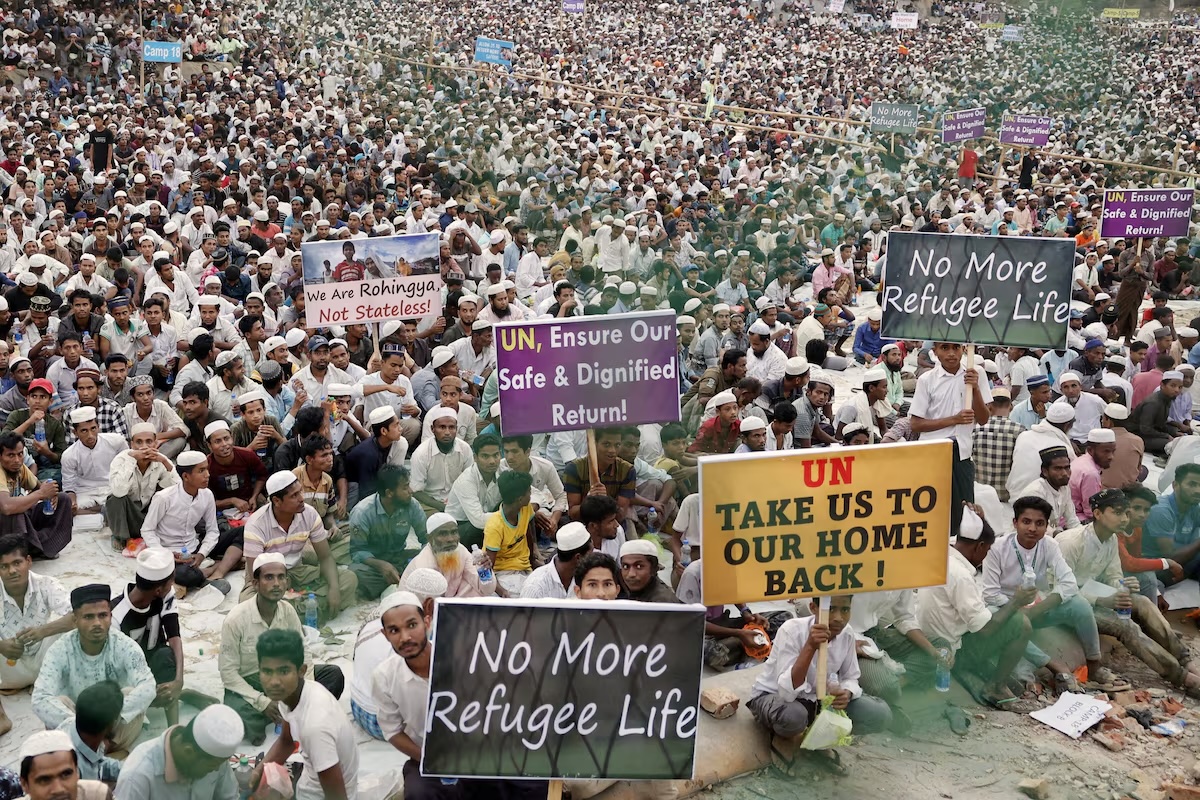
That the ARNC shares media handlers, meeting platforms, and visible stage space with the FDMN-RC is no coincidence. At a recent ARNC event in Camp 16, key FDMN-RC figures – including Kamal Hussein and MV Sawyedullah – took the microphone.
These are not peripheral players; they are well-known intermediaries in the government’s effort to manufacture consent. ARNC’s own press materials list two FDMN-RC operatives: Hussein and Mohammed Furkan. This amounts to a lot more than alignment; it is integration.
In exchange for platform, protection, and logistics, ARNC appears to have bartered away its independence. Its slogan may be “One Policy, One Vision, One Future,” but increasingly the question is – whose?
That question is not just rhetorical – it reverberates across the camps. For many Rohingya on the ground, the ARNC alignment with state-managed structures is not just suspect but alienating. Its absence from everyday life, lack of consultation, and perceived top-down imposition have fuelled skepticism.
“They never consulted us. They do what they want. That’s why these organisations become useless. They don’t really think about our nation and its future,” said Abu Taleb, a respected elder from the old “registered refugee” camps.
“No, I don’t feel ARNC fully represents us. Most people didn’t choose them, and their voice doesn’t reflect our real needs. They weren’t chosen by anyone here,” said Ayub Khan, a youth from Teknaf.
“ARNC feels more connected to external influence than older Rohingya groups that were more grassroots. Their close connection with Bangladeshi authorities and FDMN-RC makes many of us feel they might prioritise outside interests over our own,” added Khan.
It remains unclear whether all this scepticism is blunting recruitment efforts. Behind the scenes, rival bodies are locked in a quiet arms race to build credibility through numbers. One youth told me, “I’m contacted directly by both groups every day.”
Shwe Maung, the key figure in the Rohingya Congress, described the surge in support as historic. “Our rapid growth – from 39 to over 300 Congress Members in a matter of weeks – reflects a historic shift. Our people are demanding real change.”
The Rohingya Consultative Council (RCC), by contrast, emphasised selectivity over speed. “RCC isn’t in a rush to recruit,” said a spokesperson on the condition of anonymity.
“Our membership has a process: propose, review, and approval by council members in line with our goal to build a long-term political institution. While we are doing that, we’re dealing with ‘overnight councils’ aggressively poaching RCC members without any process, accountability, or clarity.”
As things stand, the ARNC path inside Myanmar’s opposition landscape looks uncertain. Aung Kyaw Moe’s on-the-record refusal to engage means the NUG, the only umbrella organization with even partial diplomatic recognition, has shut the door, at least for now.
Yet the NUG itself is no unblemished gatekeeper: its own Rohingya policy remains thin, and many refugees still weigh its promises against a record of slow movement on citizenship rights.
In other words, ARNC is not simply frozen out of a settled architecture; it is vying for space in a field whose power-centres are still shifting.
That uncertainty, compounded by the AA’s ambivalence, or antagonism, toward any Rohingya political body, leaves the Council without a clear domestic partner, even as it tries to project unity abroad.
Meanwhile, organisations preparing for the upcoming U.N. (pledging?) conference in New York face uncomfortable questions. Who gets to represent the Rohingya? Who verified their mandate? Are these groups building real institutions – or recycling old ones with better graphics?
The ARNC launched with slogans of unity and historic convergence. One month on, its credibility is under intense scrutiny. And as the NUG minister’s rebuff makes clear, legitimacy is not something that can be claimed. It must be earned.
Three ARNC media contacts were approached for comment. None of them responded.
Shafiur Rahman is a journalist and documentary filmmaker. He writes the Rohingya Refugee News newsletter.
DVB publishes a diversity of opinions that does not reflect DVB editorial policy. We’d like to hear what you think about this or any of our stories: [email protected]