


Guest contributor
Shafiur Rahman
My first message to a colleague after reading the International Crisis Group report, “The Dangers of a Rohingya Insurgency,” was just two words: strategic ambiguity.
The report circles the camp, catalogues every rogue speech and shadowy outfit, yet steps carefully around the biggest actor shaping them all: Bangladeshi state policy. It is an analysis featuring shadows without the puppeteer.
Crisis Group has had a long quarrel with Rohingya truth-telling and this is not the first time they have tip-toed around the obvious. For a decade it has framed state-directed pogroms as “communal clashes,” and its senior adviser Richard Horsey famously argued genocide is “not a helpful lens.”
In 2013, the organisation honoured ex-general Thein Sein with a peace prize at a gala event in New York while his army was driving the Rohingya off their land in Myanmar’s northern Arakan State.
That history matters because it reveals a particular incentive: Crisis Group incurs no real cost for misreading the Rohingya, but it does have everything to lose if it offends the state.
Strategic ambiguity is the bargain: keep the junta and Dhaka inside the consultation loop, and keep the lawyers calm. The stateless can be theorised, blamed, or ignored without consequence.
Crisis Group can’t or won’t name the choreographer. Access politics and legal caution require the prose to hover in limbo: enough to hint, never enough to indict. But policy built on euphemism is policy guaranteed to fail.
More than that, by not directly implicating the Bangladeshi government in orchestrating the actions of Rohingya armed groups, the report shifts the blame or responsibility from coercive governance to community pathologies – in particular, Rohingya radicalisation.
Take Dil Mohammed, the report’s multi-page character study. Until early 2024, he was known in Maungdaw Township of northern Arakan as a junta informant, smuggler and fixer for the Border Guard Police and Nasaka.
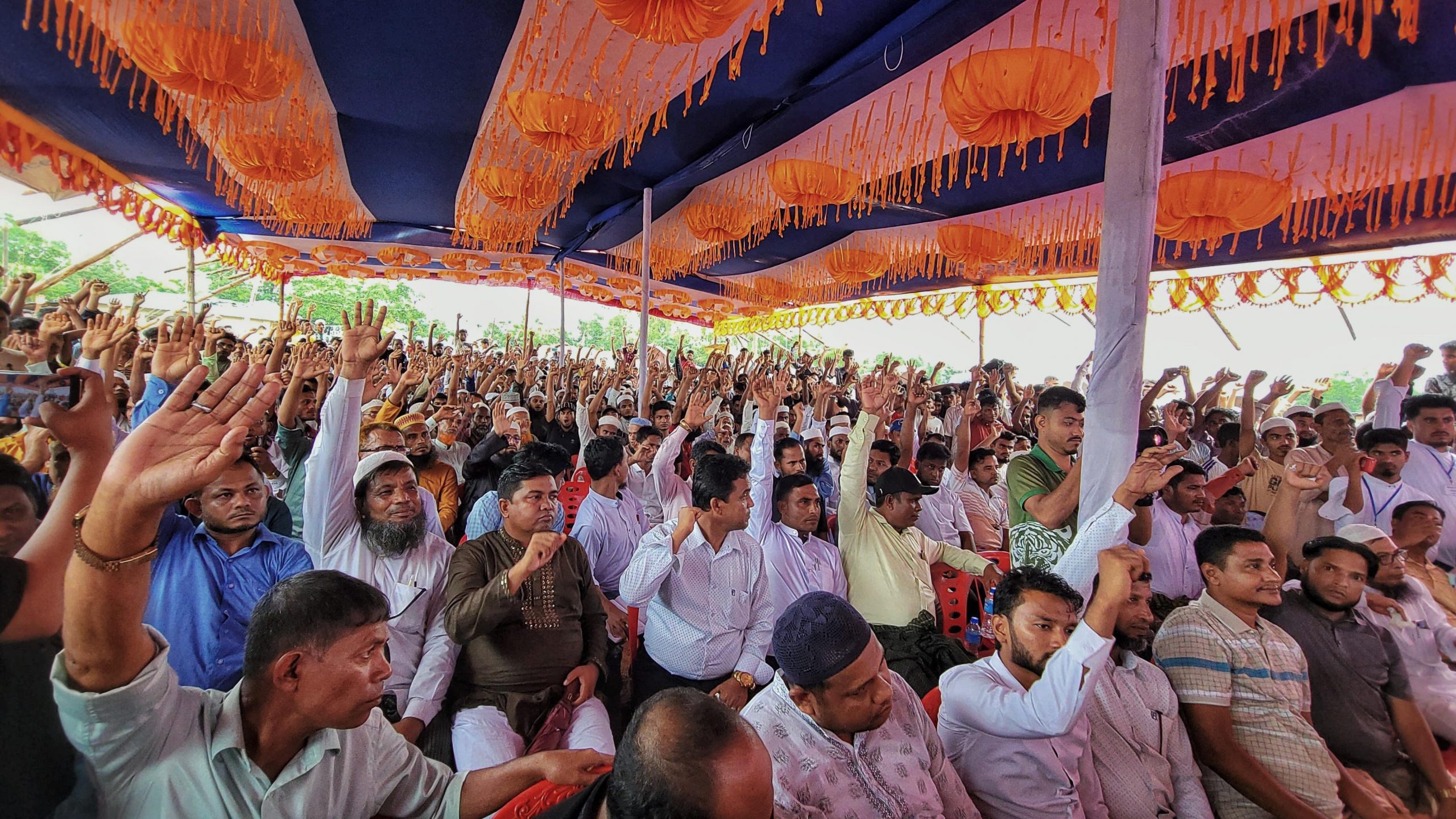
Yet only a year after slipping into Cox’s Bazar, in neighbouring Bangladesh, he is fronting stadium-size rallies and presenting himself as the camps’ future “elected” spokesman – a rise owing absolutely nothing to grassroots appeal and everything to discreet state sponsorship.
The sequence is telling. In December 2024, with Bangladeshi intelligence officers present, he roared about waging “jihad” in Arakan. By January the same officials were letting his men announce a military recruitment quota – one able-bodied male per family, or lose your rations.
Two months later, a Facebook page appeared for the newly-minted Rohingya Committee for Peace and Repatriation, and Dil Mohammed abruptly declared there was “no need to fight anyone.” Concurrently, Dil Mohammed’s close associates were given access to the OIC special envoy in February and the UN Chief António Guterres in March.
In April, he inaugurated a large office in the presence of the DGFI, or military intelligence in Bangladesh. Come June, he stood in Teknaf, banned loud wedding music, and floated a camp-wide “election” whose voter list would elect a leader to speak for all Rohingya.
Read as a timeline, the pivots march precisely to Dhaka’s beat. The jihad rhetoric served as state-licensed sabre-rattling while Bangladesh wanted to rattle the Arakan Army; the sudden pacifist turn and talk of orderly ballots arrived just as Secretary-General Antonio Guterres visited and the U.N. signalled preparations for an upcoming High level Rohingya conference.
The Crisis Group report concedes that Dhaka-based security actors “appear to tolerate, and at times quietly facilitate, RCPR meetings”, yet it leaves that phrase – “tacit tolerance” – hanging. This is as though the choreography was incidental.
This interpretative choice, by not explicitly naming the “choreographer,” transforms state tools into perceived internal vulnerabilities of the community. For instance, the report notes that declining international aid contributes to “desperation and anger” among refugees, making them more receptive to joining armed groups for “money, power and opportunities.”
This framing positions economic hardship and the subsequent turn to armed groups as evidence of “Rohingya radicalisation,” rather than the outcome of coercive governance or a state-managed lever to pressure actors.
The Crisis Group suggests that “severe cuts will deepen the disillusionment and frustration among refugees that is already playing into the hands of the budding Rohingya insurgency”, thereby implying the community’s susceptibility rather than interrogating state manipulation of these conditions.
The upshot is perverse: the more Dhaka squeezes, through deliberate policy choices like restricting livelihoods or not actively intervening against armed group recruitment (or even facilitating it), the more the report, by not definitively attributing state orchestration, blames the squeezed for looking combustible.
By treating each speech and development as a spontaneous, unpredictable shift, the report inflates the spectre of Rohingya extremism while keeping the real geopolitical lever – the Bangladeshi state – comfortably off-stage.
This analytical gap risks policymakers misreading state-managed strategic maneuvers as mere factional goings-on within the refugee population.
The same euphemism shields Bangladesh’s resurrection of the Rohingya Solidarity Organisation (RSO). And this serves as the clearest case study.
In 2021 Dhaka flipped support from Arakan Rohingya Salvation Army (ARSA) to RSO. The “upgrade” was visible in January 2023 – RSO fighters, accompanied by Bangladeshi border personnel, cleared the No Man’s Land encampment along the Myanmar-Bangladesh border, burned shelters, and hauled detainees off for questioning.
Fortify Rights later documented RSO’s commander boasting of the joint raid and detainees (indeed, survivors) describing DGFI, NSI (civilian intelligence), and Rapid Action Battalion (RAB) officers at the interrogations.
It was my reporting that first revealed covert collusion between Myanmar and Bangladesh to deploy RSO in No Man’s Land, as detailed in a leaked Myanmar junta document. This provided undeniable evidence of state orchestration, directly contradicting the official narratives.
Crisis Group, however, wraps this chain of state orchestration in carefully muted language. While acknowledging RSO “re-emerged with the alleged backing of the security forces” and that camp security “remains fragile”, it stops short of explicitly naming this “resurrection” as a government project, or detailing how its burgeoning arsenal served Dhaka’s strategic aims at the border and within the camps.
Nor does it mention the startling instances of RSO figures appearing in official photo-ops with members of the standing committee of the Ministry of Defence despite the group’s outlawed status. The images remain featured on official government websites (accessed 11 July).
By refusing to connect those dots, Crisis Group allows a once-designated crime ring to glide, unexplained, into the role of “community partner,” for want of a better phrase, while the state that choreographed the transformation stays, yet again, off-stage.
So let’s name the pitfalls. This kind of strategic ambiguity paralyses effective action by obscuring the state’s role. For example, by portraying state-licensed “jihad” rhetoric as organic extremism, it inflates the threat of ideology while concealing the actual geopolitical lever.
The optimistic narrative of Dil Mohammed speaking for refugees – potentially through an “election” whose voter list would elect a leader to speak for all Rohingya – becomes disingenuous, as it ignores the underlying influence of DGFI vetting and the coercion they permit him to exercise.
This approach guarantees future policy whiplash; today’s seemingly benign community guardian can revert to a sabre-rattler at Dhaka’s strategic whim, continually blindsiding analysts who interpret these calculated pivots as mere spontaneous mood swings of Dil Mohammed or some armed group rather than deliberate state actions.
Moreover, the same strategic silence shapes ICG’s reading of events inside Myanmar. In a formal rebuttal the Arakan Rohingya National Organisation (ARNO) argues that the report’s omissions and selective framing warp the picture of Rohingya suffering.
It shifts blame from perpetrators to victims. ARNO notes that the report “egregiously omits” the Arakan Army’s record since it took most of northern Rakhine in 2023 – drone and artillery strikes that drove more than 100,000 Rohingya across the border, whole villages emptied and handed to “Rakhine Buddhist settlers,” and a campaign of land grabs that echoes earlier junta tactics.
Crisis Group, ARNO says, also glosses over the Arakan Army’s “categorical failure to protect Rohingya civilians” even as it now wields de-facto authority across northern Arakan.
That omission sets up a double standard: other ethnic forces are implicitly applauded for taking up arms, while Rohingya pleas for basic self-defence are dismissed as “insurgency.”
ARNO further notes that the report treats Rohingya involvement with armed groups as if it were voluntary, when in reality many are dragooned into service or used as human shields by both the Myanmar military and the AA under threat of death.
By muting that coercion, Crisis Group lets participation read as chosen “militancy,” shifting blame away from the real coercers and back onto the Rohingya. Skimming past forced recruitment, human-shield tactics and demographic engineering turns a victimised population into the security problem and undercuts any serious path toward voluntary, rights-based return.
This critique is echoed and amplified by the Beyond Ah Nah newsletter, which argues that the Crisis Group report, far from objective analysis, serves as a “strategic artifact” of “misdirection.”
It contends that the report performs an “erasure” by reducing the genocide to a footnote, avoiding terms like “ethnic cleansing” and “mass atrocities,” and reclassifying horrific acts as mere “atmosphere.”
Beyond Aah Nah asserts that Crisis Group’s relentless focus on the “danger of radical Rohingya fighters” despite acknowledging their limited chances of success is “not caution. Its cover,” designed to shift attention from the military’s culpability and reframe the displaced as the primary threat.
This “narrative flexibility,” the newsletter concludes, denies Rohingya complexity, conflates victimhood with willingness (to join armed groups), and ultimately serves to “prepare the ground for whatever strategy comes next,” regardless of truth or accountability.
Real conflict analysis starts by mapping who arms whom, who licenses which speech, and who benefits when rhetoric flips from jihad to joy-filled ballots.
Until that elephant is pulled into the centre of the room, future reports, taking their cue from this Crisis Group analysis, will keep warning of Rohingya instability while overlooking its true cause. The only conclusion is that the report is not at all a helpful lens to examine the Rohingya crisis.
Shafiur Rahman is a journalist and documentary filmmaker. He writes the Rohingya Refugee News newsletter.
DVB publishes a diversity of opinions that does not reflect DVB editorial policy. We’d like to hear what you think about this or any of our stories: [email protected]