


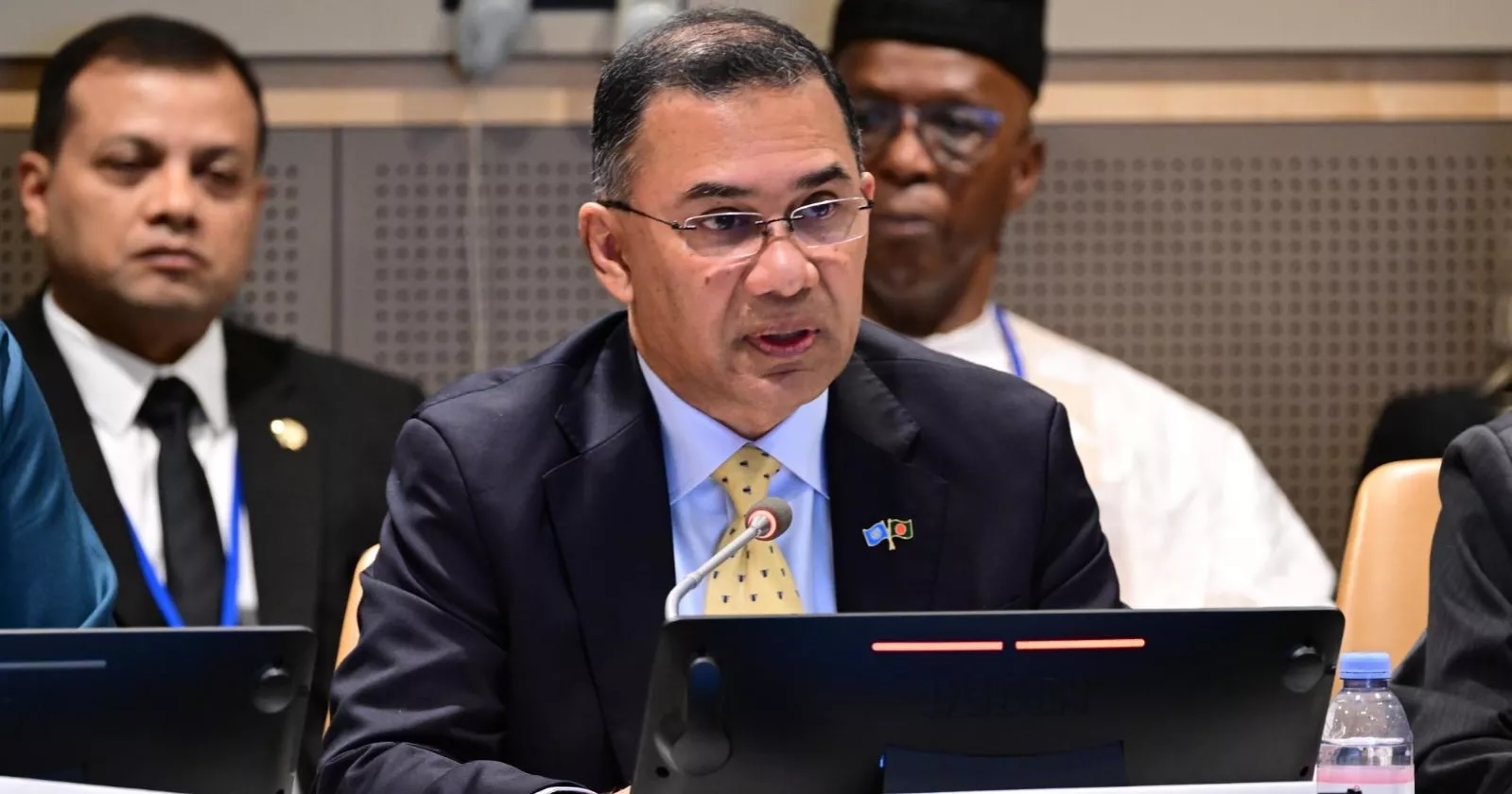
Speaking at a high-level side event during the 81st United Nations General Assembly, Bangladeshi Prime Minister Tarique Rahman proposed urgent measures to address the Rohingya crisis, urging international stakeholders to shift from managing displacement to actively ending it.
“The time has come to move from empathy to a search for root causes and their solutions,” he said at an event called “The Rohingya Crisis: A Renewed Call for a Durable Solution from Protracted Displacement, with Justice and Accountability” at the U.N. Headquarters in New York.
Prime Minister Rahman emphasized that international generosity must be accompanied by decisive political action to tackle the root causes of systemic persecution inside Myanmar. He outlined a five-point proposal:
- Clear Repatriation Roadmap: Establishing a verified, structured, and sustainable timeline for the safe, voluntary, and dignified return of Rohingya refugees to their ancestral homes in Arakan State.
- Protection of Civilian Rights: Demanding an immediate cessation of violence against civilians—including the Rohingya—and ensuring their fundamental civil rights, physical security, and freedom of movement are legally guaranteed inside Myanmar.
- Predictable Humanitarian Funding: Calling on donor nations to provide adequate, sustained financial support for refugees and local host communities in Cox’s Bazar, ensuring that local development aspirations are not compromised by humanitarian hospitality.
- Strengthened Legal Accountability: Reaffirming full support for international judicial mechanisms, including The Gambia’s legal proceedings at the International Court of Justice (ICJ) and investigations by the International Criminal Court (ICC), to hold perpetrators of grave crimes accountable.
- Combating Transnational Crime: Expanding regional and multilateral law enforcement cooperation to dismantle narco-trafficking networks, human smuggling operations, digital fraud hubs, and illicit arms trade exacerbating regional instability.
Prime Minister Rahman noted that Bangladesh continues to host over 1.2 million displaced Rohingya across more than nine years of prolonged displacement.
He highlighted the escalating social, economic, and environmental pressures placed on host communities in Bangladesh, alongside a worrying decline in international funding under the U.N. Joint Response Plan, which scaled down its appeal from over $934 million USD in 2025 to $710 million USD in 2026.
Emphasizing that human rights abuses continue to be committed by both the Myanmar military and the Arakan Army (AA) in Arakan State, Rahman reiterated that while Bangladesh carried its responsibility with humanity, the international community must fulfill its commitments.
The high-level session, moderated by Bangladesh’s Permanent Representative to the U.N. Irene Khan, included U.N. 81st General Assembly President Khalilur Rahman, U.N. Special Envoy on Myanmar Julie Bishop, The Gambia’s Vice President Mohammed B.S. Jallow, U.N. High Commissioner for Refugees Barham Salih, and European Union Commissioner for Equity Hadja Lahbib.
UNB