


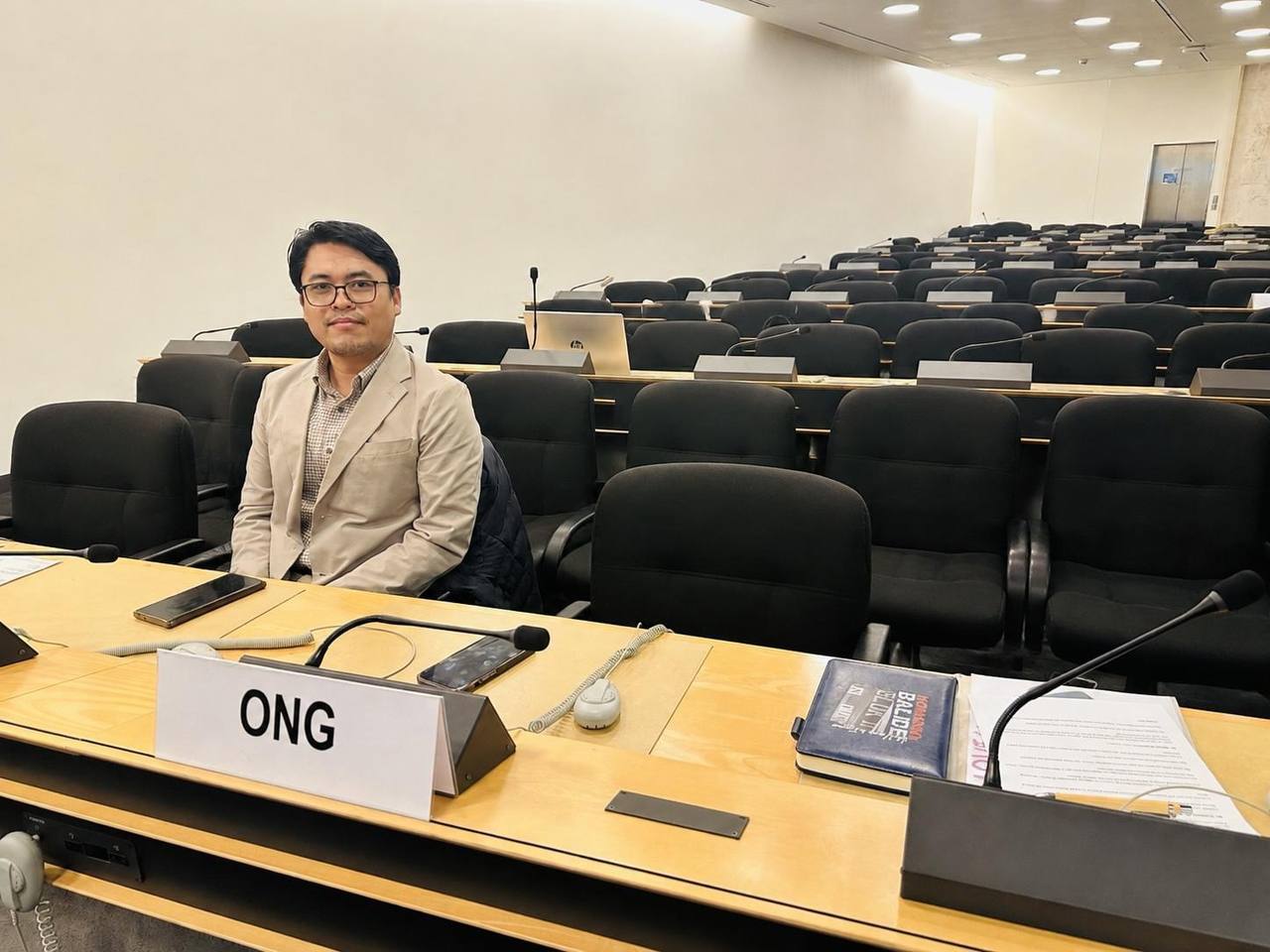
Human Rights Foundation of Monland (HURFOM) Program Director Nai Aue Mon warned of a worsening human rights crisis across Mon State, Karen State, and Tanintharyi Region, characterized by escalating standoff air attacks, widespread displacement, and forced military conscription.
In an exclusive interview with DVB, Nai Aue Mon addressed the human rights conditions in southeastern Myanmar, detailing how the regime’s growing reliance on long-range weapons—including fighter jets, Y-12 aircraft, drones, paramotors, gyrocopters, and heavy artillery—has systematically terrorized rural communities unable to defend against attacks from a distance.
Escalating Aerial Bombardment and Civilian Toll
HURFOM’s field documentation network, operating from resistance-controlled zones and border corridors under strict safety protocols, recorded a steady rise in civilian casualties resulting from standoff military operations:
- 2024 Operations: Approximately 120 recorded attacks (including 65 airstrikes) resulted in over 120 civilian deaths and more than 300 injuries.
- 2025 Operations: At least 130 documented attacks killed 136 civilians and injured over 340 others.
- 2026 Surge: Between January and March 2026 alone, HURFOM logged at least 32 airstrikes across Mon, Karen, and Tanintharyi, while partner networks reported roughly 60 additional air raids across Kawkareik, Hpapun, and Thaton districts.
- Impact on Women and Children: Between April and June 2026, HURFOM documented 55 civilian fatalities (including 35 women and 15 children) and 160 injuries (including 45 women and 28 children) across its focus areas.
HURFOM noted that military operations surrounding the regime’s 2025–2026 elections, which ended on Jan. 25, displaced over 85,000 residents of southern Mon State and northern Tanintharyi Region, where 56 armed clashes occurred and 255 homes were destroyed.
In recent months, a renewed military push around the foreign-backed Dawei Deep Seaport project has sparked fresh clashes and mass displacement in Launglon and Yebyu townships.
Systemic Forced Conscription and Border Repatriations
The regime’s forced recruitment campaign has intensified significantly across southeastern states, targeting young men (ages 18–35) and young women (ages 18–27) through checkpoint roundups, village quotas, and extortion schemes.
HURFOM estimates that since 2024, approximately 5,700 people have been forcibly conscripted in Mon State, between 3,600 and 4,800 in Karen State, and between 4,700 and 5,200 in Tanintharyi Region.
The rights group expressed grave concern over forced returnees from neighboring countries, noting that following Thailand’s March 8, 2026 deportation of over 120 Myanmar nationals through Kawthaung port, returnees within conscription age limits were immediately intercepted and transported to military recruitment facilities.
Critique of U.S. Policy Contradictions
He pointed out that while the U.S. Department of State maintains its highest Level 4 “Do Not Travel” advisory for Myanmar due to active conflict, arbitrary detention, landmines, and forced conscription, the Department of Homeland Security ended TPS on the premise that conditions had improved.
“If the country is too dangerous for an American to enter, Washington must honestly explain why it believes a Burmese activist can safely be forced back,” Nai Aue Mon stated, urging former TPS holders to consult qualified immigration attorneys, secure physical copies of their political and civil society documentation, and refrain from relying on unverified social media information.
Addressing civilians inside Myanmar, Nai Aue Mon emphasized that HURFOM will continue collecting evidence for future international accountability mechanisms while urging residents to prioritize personal security when documenting or sharing information about military abuses.
Stay tuned to DVB English News YouTube or Spotify to watch the upcoming Newsroom interview with Nai Aue Mon. To listen, follow DVB English News on Apple, Audible, Amazon Music, or wherever you get podcasts.