


Guest contributor
Nandar
I wrote “Where Are You From?” after the 2021 military coup, when I had to leave my hometown in Myanmar. That was also when I started experiencing strange feelings and symptoms I didn’t understand.
After struggling with them for a year, I finally built the courage to see a doctor in Thailand and was diagnosed with Generalized Anxiety Disorder. Something in that conversation stayed with me and became this poem.
This particular version is adapted for an international audience at the CSW event in New York in 2025. I wanted to talk about the part of the political crisis.
We don’t talk enough about the things that happen inside our bodies and minds when we lose our homes, our sense of safety, and the people we love.
For me, our mental health is tied to the political health of our society. We can’t heal alone in the dark. Healing has to be collective, and it has to be political.
Where Are You From?
Last night,
I had a dream
That I died
Without a meaningful cause
And my mother mourned for me
For a whole year
And another year
Then another year
Until she had no breath
I woke up and gasping
In a strange bed
And a foreign land
That reminds me to pay tax
I had never left the country against my will until today.
Where are you from?
I don’t know how to answer that question
Without letting the guilt swallow me alive,
Without worrying about my sisters and brothers
who are moving from one place to another for safety,
Without thinking of those who died and who are behind bars,
Without my heart trembling for longing
and my stomach clenching with grief.
The other day, when my doctor asked me,
Where you from?
With his broken English and soft Thai accent,
Closing my eyes, I started explaining to him—
I can’t sleep at night.
My brain feels like it is gonna explode.
It is like I don’t have enough oxygen to breathe.
My heart is beating so fast to the point that it’s gonna stop.
I am choking when I eat.
I don’t go outside like I used to.
I am always finding a way to die in my dreams
Do you know how to fix me?
He smiled and nodded politely.
His eyes wondered why I didn’t answer his question.
You have anxiety.
Women your age go through this. It’s normal.
No need to worry, nah.
I feel displaced and broken.
How is this normal, doc? How is this normal?
Where you come from?
He asked again, this time as if for medical reasons.
I came from
the land of safety,
Surrounded by beautiful people and mountains
who smile at each other
until their jaws hurt.
Where the street is filled with dust, dirt, and busyness,
Yet somehow charms with its delicious smell of food—
Mont Hinn Khar, Akyaw, Shan Khouk Swal, Lat Phatt Htoke.
A city where you can never go hungry, disconnected, or cold.
A home my ancestors have fought and died for.
No, the irony is not lost on me.
When I say I come from the land of safety,
I mean, I come from the land
where I don’t have to explain myself to others,
Where I don’t have to cry every night to sleep,
Where I don’t have to take anxiety pills to swallow my food,
Where I don’t have to answer the question, where are you from?
Instead, I paused and said,
Myanmar.
“Aaah, Phaama,” he replied with the sound of understanding and pity.
Your country and we, same same.
Not good people ruling.
I smiled, almost wanting to cry.
Breathe, you have to breathe every day—
for your heart, for your brain, for your body.
You no need fixing.
You only need breathing.
You will be okay, nah.
But how do I breathe, doc,
when the air is thick with the silence of the world?
When justice is a foreign language no one translates for us?
When our land is soaked in the blood of those who dared to hope?
How do we breathe
when the ones who stole our country
are still drinking their morning tea in peace,
while my people count bodies instead of days?
They tell us to wait, to be patient.
But patience does not open prison doors.
Patience does not bring back the disappeared.
When it would take us 50,000 years
to mourn
The death of our people
Your silence cost our people lives
Silence is a luxury.
We can’t afford it
We must persist
Our resistance must be
sustained,
carried forward,
not as charity,
but as necessity.
I am not asking you to save us
Solidarity isn’t the same as saving
Instead of feeling sorry for us
Would you hold my hands
stand up
Speak up
Fund us
So, I can come home to my mother
End this nightmare
I am still learning that the key to living is breathing.
Breathing like it is my job to be alive.
To be alive is my only way to resist.
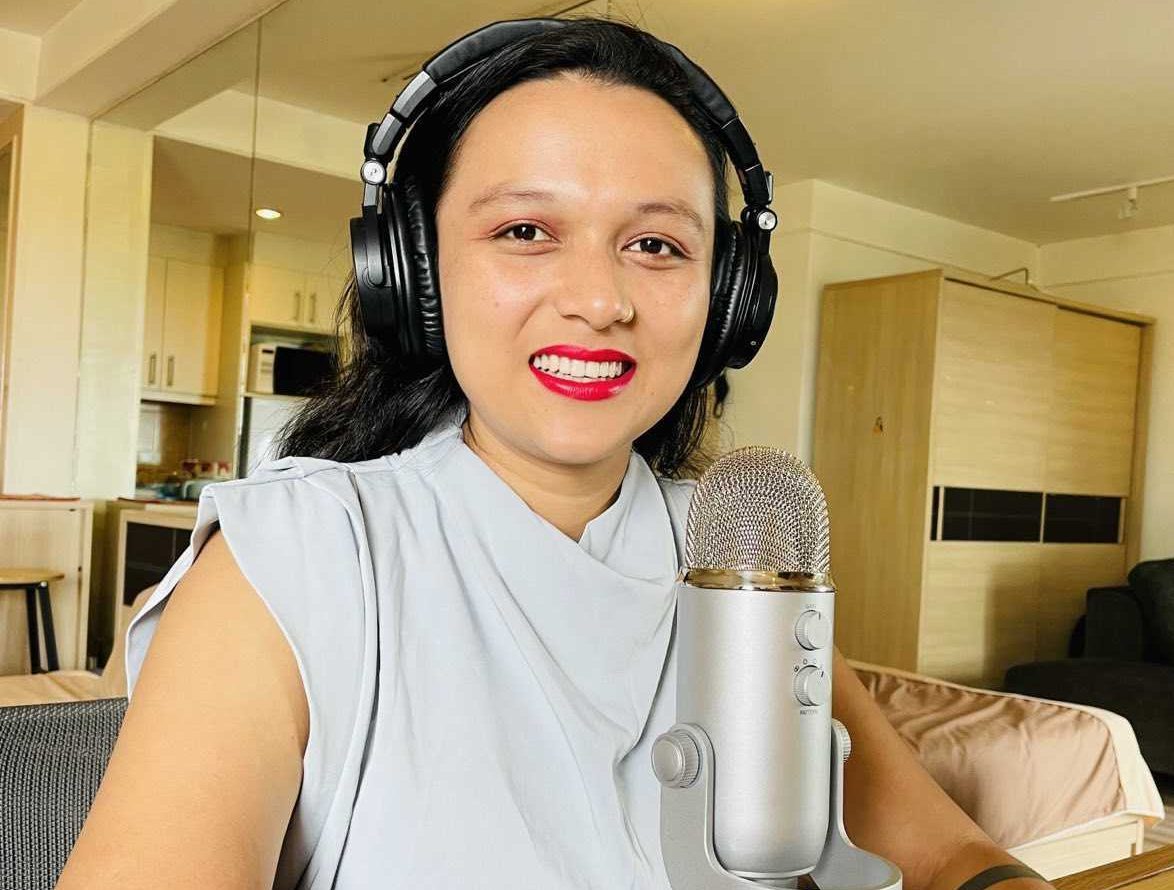
Nandar is a feminist storyteller, podcaster, and movement-builder from Myanmar. She is the Founder and Executive Director of Purple Feminists Group (PFG), a feminist organization advancing gender equality, menstrual justice, and feminist leadership through storytelling, advocacy, and community-building.
For more than a decade, Nandar has worked to create spaces for critical conversations on gender, bodily autonomy, and social justice. She is the host of the podcasts G-Taw Zagar Wyne and Feminist Talks, co-directed Myanmar’s bilingual production of The Vagina Monologues, and translated Chimamanda Ngozi Adichie’s We Should All Be Feminists and Dear Ijeawele into Burmese to make feminist ideas more accessible to local audiences.
Named to the BBC 100 Women in 2020 and a finalist for the Index on Censorship Freedom of Expression Awards, Nandar believes in the power of storytelling to challenge norms, amplify marginalized voices, and inspire collective action.