


Guest contributor
James Gomez
For defenders of women’s, gender and sexual minority (WGSM) rights in Myanmar, threats and intimidation from those purportedly seeking to “defend” Buddhism are not new.
In fact, such threats are expected to continue at an intensified pace in the post-2026 electoral landscape – this follows the February 2021 coup, which intensified the scale, coordination and ideological dogma driving the backlash directed against them.
With the post-election institutionalisation of junta rule now underway, there is little to suggest this trajectory will reverse.
The military’s seizure of power accelerated a convergence that had been developing for decades between authoritarian governance and Buddhist fundamentalism.
Groups such as MaBaTha, alongside ultranationalist monks and pro-military networks, have increasingly framed gender equality, LGBTQI+ advocacy and pluralism as threats to Bamar-Buddhist national identity.
In this post-coup environment, WGSM rights defenders have become some of the most exposed targets within Myanmar’s shrinking civic space.
Asia Centre’s recent report, Religious Fundamentalism in Myanmar: Post-Coup Repression of Gender Rights, examines how this repression operates.
The junta has weaponised both existing legislation and post-coup legal measures to criminalise dissent and monitor activists, often framing repression through the language of “moral order” and the defence of religion.
At the same time, online spaces have become central sites of coordinated harassment. Pro-military and Buddhist fundamentalist actors use social media platforms to spread hate speech, incite violence and conduct doxxing campaigns against WGSM activists, while the junta increasingly deploys surveillance technologies to monitor digital dissent.
Offline, physical violence against defenders is carried out not only by security forces, but also by militias and civilian mobs encouraged by Buddhist fundamentalist rhetoric.
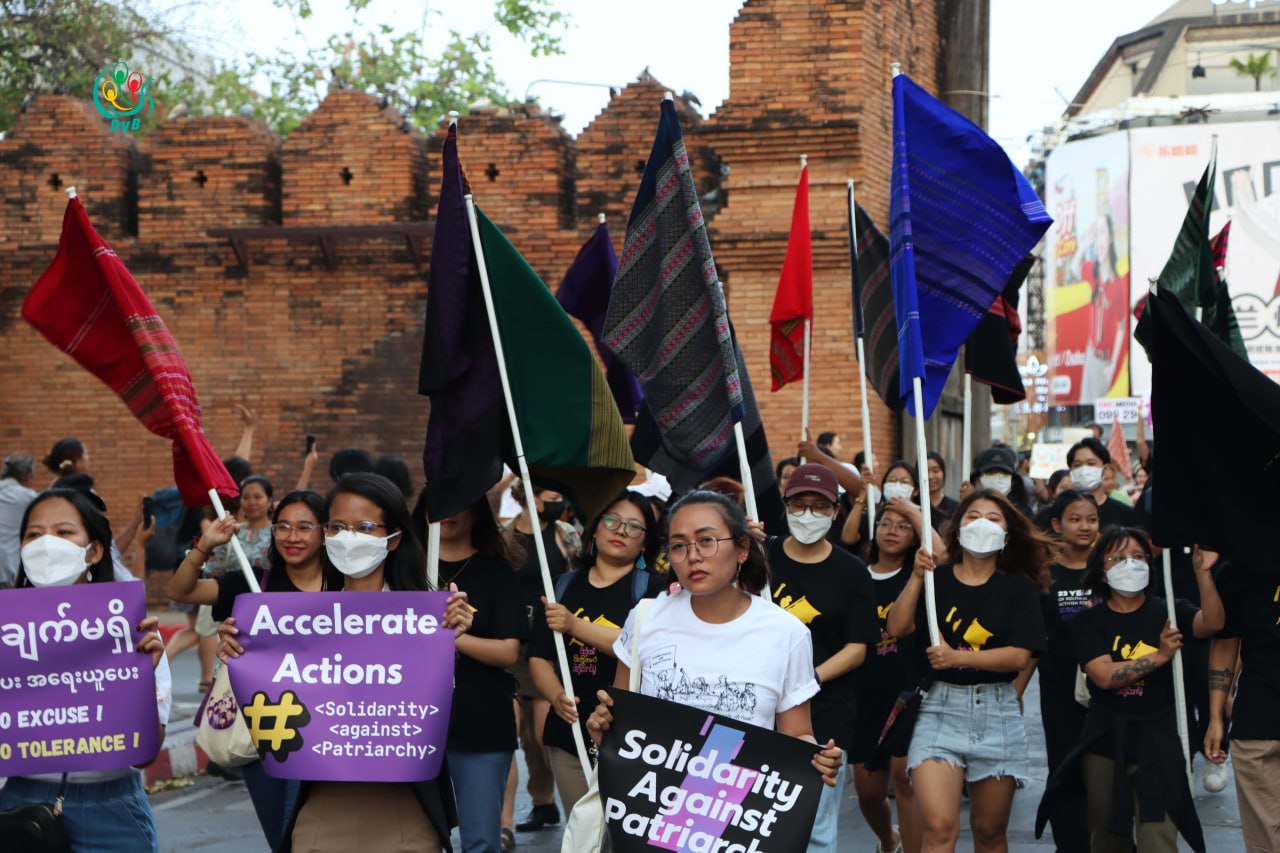
As a response to these pressures, WGSM organisations and networks have developed extensive resistance strategies. Women played leading roles in the Civil Disobedience Movement (CDM), organised protests, coordinated humanitarian support and documented abuses under conditions of extreme surveillance and insecurity.
Human rights awareness and political consciousness expanded rapidly, particularly among younger generations. WGSM voices also became more visible within pro-democracy spaces in ways that had been significantly constrained prior to the coup.
This mobilisation was accompanied by the strengthening of solidarity networks across the civil society. These networks facilitated coordination between exiled and underground women’s groups, established early warning systems, documented sexual violence and sustained advocacy around gender-based repression.
Some coalitions also succeeded in building cooperation across gender, ethnic and political divides, creating forms of solidarity that have historically been difficult to sustain within Myanmar’s fragmented civic landscape.
At the same time, many independent organisations refused to participate in junta-controlled governance mechanisms, such as the Myanmar National Committee on Women, denying the regime the legitimacy it sought through military-managed civil society “participation”.
However, the report also highlights the significant limitations and unevenness of this solidarity. Some established Bamar-majority women’s organisations remain reluctant to engage openly with issues affecting ethnic, religious and sexual minorities, often due to fears of coordinated backlash from Buddhist fundamentalist networks.
Meanwhile, some ethnic-aligned organisations, due to their operational structures, continue to prioritise intra-community concerns that limit deeper cross-community alignment.
GSM rights, in particular, also frequently remain underrepresented within broader advocacy agendas, despite the heightened vulnerabilities faced by these communities.
These fractures are further deepened by the continued presence of government-affiliated civil society organisations. Their presence contributes to distrust across the sector, causing many activists to limit information-sharing and collaboration to small circles of verified partners.
As a result, coalition-building and collective protection efforts remain constrained at a moment when coordinated resistance is most needed.
The implications of such fractures extend beyond the immediate post-coup crisis. Myanmar’s previous democratic transition introduced formal institutional reforms without fundamentally addressing the exclusionary nationalist and religious ideologies that continued to underpin political legitimacy.
While WGSM rights defenders gained limited visibility during the 2010s, they did not obtain meaningful structural protection.
This carries an important lesson for Myanmar’s future. A democratic transition that leaves intact the political role of Buddhist fundamentalism, exclusionary nationalism and entrenched gender hierarchies risks reproducing the same cycles of repression under different institutional arrangements.
For Myanmar’s pro-democracy movement, the challenge is therefore not only removing military rule, but building an inclusive political framework capable of protecting ethnic, religious, gender and sexual diversity in substantive terms.
For the gender rights sector, this requires strengthening cross-ethnic and cross-identity solidarity and resisting the marginalisation of GSM rights within broader democratic struggles.
The expansion of gender rights consciousness after the 2021 coup created important openings. Whether these openings translate into durable protection and political transformation will depend on whether future democratic efforts confront, rather than defer, the Buddhist fundamentalist structures that have long facilitated authoritarian rule in Myanmar.
Dr. James Gomez is Regional Director of the Asia Centre – a civil society research institute. This op-ed is based on Asia Centre’s new report, Religious Fundamentalism in Myanmar: Post-Coup Repression of Gender Rights. It can be downloaded from here.
Asia Centre, established in 2015, is a civil society research institute in Special Consultative Status with the United Nations Economic and Social Council (UN ECOSOC). The Centre undertakes research, training, advocacy and media initiatives focused on democracy and human rights in Asia, including freedom of religion or belief, freedom of expression, freedom of association and political participation. Since its establishment, Asia Centre has collaborated with civil society organisations, development agencies, diplomatic missions, government institutions, international NGOs and UN agencies across the region.
DVB publishes a diversity of opinions that does not reflect DVB editorial policy. We’d like to hear what you think about this or any of our stories: [email protected]