


Guest contributor
Jaivet Ealom
Last week, Malaysia’s Prime Minister Anwar Ibrahim rolled out the red carpet in Kuala Lumpur for Min Aung Hlaing, the general who oversaw the military’s 2017 atrocities against the Rohingya, seized power in the 2021 coup, and now calls himself president after an election widely dismissed as a sham.
Anwar presented the visit as the price of sending the Rohingya home. Malaysia has already returned over 10,000 people to Myanmar this year, despite warnings from the United Nations that they face grave danger.
Anwar argues that direct engagement with Myanmar’s military leadership is essential to a lasting solution. But the visit produced no agreement on Rohingya repatriation.
Min Aung Hlaing even insisted that the word “Rohingya,” which the military refuses to recognize, not be used.
What the visit did deliver was legitimacy: another capital treating the general as the indispensable gatekeeper to Myanmar’s future, even though his forces no longer control much of the country.
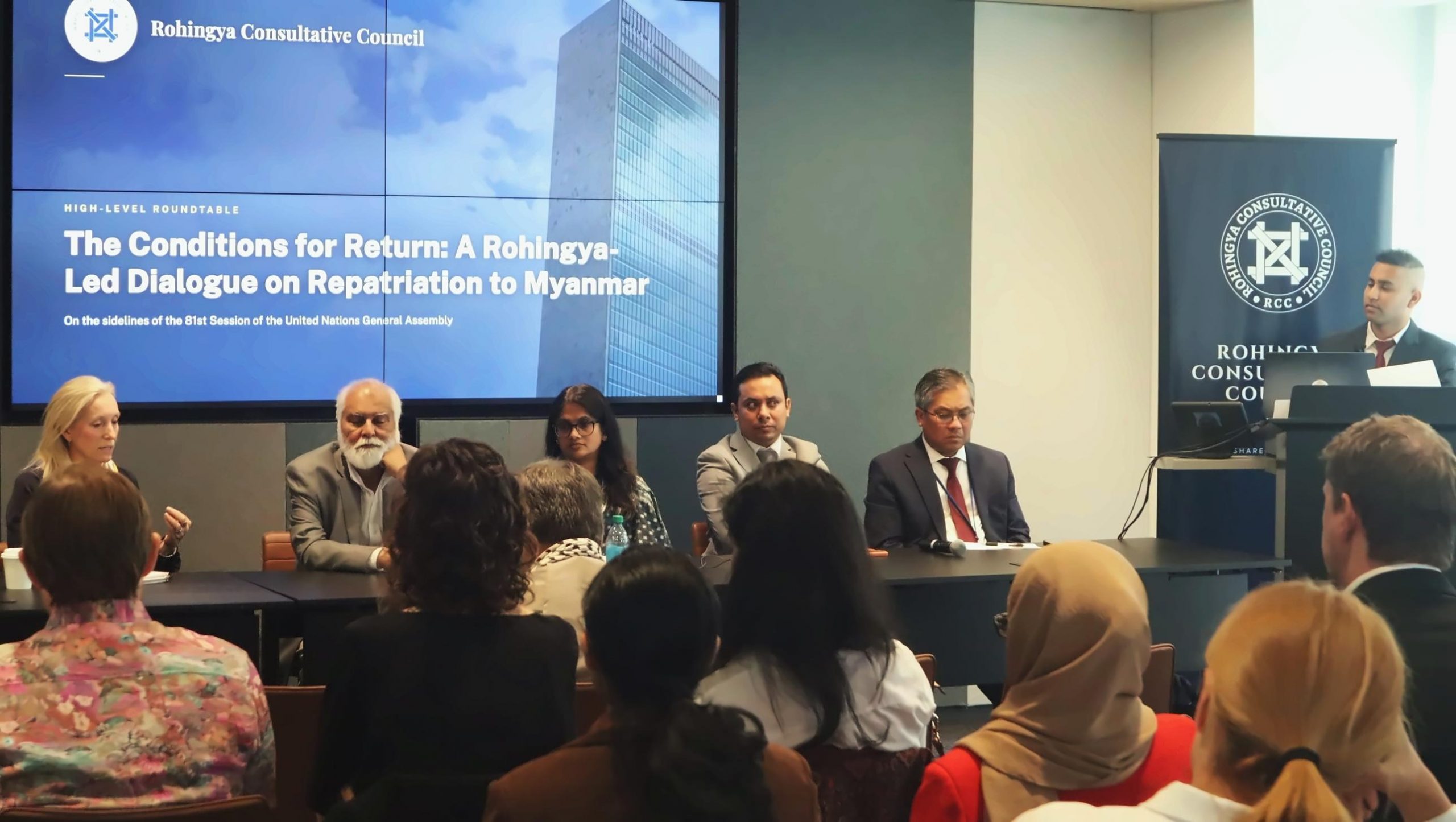
Two weeks earlier, on the sidelines of the U.N. General Assembly in New York, the Rohingya Consultative Council (RCC) convened Rohingya political leaders, representatives of the Government of Bangladesh, the Permanent Representative of Myanmar to the U.N. Ambassador Kyaw Moe Tun, and the newly-appointed U.N. Special Rapporteur on Human Rights in Myanmar Kelley Currie, to ask what it would take for Rohingya refugees to go home safely, voluntarily and with dignity.
We reached a very different conclusion: The Rohingya crisis cannot be resolved through humanitarian assistance and repatriation arrangements alone. It requires a political solution.
Get the politics of the Rohingya crisis wrong, and you will get Myanmar wrong too.
Repatriation, Not Relocation
For decades, international responses to the Rohingya crisis have focused on humanitarian assistance, refugee management and negotiations for repatriation.
These efforts are necessary, but they do not address the underlying political problem.
Rohingya were systematically deprived of citizenship, excluded from political life, subjected to discrimination and violence, and ultimately driven from their homes.
Their displacement was the consequence of a political and legal system that denied them equal membership in Myanmar.
A sustainable return must therefore involve more than an agreement to receive refugees. It requires security, citizenship, ethnic recognition, political participation, access to ancestral lands, freedom of movement and protection against renewed persecution.
Simply moving Rohingya from refugee camps in Bangladesh or detention centers in Malaysia into new camps or controlled settlements inside Myanmar cannot meaningfully be described as repatriation.
Nor can returning people to a country where the conditions that forced their displacement remain intact.
These are fundamentally political questions. Who governs the territories to which Rohingya would return? Who guarantees their safety? Who determines their citizenship and political rights? And who represents Rohingya in negotiating these arrangements?
Without credible answers, repatriation risks becoming another cycle of displacement.
Myanmar’s political reality has changed
The military no longer exercises effective control over large parts of the country.
In Rakhine State, the Arakan Army has emerged as the dominant territorial authority, while other ethnic resistance organizations and democratic institutions exercise varying degrees of authority elsewhere.
This creates enormous challenges, but also opportunities to rethink how a sustainable political settlement might emerge.
Traditional bilateral negotiations between host countries and Myanmar’s central authorities are no longer sufficient. Any settlement must reflect who holds power on the ground, while ensuring that power is exercised in ways that uphold Rohingya rights.
The Arakan Army’s territorial control makes it an unavoidable participant in discussions about return, but the group has itself been accused of abuses against Rohingya civilians, and legitimacy will depend on treating the Rohingya as equal partners in political discussion, with the right to identity, safety, security and citizenship.
Negotiations must also involve Myanmar’s wider democratic movement, including the Steering Committee for the Emergence of a Federal Democratic Union, the National Unity Government and ethnic resistance organizations.
The struggle for a federal democratic Myanmar offers an opportunity to dismantle the structures of exclusion that have denied the Rohingya equal rights and political representation.
A shared political future
Even among those opposing military rule, Rohingya rights have sometimes been regarded as an issue to address later, once the military is defeated or a new political order is established.
Even the Rohingya’s most sympathetic allies tend to treat them as recipients of humanitarian aid rather than as a people with political leaders of their own.
Both approaches are inadequate.
Rohingya need more than a seat in the audience. They need the political institutions, organizational capacity and agency to influence decisions and negotiate their future.
Calls to abolish or overhaul the discriminatory 1982 Citizenship Law are not new. Many Myanmar political stakeholders, including the National Unity Government, have made them for years.
But the statements of intent have yet to become binding commitments. Repeal must be a firm commitment of any future settlement, and the Rohingya must have a meaningful role in shaping Myanmar’s constitutional and political arrangements.
Rohingya political organizations, in turn, have an opportunity to build stronger relationships with democratic and ethnic resistance actors, develop shared positions and engage in the wider struggle for an inclusive political settlement.
This does not mean overlooking historical grievances, competing narratives or genuine political disagreements. But it does mean accepting that the political futures of all people of Myanmar, including the Rohingya, are inextricably connected.
A federal democratic Myanmar that excludes the Rohingya will reproduce one of the country’s deepest historical exclusions. And a Rohingya political movement seeking sustainable rights and return cannot afford to remain disconnected from the wider political transformation taking place inside Myanmar.
The task, therefore, is not to manufacture artificial unity. It is to create the political relationships and institutions through which differences can be negotiated rather than imposed through force.
The junta claims to be Myanmar’s legitimate government. A democratic political order that meaningfully includes the Rohingya can offer a fundamentally different basis for legitimacy — one rooted in inclusion rather than exclusion.
That requires political work now, not promises for some future settlement.
A different approach is possible
Our dialogue in New York reinforced that there is no immediate or easy pathway to return. But it also demonstrated that Rohingya leaders, Myanmar’s democratic representatives and international partners are beginning to identify the political foundations of a different approach.
The challenge now is to turn these discussions into political cooperation.
Myanmar’s democratic movement and Rohingya political organizations should begin developing a common political agenda: one that addresses citizenship and equal rights, establishes meaningful Rohingya representation, and offers the world credible alternatives to the junta.
This will not immediately eliminate the political differences between Rohingya, Rakhine and Myanmar’s other communities. But it would establish a framework for resolving those differences through political negotiation rather than military domination.
The junta benefits when Myanmar’s communities remain divided. The region should not allow that division to become the basis of its diplomacy.
The Rohingya crisis was created by political exclusion. The coup extended that exclusion to the rest of Myanmar. Neither crisis will be solved by deporting refugees and shaking hands with the general responsible for both.
They will be solved only when the Rohingya, and all of Myanmar’s people, can return to a country that offers everyone a safe and dignified political future.
Building a shared political alternative is necessary not only for Rohingya repatriation, but for Myanmar’s democratic future.
Get the Rohingya wrong, and you get Myanmar wrong.
Jaivet Ealom is Secretary-General of the Rohingya Consultative Council (RCC).
DVB publishes a diversity of opinions that does not reflect DVB editorial policy. We’d like to hear what you think about this or any of our stories: [email protected]