


Guest contributor
James Shwe
The test of returns from Malaysia to Myanmar should not be how many people can be transported by sea or air.
It should be whether those people freely chose to leave, can live safely after arrival, and retain rights that neither government can bargain away.
Without independent answers, a transfer presented as humanitarian cooperation risks becoming a political concession to Myanmar’s military.
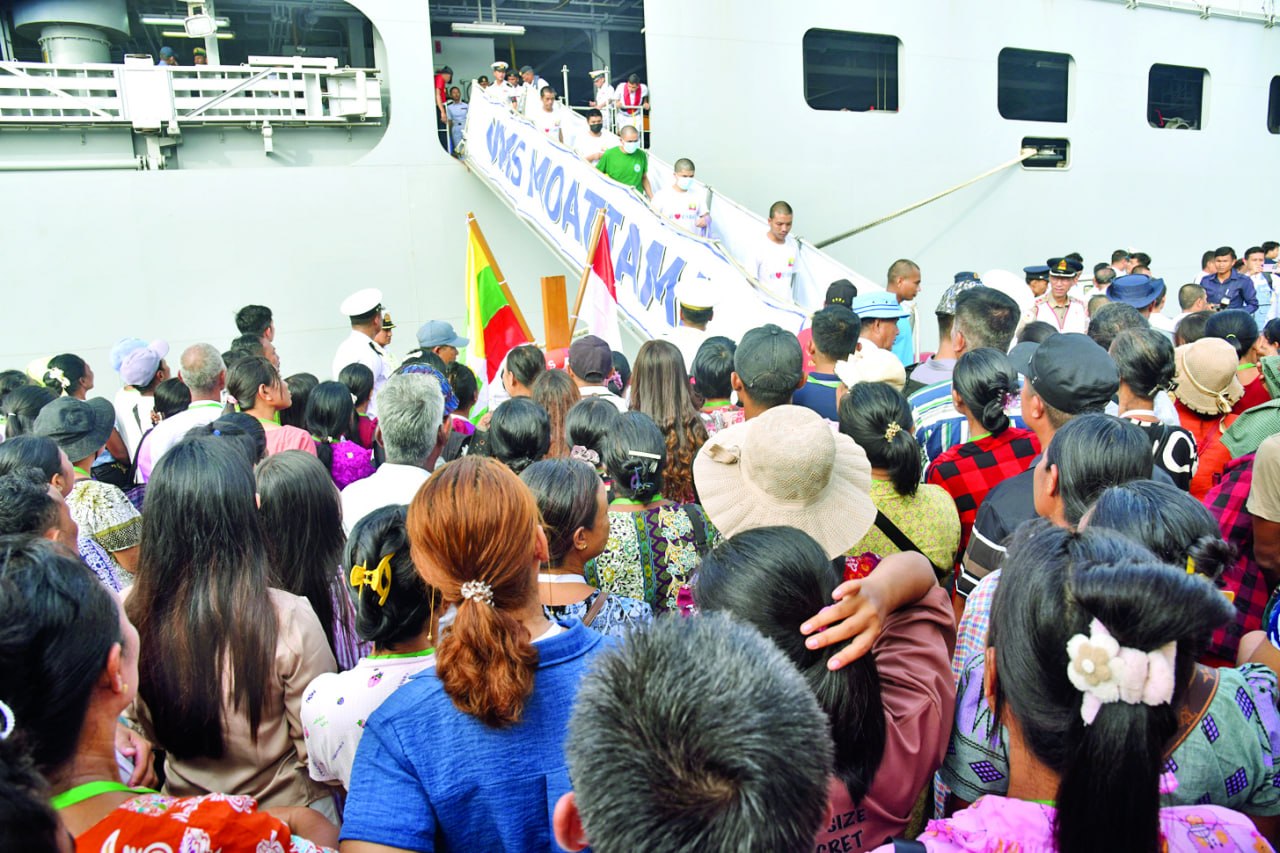
On September 29, Malaysia sent 1,476 Myanmar nationals from immigration detention aboard three Myanmar naval vessels; the group arrived at Thanlyin, near Yangon, on October 4 as the first batch under a phased arrangement covering up to 5,000 people.
Malaysia describes these returns as voluntary, but the U.N. refugee agency, UNHCR, says it had no access to the individuals to assess whether their decisions were genuinely free and informed.
The scale is now reported to be substantially larger: on October 5, AFP reported Myanmar state media’s claim that another 8,041 citizens had returned from Malaysia by air between January and August, bringing the reported air-and-sea total to 9,517; AFP said Malaysia had not commented on those flights.
These figures broaden the questions about identification, consent and post-return protection. They do not answer them.
The distinction matters. Agreeing to leave while held in detention is not, by itself, proof of a meaningful choice. UNHCR has specifically called for decisions to be assessed outside detention settings, alongside individual assessments and access to protection procedures.
Even the identity of the population supposedly being helped remains politically contested. Prime Minister Anwar Ibrahim initially spoke of an agreement to return 5,000 Rohingya, but Malaysia’s later announcement separated approximately 4,008 people, primarily Rohingya, entering a refugee-registration program from 5,000 other people designated for repatriation.
Myanmar Foreign Ministry official Han Win Aung, meanwhile, described the operation as accepting “genuine citizens,” not bringing back Rohingya; AP could not confirm whether any Rohingya were included in the first group.
Neither the 1,476 sea returnees nor Myanmar’s reported combined total of 9,517 can be treated as a verified Rohingya return count: AP’s October 4 report still said it was unclear whether any Rohingya were included, while AFP reported on October 5 that Malaysia had not disclosed the returnees’ ethnicities.
Malaysian state media Bernama’s account used wording suggesting Rohingya involvement, without providing a count, underscoring the need to distinguish the agreement’s ethnic coverage from the composition of completed returns.
Prime Minister Anwar has now addressed the question of Rohingya inclusion. Reporting his October 6 parliamentary response concerning the September 29 repatriation of 1,476 people, Malaysiakini quoted him as saying that, according to the records checked so far, no Rohingya refugees had been repatriated and that their return remained under discussion.
That statement should be acknowledged rather than treated as continued official silence. The remaining test is independent verification of the returnees’ circumstances and protection, not speculation about their ethnicity.
The absence of a breakdown proves neither inclusion nor exclusion. What is required is disclosure and independent verification, not an argument built on either assumption.
Yet ambiguity can be politically useful. Malaysia can appear to be responding to domestic demands concerning Rohingya, while Myanmar’s authorities describe the same operation as routine repatriation of citizens.
That possibility does not establish a secret bargain. It does show why an operation can acquire political value before its humanitarian merits have been demonstrated.
The link to wider diplomatic acceptance is more explicit. Anwar has connected accepting returnees with friendship, trade and a proposed visit by Min Aung Hlaing, saying, “we can be friends and trade, we can accept Myanmar, but Myanmar must accept them back.”
This raises a question for Myanmar’s democratic movement and international partners: what, precisely, is being rewarded?
Humanitarian contact with authorities controlling ports and administrative institutions may be unavoidable.
Such contact is not inherently political recognition, and opposition to military rule should not obstruct genuinely voluntary, safe returns.
But practical cooperation must not automatically purchase high-level acceptance. The ability to receive a ship is not evidence of legitimate government, respect for rights or progress toward ending repression.
There is also a danger that reception ceremonies will be used to imply that Myanmar is becoming safe. UNHCR warns that people sent back may face serious risks and that some within this group may need international protection.
If photographs of arrival substitute for scrutiny of subsequent conditions, other governments could cite the operation to justify further returns or reduced pressure for accountability.
A logistical achievement would then be mistaken for a political and humanitarian breakthrough. Anwar says returns require consent, and Bernama reports that consent was documented through Malaysia’s Home Ministry.
UNHCR, however, said it had no access to the September ship group to assess whether their decisions were genuinely free and informed.
Signed consent and official assurances should be tested through confidential interviews, individual protection assessments and independent monitoring after arrival.
If future returns include Rohingya, safeguards against coercive recruitment will be essential.
Human Rights Watch has documented the military’s forced recruitment of Rohingya, frontline deployment and coerced participation in anti-Arakan Army protests.
That record justifies preventive safeguards. It does not establish that Rohingya were among the latest returnees or that this group is being recruited to fight the Arakan Army.
Were such coercive recruitment to occur in a future Rohingya return programme, the potential political exploitation would extend beyond the battlefield.
The military and its overseas advocates could selectively use subsequent violence to portray the AA as the principal threat to Rohingya while obscuring the military’s own role.
Coercive recruitment could thus endanger returnees, deepen divisions between communities and provide material for a campaign against the resistance.
This is a risk to prevent, not a coordinated plan we can presently claim to have proved. Recognizing that danger must not become an excuse to dismiss evidence against the AA.
Human Rights Watch’s May 2026 investigation reported serious abuses attributed to the AA based on survivor interviews, satellite imagery and forensic examination; the United League of Arakan denied the allegations.
Independent investigation is not the same as junta propaganda, even when the military may exploit its findings.
The democratic movement would weaken its own credibility by confusing the two. Its strongest answer to selective propaganda is consistent civilian protection and accountability, not selective denial.
Rohingya must not be treated as collectively responsible for armed groups, coerced recruits or government decisions.
Nor should uncertainty over returnees become a source of suspicion toward people whose choices may already have been severely constrained.
For both air and sea returns, Malaysia should publish anonymised information on the returnees’ ethnicity, refugee and asylum status, consent assessments and intended or actual destinations, while Myanmar’s authorities should permit independent post-return monitoring.
Independent agencies should have confidential access to them and the ability to monitor their circumstances after arrival.
Further transfers should not proceed without credible individual protection assessments and safeguards against persecution, confinement and forced recruitment.
If Rohingya are included, the questions must extend beyond admission into Myanmar to legal status, freedom of movement, family unity and the possibility of returning to a genuine home.
Receiving people at a port is not a durable solution if their destination is renewed confinement or coercion. Diplomatic engagement should secure these protections, not replace them.
Myanmar’s democratic revolution should defend the right to return safely as firmly as it opposes being forced back into danger. Malaysia, in turn, should judge this program by what happens to the people, not by the number transported or the diplomatic access obtained.
Until those outcomes can be independently verified, the operation should earn neither a declaration that Myanmar is safe nor an unearned claim to political legitimacy.
James Shwe is a Myanmar democracy advocate based in California.
DVB publishes a diversity of opinions that does not reflect DVB editorial policy. We’d like to hear what you think about this or any of our stories: [email protected]