


Guest contributors
Thinzar Shunlei Yi and Naw Htoo Htoo
At the heart of Myanmar’s conflict is a brutal truth: women and girls are being targeted, silenced, and left without protection.
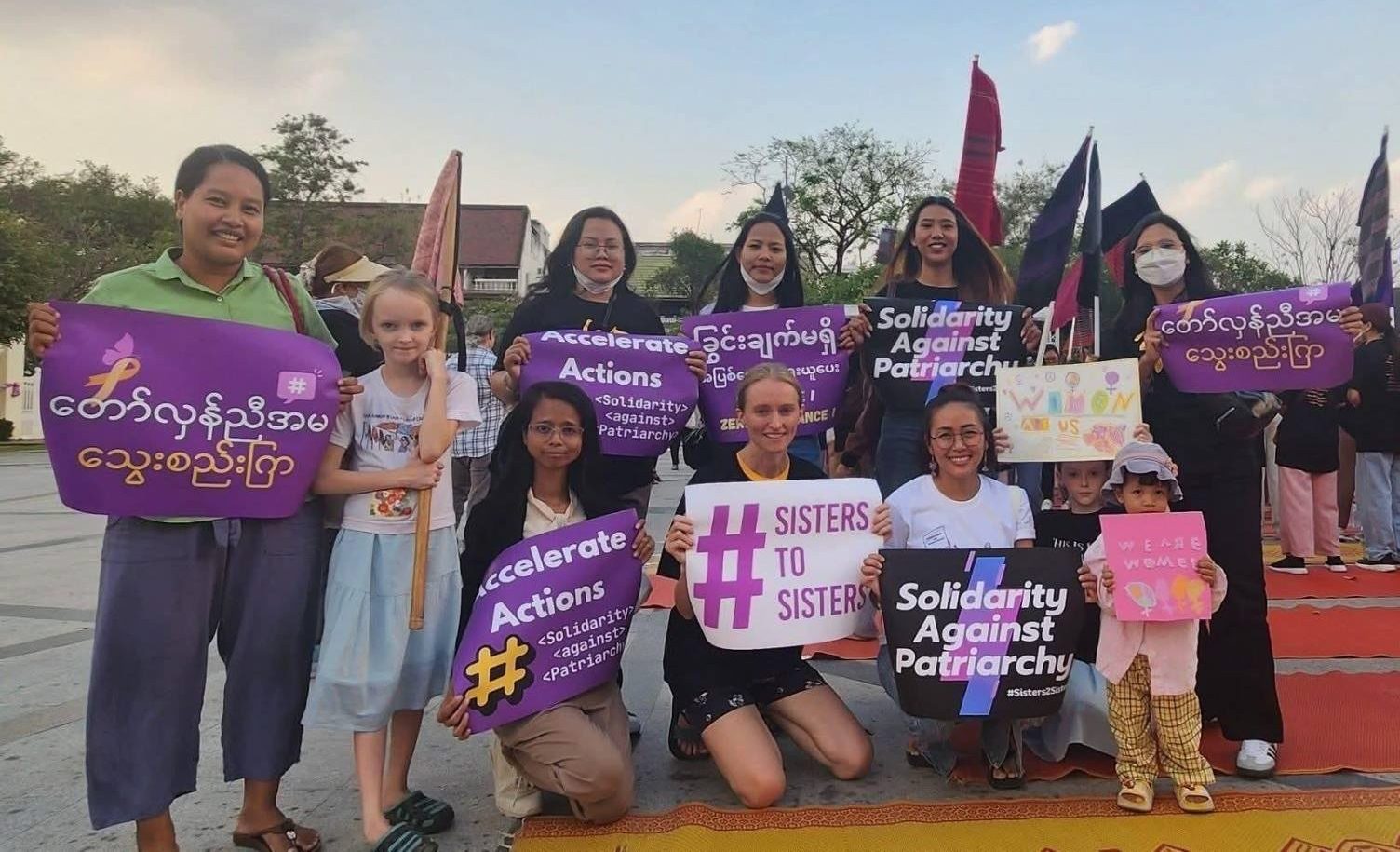
The annual 16 Day Campaign to End Gender-Based Violence, which runs from November 25 to December 10, is a worldwide effort to raise awareness, promote prevention of violence, and demand accountability to combat violence against women and girls.
In Myanmar, women and girls are among the most vulnerable due to the myriad gender-specific crises they are facing.
The conflict has worsened their lives in many ways. Over three million people have been forcibly displaced in the country, with women and children bearing the brunt of the conflict due to the many vulnerabilities exposed by the ongoing war.
Since the February 2021 military coup, the junta’s brutal crackdown has caused over 7,000 deaths, including at least 1,745 women and 863 children, with tens of thousands of others imprisoned.
The junta’s relentless attacks have caused widespread trauma and deep distress among survivors. The growing presence of junta soldiers has cast a grim new shadow over daily life.
In the wake of each village raid, homes are torched, residents are dragged away without cause, and others are killed outright: violence carried out with a chilling sense of impunity. Civilians find themselves dodging not only bullets and artillery shells, but the constant fear that they or their families could be next.
For women and young girls, the danger is even more acute. Reports of sexual violence by junta forces have surged since 2021, mirroring a broader erosion of physical security, dignity, and psychological well-being.
What was once the fabric of ordinary life—walking to a market, tending fields, sleeping through the night—has been replaced by a landscape shaped by fear, displacement, and relentless threats.
Survivors of conflict-related sexual violence, and the women human rights defenders who stand with them, carry psychological wounds that reach far beyond the immediate harm.
Many struggle to focus, work, trust, or rebuild the relationships that once anchored their lives. For decades, gender-based violence committed by the military has been met with near-total impunity.
The 2008 military-drafted constitution effectively shields soldiers from prosecution, protecting perpetrators while leaving civilian victims—especially women—without any meaningful path to justice.
Additionally, frequent power outages, including internet disruptions and shutdowns, and inadequate transportation severely limit people’s access to safety, including their ability to reach reliable healthcare.
All of this directly reduces people’s ability to access treatment. And this is especially risky for expectant women and new mothers who need regular appointments with doctors and nurses for their own health and that of their infants.
Civilians, notably women and ethnic minorities, are in urgent need of humanitarian aid due to the conflict. Still, the military junta continues to block access routes and threatens arrests for carrying vital supplies.
The regime’s intentional obstruction of aid underscores its ongoing attack on innocent civilians, particularly ethnic minorities and women, who suffer most from conflicts and disasters, as was evident in the aftermath of the devastating earthquake earlier this year.
Their manipulation of aid hampers both local and international efforts to reach remote communities, where ethnic women face higher risks, such as gender-based violence and exploitation caused by resource shortages.
Among the many crises confronting women in Myanmar today, the rise of transnational crime stands out as one of the most urgent. Traffickers use false job offers to lure women from across the region, only to force them into brutal conditions where sleep, food, and even water are withheld—and where torture is the price of refusal.
These cases are not aberrations. Women across Asia and beyond are being funnelled into the same violent machinery inside Myanmar’s scam centres, where abuse, extortion, and coercion are routine. And where far too many never make it out alive.
Against this backdrop of violence and repression, the junta’s ongoing promotion of a free and fair election is not just implausible—it is morally reprehensible. The military’s self-appointed governing body has no authority to conduct elections.
It is not a government chosen by the people but a regime that seized power through force, nullifying the 2020 election results that overwhelmingly favoured pro-democracy parties like the National League for Democracy (NLD).
The upcoming election is nothing more than a smokescreen to devitalize the resistance movements closing in on the junta and to offer an empty, pseudo-democratic charade to international governments eager to avoid involvement in the conflict.
Gender-inclusive and rights-based organizations have worked tirelessly to make life possible for those who have lost their livelihoods and ability to provide for their families.
Without their support and awareness in conflict-affected communities, thousands would not survive, as the most vulnerable are often deprived of their human rights.
With elected officials in hiding, the military has stacked courts, parliament, and various social and defence sectors with military commanders and generals, further reducing access to legitimate justice mechanisms.
International actors have largely failed to grasp the realities women and girls face under a system that enables ongoing sexual violence. Women-led groups have consistently and bravely documented cases for international courts.
Yet, legal action remains slow, and diplomats have shown little urgency in providing the comprehensive support survivors urgently need. The truth is that decisive action is crucial to seek justice for women and girls in Myanmar.
Countries that are parties to the Rome Statute should refer the military junta to the International Criminal Court (ICC) due to their widespread crimes against humanity, including acts of rape and conflict-related sexual violence affecting women and girls.
Ongoing judicial efforts at the International Court of Justice (ICJ) need support, and domestic proceedings should also be launched through the principle of universal jurisdiction.
Additionally, transitional justice pathways should be established to ensure reparations for survivors and the families of victims. Impartial and independent inquiries into incidents of gender-based violence, conflict-related sexual violence and sexual gender based violence are essential.
Practical and tangible measures must be implemented to break the cycle of impunity. In line with the U.N. Security Council Resolution 2669, adopted in 2022, there must be an immediate end to violence in Burma, including the need to protect the civilian population, in particular women and children.
The women of Myanmar have endured unimaginable suffering in their fight for freedom. Their courage demands solidarity. To stand with survivors during the 16 Days campaign is to act: to protect women’s safety, reject the junta’s sham election, and support those resisting its violence.
The international community must choose a side: one that upholds justice, defends democracy, and helps build a future free from military rule.
Thinzar Shunlei Yi leads the #Sisters2Sisters campaign, which promotes solidarity among Myanmar women and raises awareness of excessive force and sexual violence used against women by the Myanmar military.
Naw Htoo Htoo is a human rights advocate advancing women’s rights and gender justice in Myanmar. She works with the Sisters2Sisters campaign to raise awareness on gender-based violence, strengthen women’s leadership, and promote human rights.
DVB publishes a diversity of opinions that does not reflect DVB editorial policy. We’d like to hear what you think about this or any of our stories: [email protected]