


Despite expanding educational opportunities in Mae Sot, youth from Myanmar face an impossible choice: pursue costly qualifications with little hope of university access, or abandon their academic dreams entirely.
By Emily Ou Yong and Lok Bing Hong
MAE SOT, Thailand – Tun Lin, 21, is the image of an average college-age student: unassuming and laid-back with tousled hair. But while others his age might be continuing their education, he is teaching migrant students at his alma mater, Minmahaw School in Thailand’s Mae Sot.
Born in Yangon, Myanmar, and raised in Mae La Refugee Camp across the border, he is one of the few migrant and refugee students to graduate with a General Education Development (GED) certificate.
The question is not whether he has the skills for higher education, but why, with his qualifications, he has not been able to access it.
Mae Sot has become a hub for migrant education. It now offers more GED programmes than ever before, providing the high school diploma equivalent needed to enter universities.
More than 2,000 foreign children cross the border monthly, with about 18,250 enrolled in Tak province schools – 75 per cent of them concentrated in Mae Sot, a 2018 study by non-governmental organisation Help Without Frontiers (HWF) showed. These numbers have increased by up to 25 percent each year since the 2021 military coup.
But while the system successfully helps students earn GED certificates, it falls short of making sure they actually get into universities, owing to the lack of legal documentation, funds, and sufficient scholarship opportunities.
This pushes students toward vocational training and immediate employment instead.
“Even if we [refugees] sacrifice a lot, it’s still quite hard for us to go to university,” said Tun Lin, who remains uncertain about his future.
Education for all?
Thailand’s “Education for All” policy grants every child 15 years of free education regardless of legal status or nationality. Under this framework, migrant and refugee children receive temporary student identification numbers to enter the formal Thai education system.
However, most undocumented Myanmar children bypass Thai public schools entirely, instead attending one of 64 Migrant Learning Centres (MLCs), like Minmahaw School.
Established and run by migrants and refugees themselves, MLCs provide education in students’ native languages that are more culturally relevant and have fewer barriers to enrolment than Thai public schools.
“Even though Thailand has a progressive policy, it’s not easy in practice,” said Ms Siraporn Kaewsombat, director of HWF.
“Border areas like Mae Sot are overcrowded, and schools have to screen applicants to fit their available seats. Government schools prioritise children born in Thailand, those with documentation, or those with guarantees from employers,” she said.
These are criteria that recently-arrived Myanmar youth cannot meet.
Mr Ko Moe, 49, who spoke under a pseudonym, is an exiled documentary filmmaker who entered Mae Sot illegally along the Thai-Myanmar border with his wife and 12-year-old son a year after the 2021 military coup.
“I couldn’t send my son to school for two years after arriving in Mae Sot out of fear that we would be arrested,” he said.
Many stop their education after high school at the age of 15 – provided they receive schooling in the first place.
“Out of all the migrant learning centres, there are only a few that provide higher education programmes to get the GED certificate,” said Mr Ko Ye, 39, coordinator at Minmahaw School.
“Otherwise, students don’t have any accreditation from migrant learning centres after they graduate,” he said.
Stateless and stuck
But obtaining a GED certification is only the first battle won in the fight for further education.
Despite Tun Lin’s qualifications, his lack of documentation prevents him from applying for scholarships.
“I left Myanmar when I was two, and I don’t have my birth certificate, so they don’t know whether I was born in Myanmar or Thailand,” he said.
“Every year a lot of people apply for scholarships – hundreds and thousands of people,” he added. “Why would they give it to you if you are not even sure that you will get [documentation]?”
The documentation process is costly and demands the very connections and money these students lack.
The non-profit Inclusive Education Foundation – which works with MLCs and Thai schools to support migrant children education – said that total legal support for their students’ documentation alone costs them upwards of $12,900 USD a year.
“All of the students from Myanmar are determined to continue their education, but the students themselves are starting to lose hope, generation by generation,” said Mr Patrick (Not his real name), 25, who passed his GED examinations in 2024.
Moving the bottleneck
Faced with these realities, many students are giving up further education in a bid to enter the working field earlier.
The shift largely stems from the economic pressures facing migrant families, which puts pressure on students to start earning income quickly.
A teacher at another MLC, Hsa Thoo Lei School, who only wishes to be identified as Star, said: “Some parents don’t even have a job. Their [family] budget is very restrictive.”
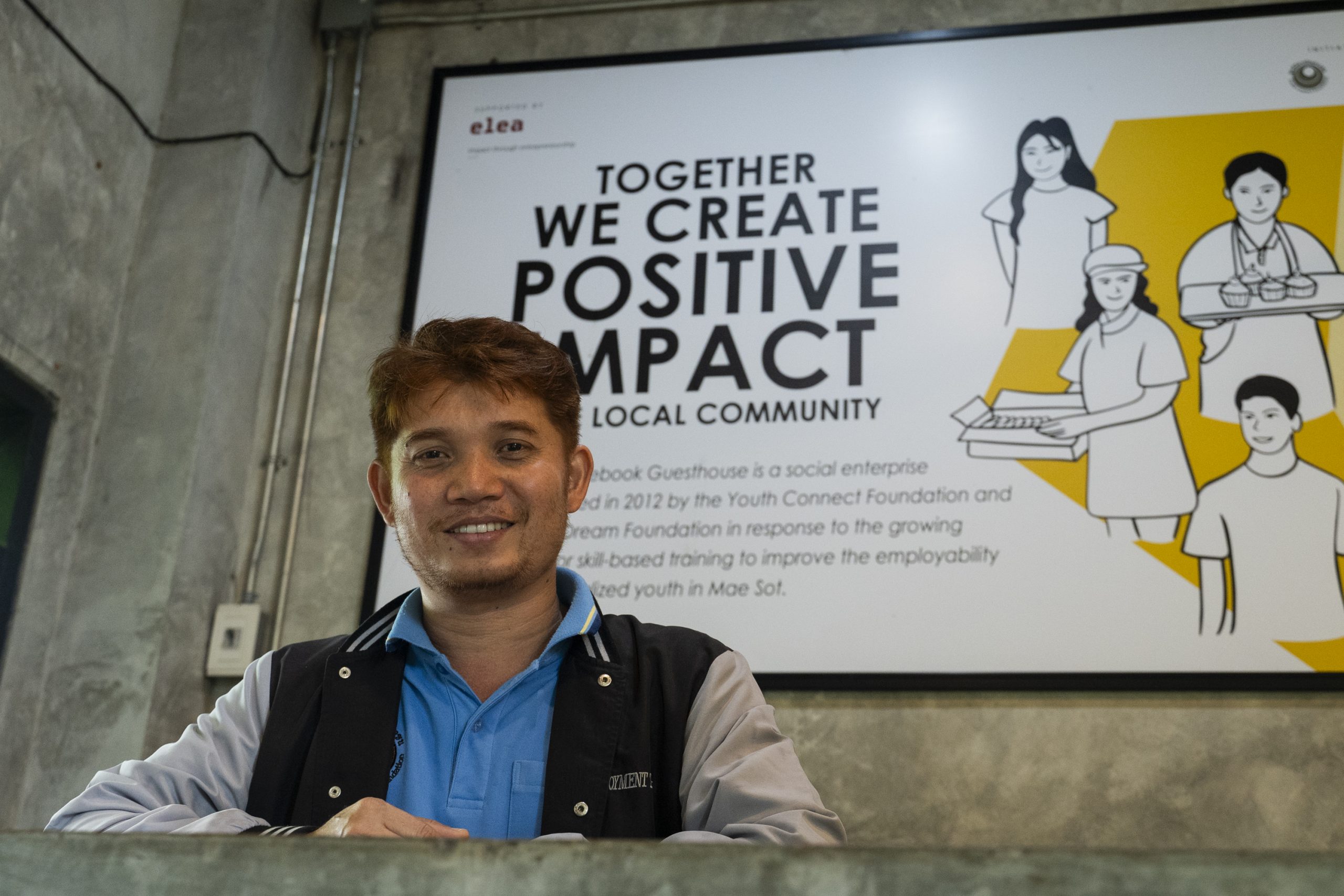
Mr Thaw Haw Htoo, 21, who is undergoing hospitality training at Picturebook Guesthouse, said: “I was planning to take GED to go for a scholarship, but I wasn’t confident enough because of financial and legal issues.”
Picturebook Guesthouse is a boutique hotel and social enterprise run by Youth Connect Foundation (YCF), which leads vocational training programmes for 90 students a year in Mae Sot.
Such vocational programmes like YCF’s have direct partnerships with local businesses, guaranteeing job placements for their graduates – which is why they can only accept as many students as there are available positions.
Vocational training is gaining popularity even among those with a GED certification, who increasingly see it as offering better job prospects than the elusive university pathway.
“There are a lot of students who finish GED and come back to vocational training,” said Mr Bo Phyu, education coordinator at YCF.
A lost generation
For most, optimism is all they have left as they pursue their education.
“I know it’s hard and I don’t know if [university] is possible, but this is the best option for my future,” said Ms Violet, 22, a student at BHSOH High School. “I must at least try.”
Ms Katie Julian, curriculum designer at Mote Oo Education, which works with displaced Myanmar communities, said: “People who are keen enough to get into a GED programme will persist…because the prize at the end of that is the qualification to go to university.”
But that persistence comes at a cost, with each of the four GED tests costing $80 USD.
“Families put aside money that they can’t really afford because they desperately want their child to get an education,” she said.
Back in Minmahaw School, Tun Lin still teaches while waiting for his own documentation to be sorted. Despite remaining in an administrative limbo, he sees the struggle as ultimately worthwhile.
“Right now, it’s a loop of endless suffering,” he said. “But only through fighting for education would we know its value, creating a generation of people passionate and enthusiastic to give back to the community.”
Whether his persistence will eventually pay off with a scholarship and university admission remains an open question.
What is certain is that he represents a lost generation of young people caught between an educational system that has expanded enough to create hope, but not enough to fulfil it.

This article is part of a package produced by a group of final-year undergraduates from Nanyang Technological University’s Wee Kim Wee School of Communication and Information, for the programme Going Overseas For Advanced Reporting, or Gofar. They reported from a town called Mae Sot at the Myanmar-Thailand border in July and August 2025. There, they met migrants and refugees displaced by six decades of civil war in Myanmar and are rebuilding their lives in Thailand.