


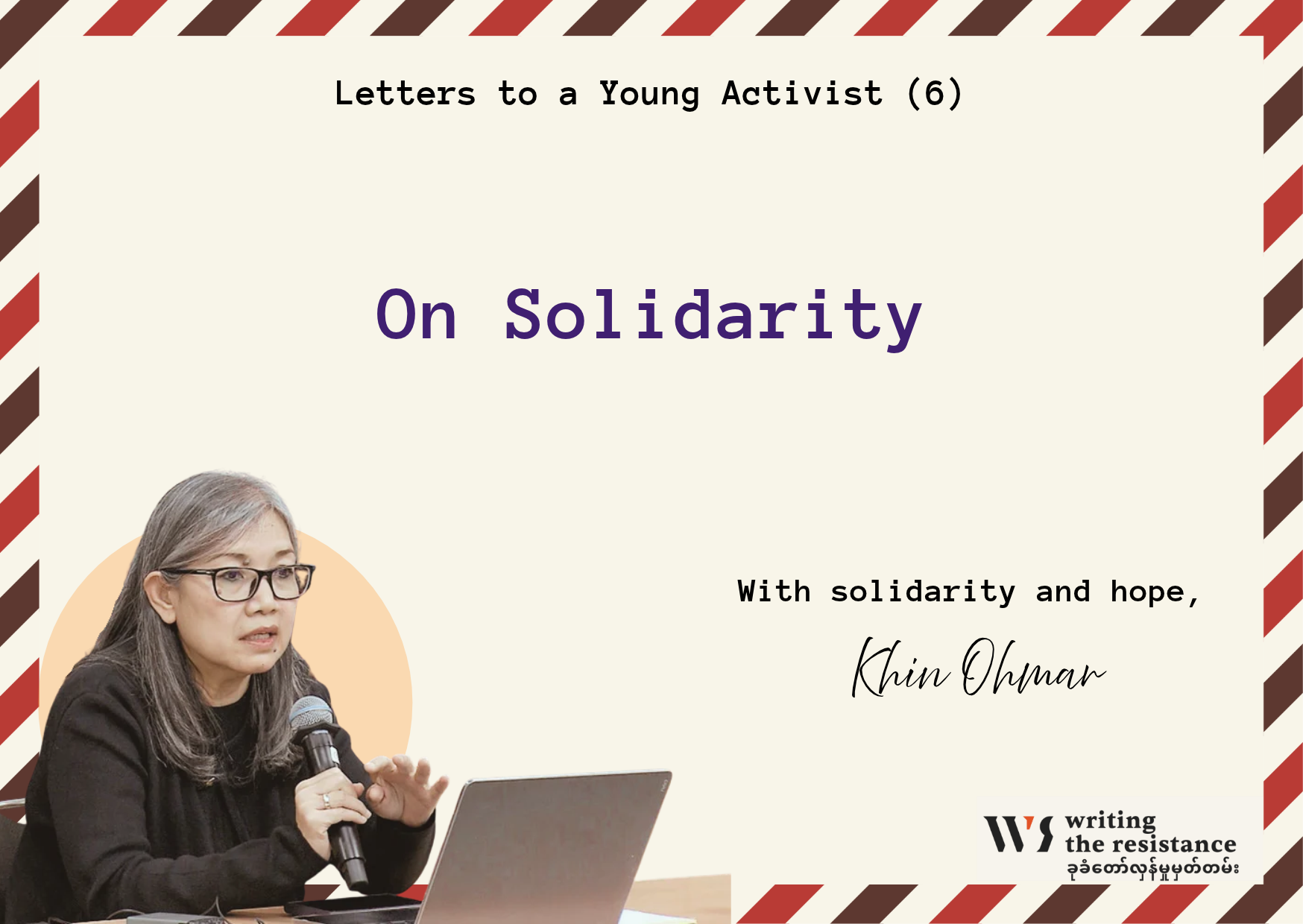
Guest contributor
Khin Ohmar
Dear young activist,
One of the most important truths to hold close on this long path toward freedom is that you are part of something far larger than yourself. Activism is, by its very nature, a collective journey.
No single individual can build or win a revolution alone. But we can certainly achieve victory together when we commit to genuine solidarity that begins with empathy and matures into collective, accountable action, led by those who are most impacted and sustained by our willingness to share both the tasks and the risk.
Genuine solidarity is neither charity nor pity. True empathy occurs when two hearts meet, and I begin to see our struggles as intertwined. In these moments, I do not presume to make decisions for you. Instead, I simply show up, to stand beside you and ask how I can best support you.
Too often, solidarity is offered from a place of privilege, operating on the premise, “I feel for you, so I will do this for you.”Unfortunately, this approach only reinforces the very power imbalances we seek to dismantle.
True solidarity is not a gift we bestow; it is something we build together. In this shared effort, those directly impacted must be able to take the driver’s seat, with supporters in the back, sharing the collective risk.
These roles are fluid. The front and back seats interchange over time, as freedom fighters and defenders from different movements reach out to one another for support in the struggle.
In movements like ours, you will work with people from many communities, each with their own history, pain, aspirations, and fight. One of the most important skills you can develop is the ability to see, through empathy and solidarity, how all our struggles connect while refusing to compare one person’s or movement’s suffering or sacrifice to another’s.
You will also have to balance personal pride and ego with the larger goals we all share to build a movement.
Ego is a subtle and tricky thing. On one hand, it grants us the confidence to stand up and speak out when it matters most. On the other hand, it can cause us to cling too tightly to our own perspectives, ultimately confining our potential within narrow walls.
Too often, we act unconsciously from the ego, quietly shaped by the sources of power around and within us: our age, position, social and economic status, education, and experience.
The moment our ego takes over, we instinctively place ourselves at the center or at the very front of the room. Instead of standing shoulder to shoulder in a circle of solidarity, “we” dissolves into “I.”
When this happens, the story becomes entirely about the self, rather than the greater movement we are a part of. So I constantly remind myself to stay aware and step back so that others, especially those from the most affected communities, can lead from the front.
While my organization, Progressive Voice, and I work to amplify their voices and those of their communities, our role is not to speak for them.
Instead, we aim to create spaces, highlight opportunities, share ideas and experiences, and offer support they need to take the lead and raise their own voice.
The same is true for international allies and donors. They should listen more and impose less. Whatever their position may be, if they want to show solidarity with the people of Myanmar, the most essential step is to listen to and stand with those who are most impacted and least heard.
They must take a backseat and trust in the agency of affected communities rather than leading them or imposing upon them. They must trust grassroots voices, ask what is needed, and support without domination.
That is the kind of genuine solidarity, rooted in justice, that impacted communities seek and strive for in the face of systemic repression and violence.
Yet solidarity is not a given. Some groups stand firm, while others hide behind so-called “neutrality,” an easy position that avoids criticism but fails to confront injustice, and one I find unprincipled.
Worse is the betrayal of principle. Even within our human rights communities, some are biased and partial, discriminating against communities such as the Rohingya and other minorities when it comes to defending the rights of all.
Genuine solidarity is also the recognition that sovereignty, race, and religion may divide us, but beneath those barriers we share one humanity.
We are all connected, and when one community is not free, none of us are free. If rights are denied to one community today, another may face the same tomorrow.
This is our crossroads. We can fall into the same traps of division and competition that the military designed to keep us weak and submissive to their domination – or we can stand together, majority and minority, civilian and armed, every gender, every ethnicity, every identity, in genuine solidarity.
If we fail to unite, we all lose to the same enemy. But if we succeed, we will create something no military tyranny can ever destroy: a Myanmar where diversity is our strength, and freedom and dignity belong to us all.
If we truly believe that power must rest in the hands of the people, then we, the people, must join hands and stand together across borders and across struggles.
That is the power and the necessity of solidarity. In Burma/Myanmar, our intergenerational movement to dismantle the military’s oppressive system has been a long tunnel, and the darkness is most intense just before the light.
In that darkness, fear can make us stumble, turn on one another, or doubt our core belief that light awaits. In these moments, we must hold each other tightly, and keep walking forward together.
So let us continue with courage and compassion. Justice is the light at the end of the tunnel, and it will prevail if we hold on to our convictions, learn from our mistakes, and carry on together.
In solidarity and hope,
Khin Ohmar is a Myanmar human rights activist who was involved in organizing the ‘8888’ nationwide pro-democracy uprising. She is also the founder and chairperson of Progressive Voice, a Myanmar human rights organization. She developed the Women Peacebuilding Program for Women’s League of Burma and served as program coordinator from 2000 to 2006.
DVB publishes a diversity of opinions that does not reflect DVB editorial policy. We’d like to hear what you think about this or any of our stories: [email protected]