


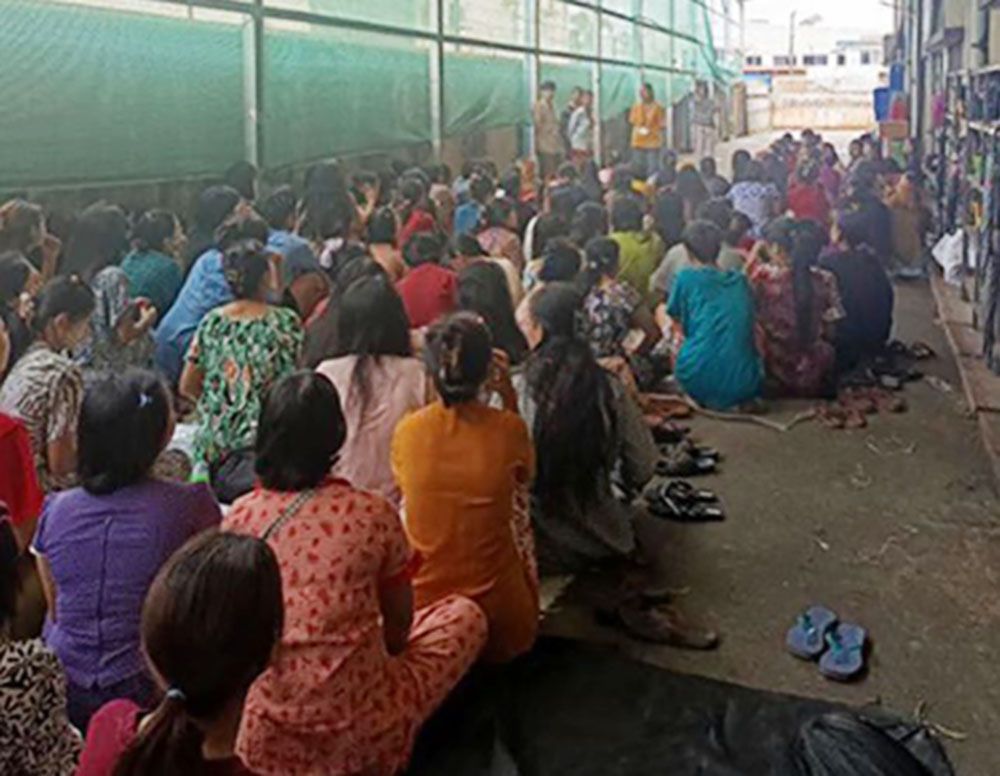
Over 1,000 employees at the Sunrise (Myanmar) Fashion Co. Ltd garment factory in Yangon’s Shwepyitha Township Thardukan Industrial Zone 4 are among the estimated 60,000 garment factory workers to be laid off this month.
“The management and the workers are still negotiating for severance pay depending on how many years they worked for the company,” a worker told DVB on the condition of anonymity, adding that the 1,000 workers will be laid off by Oct. 22.
Sunrise (Myanmar) Fashion Co. Ltd, owned by a Chinese national, manufactures apparel for Japan’s Burtle, Zerostage and Closshi brands. Factory management confirmed to labour rights groups that it will provide workers compensation based on the length of employment.
Garment workers in Yangon told DVB that their daily wages, which is around 10,000 MMK ($2.22 USD), are insufficient due to increasing prices of basic commodities.
According to labor organizations monitored by the IndustriALL Global Union, thousands of workers from at least a dozen garment factories across Yangon and Bago regions went on strike in August to demand wage increases to keep up with rising living costs.
Labor rights activist and general secretary of the Myanmar Industry Craft Service-Trade Unions Federation (MICS-TUsF) Thet Hnin Aung told DVB that workers should receive a minimum wage of at least 20,000 MMK ($4.44 USD) to meet the rising costs.
The Teng Hui (Myanmar) garment factory in Yangon’s Htantabin Township, which has been operating since 2013, has produced garments for Swedish fashion brand H&M. It announced its closure in September after failing to receive further orders.
The closure of the Chinese-owned factory means over 3,000 workers will be unemployed, according to regime media.
Around 17 garment factories in Yangon operating under the Cutting, Making and Packing (CMP) system have officially informed the regime’s Myanmar Investment Commission (MIC), an agency responsible for verifying, appraising, and approving domestic and foreign investment proposals in Myanmar, about the impending closures.
Labor rights groups told DVB that the main cause of the factory closures is the economic decline caused by the 2021 military coup, which has resulted in sanctions against the regime.
There’s been a steady decrease in new orders, a lack of skilled workers, and the shortage of raw materials over the last five years, they added.
A garment worker in Yangon, who recently lost her job, told DVB that the regime’s Ministry of Labor has been offering jobs in the agricultural sector since August. “They offered 200 positions but there were over 3,000 people needing jobs,” she said.
During a meeting in Yangon on Sept. 26, the regime’s Minister of Labour Khin Maung Soe blamed the Myanmar diaspora for spreading misleading information about foreign investment inside the country which has led to the factory closures.
The Myanmar Garment Manufacturers Association (MGMA) announced that exports from the country’s garment industry, known as CMP, have steadily decreased since 2022 from roughly 14 per cent in 2023 to 11 per cent in 2024.
This has resulted in a decrease of about $750 million USD in export revenue for Myanmar, according to MGMA.