


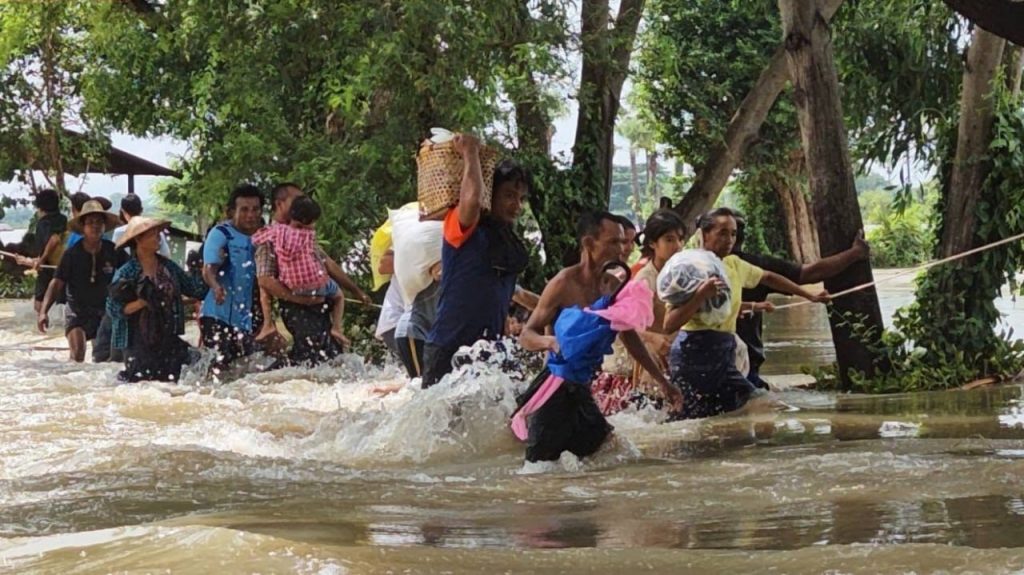
At least 10,000 acres of farmland across Sagaing Region may soon be submerged after the regime administration discharged water from the Thaphan Seik Dam on Thursday, which they claim is to release excess water exceeding the dam’s capacity.
Residents in Shwebo, Depayin, Khin-U, Myinmu and Wetlet townships accuse the regime of deliberately attempting to deprive resistance forces of food supplies ahead of an impending regime counteroffensive in Shwebo.
The five towns, located 36-70 miles (57-112 km) northeast and southeast of the region’s capital Monywa, are contested between regime and resistance forces.
At least 32 people have been killed during flooding that has impacted 610,000 residents in 25 townships in Sagaing, Magway, Mandalay, and Ayeyarwady regions, as well as Karen State, according to a report from the National Unity Government (NUG) on Aug. 22.
Twenty-four people were killed and two were reported missing in Shwebo, Taze, Kanbalu, Ayardaw, Depayin, Kyunhla, Kawlin, Wetet, Ye-U, Banmauk, and Khin-U townships due to flooding triggered by a large volume of water discharged from the Thaphan Seik Dam on Aug. 6.
The People’s Defense Force (PDF) in Depayin told DVB that the flooding has persisted in the town since August, and the latest discharge from the Thaphan Seik Dam could worsen the floods.
The Myanmar Air Force carried out three airstrikes on Khin-U on Aug. 11, targeting an area already reeling from serious flooding while three military fighter jets flew reconnaissance sorties over neighboring Wetlet, Shwebo, and Sagaing towns. No casualties were reported.
Built in 2001, the Thaphan Seik Dam is 108 feet (33 m) tall and 22,587 feet (6,885 m) — making it the longest dam in Southeast Asia, with a total storage capacity of 2.8 million units, irrigating 500,000 acres of farmland and generating 30 megawatts of electricity, regime media reported on Aug. 1, 2021.