


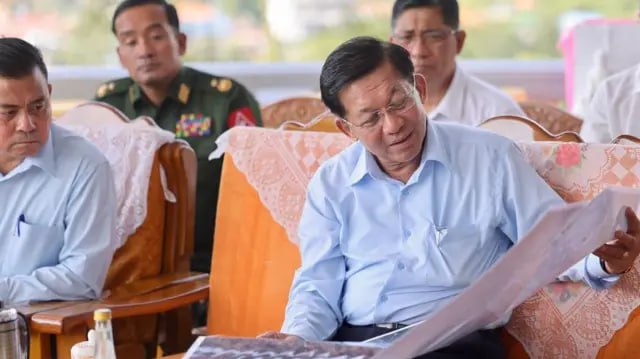
Min Aung Hlaing confidant appointed Myanmar army chief
A source close to the military regime in Naypyidaw told DVB that the Chief of the Military Security Affairs Corps Ye Win Oo was appointed Chief of the Burma Army by regime leader Senior General Min Aung Hlaing on Monday. Ye Win Oo, known as the “eyes and ears” of the regime, is also tapped as a possible successor to Min Aung Hlaing as Burma’s next commander-in-chief of the armed forces.
The army chief position was formerly held by deputy regime leader Soe Win, who is also the deputy commander-in-chief, since the regime seized power during the military coup on Feb. 1, 2021. The source told DVB on the condition of anonymity that Soe Win is expected to retire after the Union Solidarity and Development Party (USDP) administration takes office as the Pyidaungsu Hluttaw, or union parliament, convenes on March 16.
Ye Win Oo, who is also the chief executive officer of the regime’s National Defence and Security Council (NDSC), was sanctioned by the U.S. Treasury Department on Feb. 11, 2021. The NDSC introduced a new law on Feb. 3, allowing the next president to form and appoint a five-member “Union Consultative Council” to advise the government. Min Aung Hlaing is widely expected by analysts to become Burma’s next president.
Half of total 7,337 political prisoners ‘not freed’ despite amnesty
The Political Prisoners Network Myanmar (PPNM) told DVB that 2,934 political prisoners convicted under the Counter-Terrorism Law are still in prison as of Thursday despite a regime amnesty granted on Monday to 7,337 prisoners sentenced under this law. PPNM added that a total of 4,403 political prisoners have been released since March 2.
Thaik Tun Oo, the PPNM spokesperson, told DVB that the international community should question why the regime in Naypyidaw has only released half of the political prisoners scheduled for release so far. Sources told DVB that jailed National League for Democracy (NLD) State Counsellor Aung San Suu Kyi and President Win Myint, who have been held in detention by the military since the 2021 coup, were not freed.
A total of 10,172 prisoners, including 7,337 convicted of violating Sections 50(j) and 52(a) of the Counter-Terrorism Law, were included in the regime’s Peasants’ Day amnesty on March 2. Fifty out of 250 political prisoners “scheduled to be released” were freed from Bago Region’s Daik-U Prison and two of an estimated 300 were freed from Arakan State’s Sittwe and Kyaukphyu prisons on March 2, according to PPNM.

Meeting on crisis since 2021 coup held in Japan
Members of Japan’s parliament, including pro-democracy activists from Burma, told DVB that they reiterated calls for Japan to reject Burma’s military-run 2025–26 elections and recognize the group representing lawmakers ousted in the 2021 military coup, the National Unity Government (NUG), during a meeting at at the House of Councillors Office Building in Tokyo, Japan, on Monday.
The event was organized by the Japanese Parliamentary Association for Supporting Myanmar’s Democratization, a group of 61 elected members of Japan’s National Diet. An estimated 90 people attended, including the NUG Representative to Japan Saw Hla Thein, as well as pro-democracy activists from Burma and Japan. NUG Foreign Minister Zin Mar Aung and leading democracy activist Min Ko Naing joined online.
Attendees told DVB that they updated the Japanese on the worsening humanitarian situation in Burma since the March 28 earthquake and shared testimony from those living at Internally Displaced Persons (IDP) camps inside Burma and refugees staying in Thailand. Japan’s Ministry of Foreign Affairs stated in September that it would not accept the results of military elections in Burma and called for an immediate end to violence.
News by Region
ARAKAN—Residents of Mrauk-U and Kyauktaw townships told DVB that the Arakan Army (AA) has announced that it will arrest and jail anyone caught using or in possession of kratom, known locally as Asean Pin, living in territory under its control. The AA added that it will sentence kratom users to five years of detention.
A Kyauktaw resident told DVB that he welcomed the crackdown. Kratom is a plant that originates in Southeast Asia, where it has been used for treating pain and other health-related problems by producing opioid-and stimulant-like effects. One viss (1.634 kg) of kratom is 200,000 MMK ($50 USD) in AA-controlled townships, according to residents.
MON—Aid workers in Bilin Township told DVB that over 15,000 people are in need of food and medicine since being displaced from their homes in December due to fighting between regime forces and the Karen National Liberation Army (KNLA). Bilin, located 69 miles (111 km) north of the state capital Mawlamyine, is located in Karen National Union (KNU) Brigade 1 territory.
A Bilin resident told DVB that three civilians were killed by regime artillery strikes on Jan. 2. The KNU Brigade 1 Secretary Aye Naing told DVB that regime forces ordered residents from 19 villages to return home from the Internally Displaced Persons (IDP) camp or their homes will be burned down. DVB is unable to confirm this claim independently.
NAYPYIDAW—The regime announced that mobile phone users must register their International Mobile Equipment Identity (IMEI), which is a 15 digit code that identifies the brand and model of a mobile device, with the Central Equipment Identity Register (CEIR) by March 31 or face a fine if they want to continue accessing telecoms networks.
The CEIR is a centralized database to manage mobile device registration. The Assistance Association for Myanmar-based Independent Journalists (AAMIJ) claimed that it has been used to track and arrest anti-coup activists since 2024. It urged citizens to keep their mobile phones secure by not registering their IMEI with CEIR.
(Exchange rate: $1 USD = 3,945 MMK)

Stay up-to-date with the latest on #WhatsHappeninginMyanmar by subscribing for free to the DVB English News Daily Briefing newsletter.