


Guest contributor
James Shwe
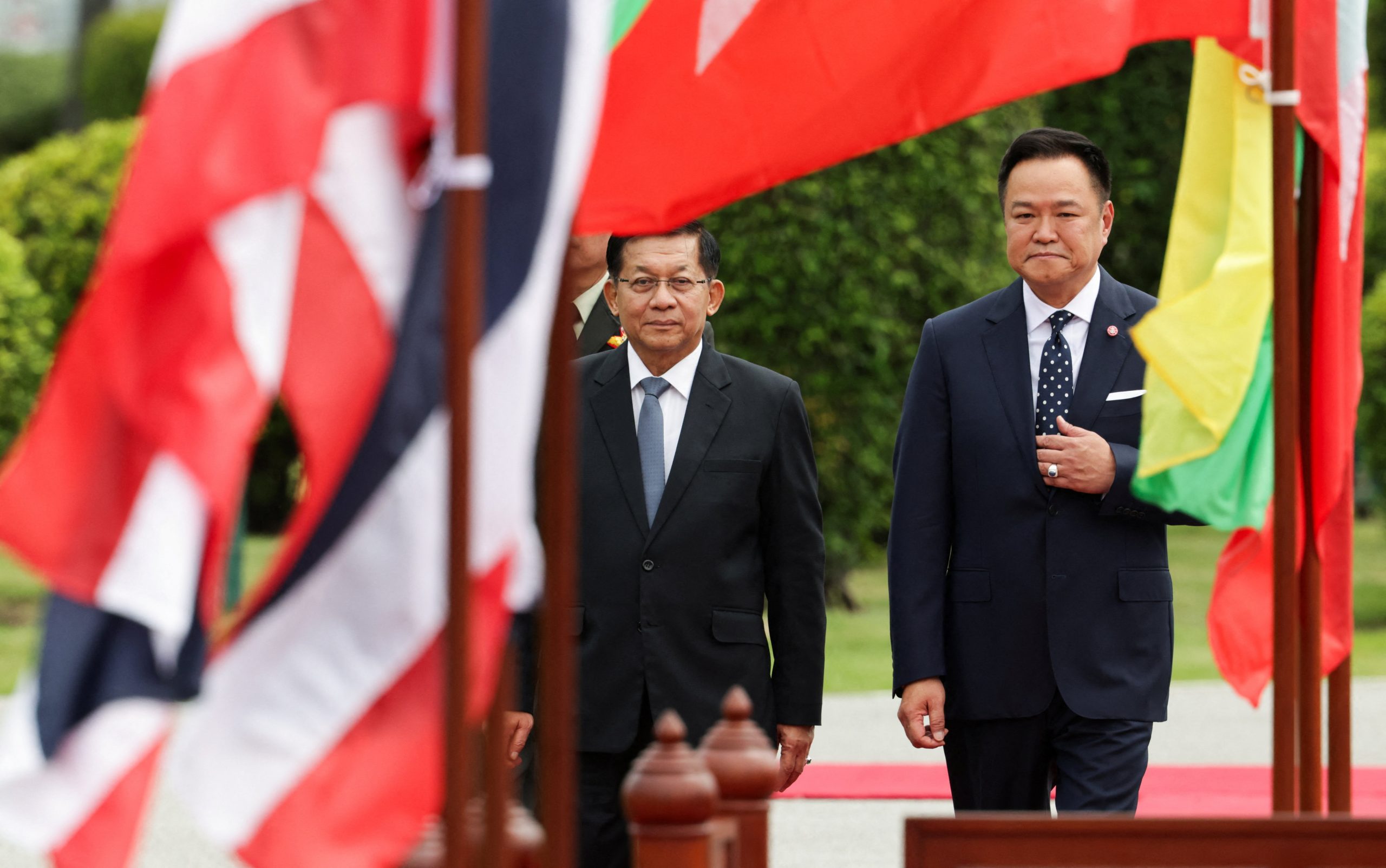
Min Aung Hlaing flew home from Bangkok on August 7 after a two-day official visit heavy on protocol and light on substance.
Day two told the story: a meeting with the Senate President, homage at Wat Phra Kaew, a stop at the Myanmar Embassy, departure.
No royal audience. No press conference. No new agreements — every instrument had been exchanged the day before.
That thinness matters, but not in the way many of us would like. The visit was never designed to produce deliverables. It was designed to produce a paragraph.
What he actually took home
The paragraph sits in the joint statement, where Thailand reaffirms support for Myanmar’s “full and equal participation in ASEAN mechanisms.” Around it: a labor cooperation memorandum, a working group on Kok and Sai river water quality, a space technology memorandum, a $12 billion USD dollar trade target, the reopening of the second Friendship Bridge, and a security dialogue.
Only the labor agreement is genuinely deliverable, because it is bilateral and administrative. The rest are aspirational or depend on territory Naypyidaw does not control.
Thailand’s own opposition made this point better than most of our statements did. People’s Party deputy leader Rangsiman Rome noted that the mines poisoning the Kok River sit in United Wa State Army territory, not the military’s, and the Myawaddy scam compounds are in Karen Border Guard Force hands.
Bangkok has staked river remediation, scam suppression and border stability on a counterpart who controls neither the upstream water nor the downstream crime.
That is not a moral argument. It is an implementation problem, and it will surface on a schedule.
What he did not get is equally instructive. No new state recognized his government. The 2026 chair of ASEAN repeated on August 7 that its position is unchanged.
Washington’s only statement of the week demanded the unconditional release of Aung San Suu Kyi and all political prisoners.
He was not received by the Thai King. He did not face the press.
One sentence in a joint statement is not recognition. It is a claim he now has to defend at every meeting between here and December.
What to expect: my assessment
These are my judgments, not established facts. I mark them as such because credibility is the only currency we have abroad.
Expect the paragraph to be recycled rather than built upon, starting August 19-21, when the ninth Thailand–Myanmar High-Level Committee meets in Bangkok and a technical session is presented as continuity of head-of-state engagement.
Expect the real fight in Manila on November 10-12, where the 49th ASEAN Summit takes up the review of the Five-Point Consensus and benchmark language drafted since July either hardens or dissolves.
Thailand’s bridge role gives Naypyidaw an advocate inside the room for the first time in five years. My assessment is that the junta will not seek a summit seat but something smaller and more durable — attendance at sectoral or economic meetings, presented as a technical step.
Expect the substitution of “reduction” for “cessation.” Thailand’s foreign minister framed the visit as “not about legitimacy, it’s about reality.”
That invites a rewrite in which measurable obligations become negotiable quantities. The decisive text will be drafted quietly by officials, not announced at summits, and that single word would cost us more than the red carpet did.
Expect the talks track to be used as cover. The April 20 ultimatum to negotiate but surrender weapons within 100 days expired on July 31 and was rejected across the board.
The Karen National Union, Chin National Front and All Burma Students’ Democratic Front declared the ceasefire accords void. The Kachin Independence Army and Arakan Army rejected it outright.
Yet that same day Min Aung Hlaing told parliament that thirteen ethnic armed organizations had joined talks, and none were fighting. Naypyidaw also refuses the Steering Council for the Emergence of a Federal Democratic Union as an interlocutor, preferring to approach groups one at a time.
That is divide-and-rule dressed as peacemaking.
Expect escalation alongside diplomacy. The Armed Conflict Location and Event Data (ACLED) Project reported on August 6 that the military has retaken roughly 27 towns since January and forecasts intensified fighting in Sagaing, Magway and Mandalay.
Airstrikes on Rakhine State’s Thandwe on July 31 killed four civilians, including an infant.
Why November is ASEAN’s problem, not ours
There is an argument available to us that requires no one to care about Myanmar, and we have barely begun to make it.
The Philippines took the chair of ASEAN this year on three pillars, the first being “Peace and Security Anchors: championing peace and regional stability through dialogue, adherence to international law.”
Manila’s signature ambition is to conclude the South China Sea Code of Conduct with China, “in accordance with international law, particularly the 1982 United Nations Convention on the Law of the Sea.” Malaysia’s foreign minister expects it to be finalized at the 49th ASEAN Summit in November — the same summit, in the same week, as the Five-Point Consensus review.
Consider what ASEAN would be doing in that room: asking a great power to accept written, binding constraints on its conduct at sea, while declining to hold one of its own members to the founding treaty that member violates on land.
Beijing’s negotiators will not miss it. A Code of Conduct is worth exactly what ASEAN’s willingness to enforce rules against one of its own is worth. If the Charter yields to a member with a border and a trade target, no one will expect it to bind a country with a navy.
So Myanmar is not a humanitarian sideshow for the region. Every state that wants the Code to mean something has an institutional interest in Myanmar being measured against the ASEAN Charter’s Article 1, which commits the organization to strengthen democracy, good governance and the rule of law and to protect human rights.
Not out of sympathy for us. Out of self-preservation. Small and middle-sized states do not have the option of a world without rules. That is the whole reason ASEAN exists.
The right arguments, in the wrong formats
The resistance was not silent this week. It made the correct arguments, on the correct terms, in places the people drafting November’s language will never see.
Nay Phone Latt, spokesperson for the National Unity Government Prime Minister’s Office, told Radio Free Asia on August 6 that the invitation runs against the will of the people, then made the argument that bites: fighting is nationwide and revolutionary forces hold territory, so signing agreements with Min Aung Hlaing alone “is not a practical situation in which they can be implemented.”
Foreign Minister Zin Mar Aung used the strongest instrument available to her that day — a Facebook post. It showed a printed page of the ASEAN Charter — Chapter I, Article 1, purposes six and seven underlined in red by hand, above a single question: what anyone imagines can be obtained from a leader who stands in flat contradiction to them?
Here is the problem. One was a spokesperson’s remark to a Burmese-language broadcaster; the other a minister’s personal social media post. Neither was a formal statement from the National Unity Government, the National Unity Consultative Council or the Steering Council, and no ethnic resistance organization issued one either.
Some restraint is defensible, since several of these bodies are managing quiet diplomacy with Bangkok and Manila. But a Facebook post is not a document. It cannot be cited in an ASEAN working paper, attached to a chair’s summary, or handed to a congressional staffer.
How the resistance should prepare
Convert the joint statement into a delivery audit. The most useful document anyone can produce this fortnight is short and dated: what Thailand said it would obtain, and what it obtained. Publish before August 19 so it frames the High-Level Committee rather than reacting to it. Track airstrikes, prisoner releases, humanitarian access to non-regime areas, and independent access to Aung San Suu Kyi. A Red Cross visit arranged by the detaining authority is not independent verification. Note also, item by item, which deliverables sit in territory Naypyidaw does not administer.
Lobby the wording, not the photographs. Between now and November, press for cessation rather than reduction, independent verification rather than reported progress, and access to non-regime areas written explicitly rather than implied.
Argue from the Charter, not only the Consensus. Zin Mar Aung’s instinct should become policy. The Five-Point Consensus is a 2021 political agreement the junta’s own parliament formally rejected in July, which lets Naypyidaw treat it as spent and sympathetic states treat compliance as negotiable. The Charter is a ratified treaty binding on every member, Thailand included, whose Article 2 requires “adherence to the rule of law, good governance, the principles of democracy and constitutional government.” Airstrikes on villages are not a values disagreement. They are a treaty question, and the one to put to Bangkok and the Philippine chair in writing is which Charter provision “full and equal participation” rests on.
Prepare for the credentials fight, and be precise. December’s United Nations Credentials Committee meets against a new narrative — an inauguration certificate, four foreign trips, a Thai sentence about full participation. Answer it with the election itself: 13.1 million ballots against 25.9 million in 2020, 67 townships excluded, participation under five per cent in Chin State, 404 people charged for criticizing it. And keep the legal claims exact. Min Aung Hlaing is subject to a pending International Criminal Court arrest warrant request on which the judges have not ruled, and separately to Argentine warrants under universal jurisdiction. Calling him “wanted by the ICC” is wrong, and one imprecise phrase lets a hostile reader discard an entire letter.
Protect the people who carry the risk. Thailand’s cabinet approved a draft deportation regulation in July, and Fortify Rights has documented 4,571 forced returns through Ranong since December 2023. Any advocacy asking Myanmar nationals in Thailand to sign or appear publicly must treat consent as specific, revocable and confidential by default.
The measure of Bangkok
Bangkok gave Min Aung Hlaing a guard of honor, a business podium and a sentence he will quote for months. It gave Thailand a few modest instruments and promises resting on a counterparty who cannot keep them.
Neither side got what it claimed, and we can still decide what the visit comes to mean, because the events that will settle it are already scheduled: August 19 in Bangkok, September in Geneva and New York, November 10 to 12 in Manila, and December at the General Assembly.
Manila matters most, and not only to us. ASEAN will sit down there to ask China to write down its obligations and keep them. It should be able to say, in the same week, that it holds its own members to the same standard.
We lost a news cycle in Bangkok. We have not lost the calendar. Keeping it means showing up with documents rather than reactions.
James Shwe is a Myanmar American professional engineer and advocate for democracy in Myanmar, affiliated with the Los Angeles Myanmar Movement.
DVB publishes a diversity of opinions that do not reflect DVB editorial policy. We’d like to hear what you think about this or any of our stories: [email protected]