


Originally published on RSF
One month before the general elections organised by Myanmar’s military junta, Reporters Without Borders (RSF) warns against the use of a so-called “electoral interference” law to prosecute the Assistance Association for Myanmar-based Independent Journalists (AAMIJ) for its journalistic work. RSF denounces the ongoing repression of independent media, which makes it impossible to hold a transparent vote.
On 28 December 2025, the military junta will begin holding votes in the parts of the country it controls — roughly half of Myanmar’s territory. These general elections, which will continue into January 2026, will be the first since the 2021 coup d’État, after which Myanmar’s generals imposed a policy of brutal repression of the press.
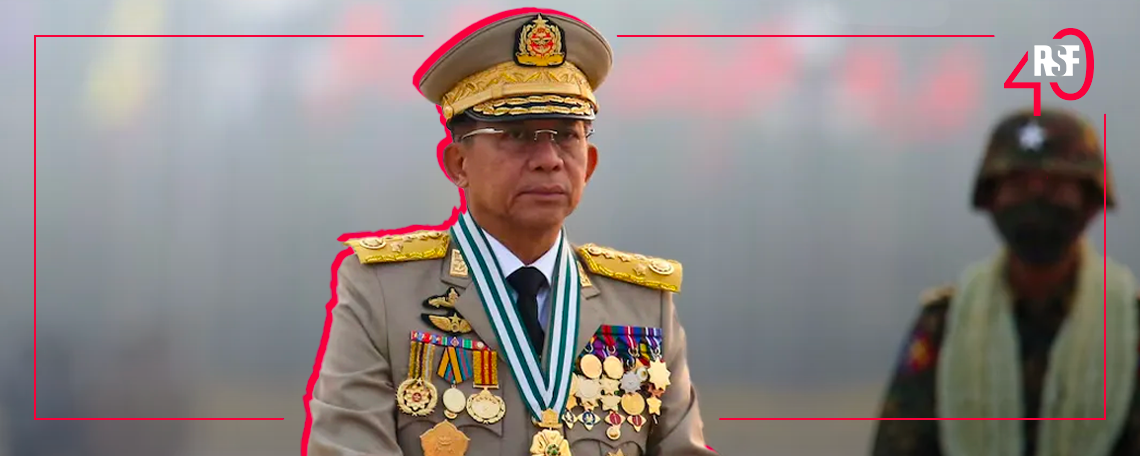
In recent weeks, the military junta — listed by RSF as one of the 2025 Press Freedom Predators — has again intensified its crackdown on the media. For the first time, it is resorting to the electoral interference law, a vaguely worded text adopted in July to expand its legislative arsenal ahead of the elections.
On 10 November, the military authorities charged the Assistance Association for Myanmar-based Independent Journalists (AAMIJ) — both a media outlet and an association publishing independent reporting on the situation in Myanmar from exile — under Article 24(a) of this law, which punishes “any threat or harm caused to a candidate” with sentences of up to seven years in prison. AAMIJ’s “offence”: having revealed evidence linking an electoral candidate to drug trafficking.
“As the polls approach, Myanmar’s military junta is strengthening its policy of information control up to a complete media shutdown. The message is chilling: journalists who seek to freely cover the elections will face harassment, violence, prison and may even be killed. It is time for the international community to step up its pressure on the junta and compel it to end its campaign against independent journalism,” said Cédric Alviani, Director of RSF’s Asia-Pacific Bureau
At the end of October, the junta — which severely restricts foreign media access to the country — announced that it would “allow” international journalists to cover the elections. This apparent gesture of openness is, however, accompanied by strict conditions: the military authorities have made clear that election coverage will not be permitted without obtaining official accreditation.
The conditions set for the polls have been described as “fraudulent” by U.N. Special Rapporteur Tom Andrews, as well as by numerous international experts, notably due to the repression of independent media.
Since the coup, the junta has waged an extremely brutal crackdown on the media:
- Seven journalists and press freedom defenders have been executed.
- More than 200 journalists have been imprisoned, at least 51 of whom remain behind bars to this day.
- Journalists exposing the regime’s repression have been systematically tortured – beaten, subjected to sexual violence and deprived of sleep and food.
- The licences of 15 media outlets have been arbitrarily revoked, forcing their teams to work underground due to increased security risks.
- Internet shutdowns have prevented journalists from working or communicating, creating “information black holes” in certain regions.
Myanmar ranks 169th out of 180 countries and territories in the 2025 RSF World Press Freedom Index. The country is the world’s second-largest jailer of journalists, just behind China.